About Karam Festival:
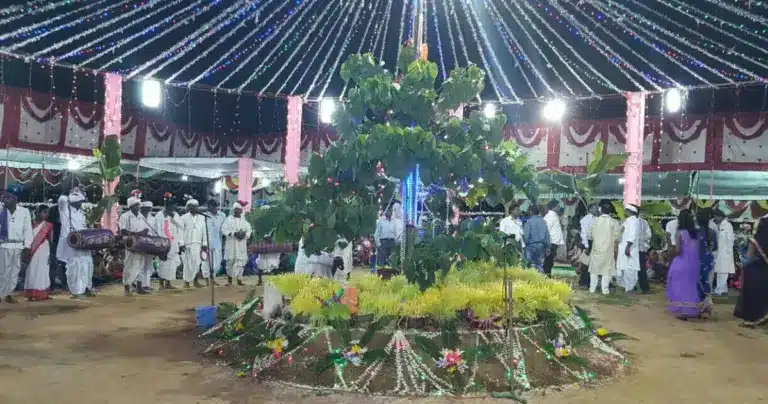
- Karma Puja, one of the most popular festivals, is related to the harvest and a tribute to the Karam tree. This tree symbolises fertility, prosperity and everything that is auspicious.
- Origin: The origin of the festival can be traced to the beginning of agriculture by tribal communities.
- How is it celebrated?
- About a week before the festival commences, young women bring clear sand from the river, in which they sow seven types of grains.
- On the day of the festival, a branch of the Karam tree is planted in the courtyard or ‘akhra’.
- Devotees come with jawa (hibiscus) flowers, and the pahan (priest) worships the Karam Raja. Dancing and singing of traditional Karam songs follow.
- The festival concludes with the immersion of the Karam branch in a river or pond, and the jawa is distributed among the devotees.
- Towards the end of the Karam festival, branches from sal or bhelua trees are often planted in the fields with the hope that the Karam Raja/ Devta will protect their crops.
- It is traditionally celebrated on the Ekadashi tithi (eleventh day) of the lunar fortnight in the month of Bhado/ Bhadra, which corresponds to August-September in the Gregorian calendar.
- The festival is popular especially among the Munda, Ho, Oraon, Baiga, Kharia, and Santhal peoples.
- It is mainly celebrated in Jharkhand, West Bengal, Bihar, Madhya Pradesh, Chhattisgarh, Assam, and Odisha.
Q1: What is the Gregorian calendar?
It is a solar dating system used by most of the world. It is named for Pope Gregory XIII, who issued the papal bull Inter gravissimas in 1582, announcing calendar reforms for all of Catholic Christendom. The Gregorian calendar modified the existing Julian calendar, which Julius Caesar had introduced to the ancient Roman Republic in 46 BCE.
Source: Worshipping the Karam tree: Myth and farm practice in the tribal harvest festival of Karma






 Last updated on March, 2026
→ UPSC Final Result 2025 is now out.
→ UPSC has released UPSC Toppers List 2025 with the Civil Services final result on its official website.
→ Anuj Agnihotri secured AIR 1 in the UPSC Civil Services Examination 2025.
→ UPSC Marksheet 2025 is now out.
→ UPSC Notification 2026 & UPSC IFoS Notification 2026 is now out on the official website at upsconline.nic.in.
→ UPSC Calendar 2026 has been released.
→ Check out the latest UPSC Syllabus 2026 here.
→ UPSC Prelims 2026 will be conducted on 24th May, 2026 & UPSC Mains 2026 will be conducted on 21st August 2026.
→ The UPSC Selection Process is of 3 stages-Prelims, Mains and Interview.
→ Prepare effectively with Vajiram & Ravi’s UPSC Prelims Test Series 2026 featuring full-length mock tests, detailed solutions, and performance analysis.
→ Enroll in Vajiram & Ravi’s UPSC Mains Test Series 2026 for structured answer writing practice, expert evaluation, and exam-oriented feedback.
→ Join Vajiram & Ravi’s Best UPSC Mentorship Program for personalized guidance, strategy planning, and one-to-one support from experienced mentors.
→ Shakti Dubey secures AIR 1 in UPSC CSE Exam 2024.
→ Also check Best UPSC Coaching in India