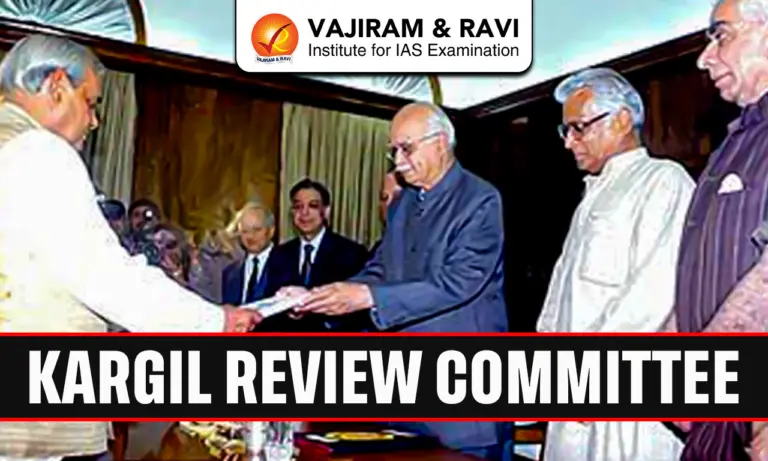
The Kargil Review Committee (KRC) was established by the Government of India on 29 July 1999 after the Kargil War to examine the sequence of events and recommend measures to strengthen national security. The committee was headed by K. Subrahmanyam. The KRC submitted its report to the serving Prime Minister Atal Bihari Vajpayee on 7 January 2000. The report became a landmark in security reforms of India.
Kargil Review Committee Background
The Kargil Review Committee was formed to investigate the Kargil intrusion, analyse systemic failures and recommend reforms in India’s national security framework after the 1999 conflict.
- Formation: The KRC was set up on 29 July 1999, finalised its report on 15 December 1999 and it was tabled in Parliament on 23 February 2000 after submission.
- Objectives: The committee examined events leading to the Kargil crisis and aimed to prevent future intrusions without assigning blame to individuals or institutions involved in the failure.
- Scope of analysis: It studied historical and strategic aspects including the Simla Agreement, proxy war in Jammu and Kashmir and nuclear dynamics in India-Pakistan Relations affecting security decisions.
- Consultations: Around 95 individuals, including former Presidents, Prime Ministers, Army Chiefs, RAW and IB heads, ministers and journalists, were consulted through recorded and verified discussions.
Kargil Review Committee Observations
The Kargil Review Committee made the observations related to the Kargil War and highlighted the following concerns:
- Intelligence failure findings: The committee found intelligence inputs from RAW inadequate, outdated and insufficient to predict intrusions, highlighting systemic weaknesses rather than institutional incompetence.
- Army operational mindset: Since 1971, the Army assumed no threat in Kargil due to harsh terrain and weather, leading to lack of patrolling and unchanged brigade deployment, causing misjudgment of threat.
- Inter agency coordination issues: Intelligence agencies and armed forces failed to share critical information, resulting in lack of coordination and delayed response to Pakistani intrusions.
- Technological gaps: The report questioned why satellite imagery and space technology were not effectively used to monitor unpatrolled high altitude areas along the northern borders.
- Structural weaknesses: National security mechanisms remained largely unchanged for over 50 years, despite wars in 1962, 1965 and 1971 and evolving threats like nuclearisation and proxy conflicts.
- Systemic policy concerns: The committee raised questions on lack of proactive policy in Jammu and Kashmir, inadequate intelligence upgrades and absence of continuous reassessment of border strategies.





Kargil Review Committee Recommendations
The Kargil Review Committee proposed comprehensive reforms in intelligence, defence management and national security decision making to prevent recurrence of similar crises.
- National security review: Recommended a complete review of the national security system to improve decision making, coordination and response mechanisms at strategic and operational levels.
- Intelligence reforms: Suggested strengthening intelligence collection, improving inter agency coordination and integrating tactical and strategic intelligence for better threat anticipation and response.
- Defence management restructuring: Called for better integration between the Ministry of Defence and Service Headquarters to ensure efficient communication and unified military planning.
- Chief of Defence Staff proposal: Recommended creation of the Chief of Defence Staff (CDS) post to ensure jointness among Army, Navy and Air Force and improve unified military command.
- Border management improvements: Emphasised use of advanced surveillance technologies, including satellites and UAVs, to monitor inaccessible and high altitude border areas effectively.
- Counter terrorism strategy: Suggested proactive policies to address militancy in Jammu and Kashmir and prevent cross border infiltration through coordinated military and political measures.
- Joint command structure: Recommended establishing unified command systems to address coordination issues between Army, paramilitary forces and civil authorities in conflict regions.
- Defence modernisation: Highlighted need to improve conventional military superiority beyond the existing ratio of 1.37:1 and modernise equipment, logistics and operational capabilities.
- Media and information management: Called for structured communication systems to avoid misinformation and speculation during crises by ensuring timely dissemination of accurate information.
- Strategic policy framework: Recommended development of a consistent long term national security strategy integrating political, diplomatic and military approaches.
Kargil Review Committee Impacts
The Kargil Review Committee report led to major institutional reforms and structural changes in India’s national security and defence management systems.
- Group of Ministers (GoM): A GoM was established in April 2000 to review Kargil Review Committee recommendations, leading to a comprehensive report on reforming India’s security apparatus.
- Implementation of recommendations: Out of 75 recommendations in defence management, 63 were implemented, four were in progress and eight related to CDS remained under consideration initially.
- Creation of HQ IDS: The Headquarters Integrated Defence Staff was established to enhance jointness in planning, training, intelligence sharing and operational coordination among armed forces.
- Tri service commands: The Andaman & Nicobar Command was created to ensure unified command over tri service and Coast Guard operations in strategically important island territories.
- Intelligence agencies strengthening: Establishment of Defence Intelligence Agency and National Technical Research Organisation improved technical and strategic intelligence capabilities.
- Surveillance enhancement: Use of UAVs and RISAT satellites significantly improved aerial surveillance and monitoring of sensitive border regions.
- Institutional reforms: Bodies like the Nuclear Command Authority, Strategic Forces Command, Defence Acquisition Council and Defence Technology Council were established.
- Chief of Defence Staff: The CDS post, recommended by KRC, was eventually implemented in December 2019 to strengthen military leadership and integration.
- National Security Advisor role: A full time National Security Advisor system was institutionalised to coordinate security policy at the highest level.
- Long term review mechanisms: Subsequent committees like Naresh Chandra Task Force (2011) and others continued evaluating and advancing national security reforms.
Kargil Review Committee Significance
The Kargil Review Committee marked a turning point in India’s strategic thinking and institutional reforms related to national security and defence preparedness.
- First public security review: It was the first comprehensive and publicly available review of India’s national security system, increasing transparency and accountability.
- Systemic reform approach: Shifted focus from individual blame to systemic weaknesses, ensuring long term structural improvements rather than short term corrective actions.
- Strengthened civil military relations: Emphasised better integration between civilian leadership and military institutions, improving coordination and decision making processes.
- Intelligence transformation: Highlighted critical need for coordination and modernisation of intelligence agencies, shaping reforms in intelligence architecture.
- Strategic awareness: Brought attention to importance of continuous reassessment of threats, especially in high risk regions like Jammu and Kashmir.
- Technological integration: Underlined the role of modern technology in warfare and surveillance, leading to increased adoption of advanced defence systems.
- Policy driven approach: Encouraged development of consistent national security policies instead of ad hoc responses to crises.
- Enhanced preparedness: Improved India’s readiness to handle future conflicts through better planning, coordination and intelligence based operations.
- Institutional legacy: Led to creation of multiple long lasting institutions that continue to shape India’s defence and security framework.
- Continuing relevance: Many recommendations remain relevant, especially regarding defence procurement, intelligence coordination and need for a formal National Security Doctrine.

 Last updated on March, 2026
→ UPSC Final Result 2025 is now out.
→ UPSC has released UPSC Toppers List 2025 with the Civil Services final result on its official website.
→ Anuj Agnihotri secured AIR 1 in the UPSC Civil Services Examination 2025.
→ UPSC Marksheet 2025 is now out.
→ UPSC Notification 2026 & UPSC IFoS Notification 2026 is now out on the official website at upsconline.nic.in.
→ UPSC Calendar 2026 has been released.
→ Check out the latest UPSC Syllabus 2026 here.
→ UPSC Prelims 2026 will be conducted on 24th May, 2026 & UPSC Mains 2026 will be conducted on 21st August 2026.
→ The UPSC Selection Process is of 3 stages-Prelims, Mains and Interview.
→ Prepare effectively with Vajiram & Ravi’s UPSC Prelims Test Series 2026 featuring full-length mock tests, detailed solutions, and performance analysis.
→ Enroll in Vajiram & Ravi’s UPSC Mains Test Series 2026 for structured answer writing practice, expert evaluation, and exam-oriented feedback.
→ Join Vajiram & Ravi’s Best UPSC Mentorship Program for personalized guidance, strategy planning, and one-to-one support from experienced mentors.
→ Shakti Dubey secures AIR 1 in UPSC CSE Exam 2024.
→ Also check Best UPSC Coaching in India
Kargil Review Committee FAQs
Q1. What was the Kargil Review Committee?+
Q2. Who headed the Kargil Review Committee?+
Q3. When was the Kargil Review Committee report submitted?+
Q4. What were the key findings of the Kargil Review Committee?+
Q5. What major reforms resulted from the Kargil Review Committee recommendations?+
Tags: defence management kargil review committee national security