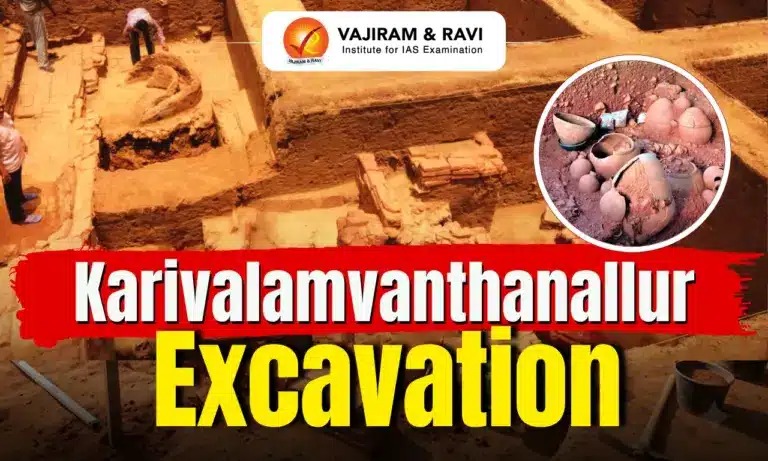
The ongoing excavation at Karivalamvanthanallur in Tamil Nadu’s Tenkasi district has uncovered important archaeological evidence that sheds light on ancient Tamil society, including its settlement patterns, technology, craft production, burial practices and trade activities.
About Karivalamvanthanallur Excavation
Karivalamvanthanallur is an important archaeological site that helps understand the cultural development of southern Tamil Nadu from prehistoric times to the historic period.
- The site is located at Malayadipatti near Karivalamvanthanallur in Tenkasi district, Tamil Nadu, on the banks of the Vaippar River.
- The excavation is being conducted by the Tamil Nadu State Department of Archaeology (TNSDA) as part of the state’s broader archaeological exploration programme, which also includes sites such as Keeladi.
- The historical importance of the region was recognised nearly a century ago after reports of Roman coins, glass beads and burial urns were found in the area, indicating ancient trade and cultural activity.
Karivalamvanthanallur Excavation Major Archaeological Findings
The artefacts discovered from Karivalamvanthanallur provide valuable insights into the technological advancement, economic activities, cultural practices and social life of ancient communities.
- Microlithic Tools: The discovery of small stone tools (microliths) provides evidence of early human activity at the site and indicates the presence of prehistoric communities in the region.
- Evidence of Iron Technology: The discovery of hematite (used for iron extraction) and iron implements indicates knowledge of iron-working and metal production during the historic period.
- Sangam-Era Brick Structure: A large brick structure measuring around 8.7 metres × 4.2 metres with descending steps has been unearthed. It may have functioned as an underground granary or a rainwater harvesting structure, reflecting advanced construction techniques and water management practices.
- Craft Production Activities: The presence of glass beads, shell bangles and terracotta spindle whorls indicates specialised activities such as bead-making, ornament production and weaving. These findings suggest that Karivalamvanthanallur developed as a centre of organised production during the Sangam Age.
- Pottery and Daily Life: The discovery of Black-and-Red Ware pottery, graffiti-marked pottery, black-painted vessels, perforated bowls, terracotta figurines and gaming pieces provides insights into the lifestyle, artistic skills and cultural practices of ancient communities.
- Burial Practices and Cultural Traditions: A burial urn decorated with painted peacock motifs, along with human teeth remains and associated pottery, provides evidence of ancient burial practices. The peacock motif also finds resonance with Sangam literature, particularly Akananuru, where peacock feathers are associated with memorial traditions.
- Evidence of Trade and Economic Activity: The combination of habitation remains, craft production and diverse artefacts suggests that Karivalamvanthanallur was not merely a residential settlement but also a centre of manufacturing and exchange. Its location along ancient routes connecting the eastern and western coasts may have supported regional trade networks.
- Evidence of an Organised Settlement and Economy: The findings indicate that Karivalamvanthanallur was a well-developed settlement with both residential and economic activities, as evidence of iron-working, bead-making, shell bangle production and weaving suggests the presence of specialised workshops, while its location near ancient trade routes may have facilitated exchange and interaction with other regions.


Karivalamvanthanallur Excavation Significance
Karivalamvanthanallur excavation adds important evidence to the understanding of early South Indian history and the development of Tamil civilization.
- It strengthens the understanding of the cultural continuity of Tamil Nadu from prehistoric times to the Sangam Age.
- It provides evidence of ancient achievements in iron technology, craft production, water management and trade.
- It challenges the perception that early settlements were only agricultural communities by highlighting specialised manufacturing activities.
- Along with Keeladi, Adichanallur and Sivagalai, it contributes to the reconstruction of early historic urban and cultural developments in South India.

 Last updated on Oct, 2026
→ UPSC 2027 Notification will be released on 13 January 2027 at upsconline.nic.in.
→ Check Nobel Prize 2026 Winners List here.
→ Download PIB PRiSM Monthly Magazine 2026 here.
→ Check UPSC Monthly Current Affairs Magazine The Recitals here.
→ Check out the latest UPSC Syllabus here.
→ Download UPSC Model Answers for Mains 2026
→ UPSC Mains Question Paper 2026 is out now for Essay & GS Paper 1, 2, 3 & 4.
→ UPSC Calendar 2027 has been released.
→ Enroll in Vajiram & Ravi’s UPSC Mains Test Series 2027 for structured answer writing practice, expert evaluation, and exam-oriented feedback.
→ Join Vajiram & Ravi’s UPSC Mentorship Program 2027 for personalized guidance, strategy planning, and one-to-one support from experienced mentors.
→ Go through the UPSC Mains Previous Year Papers to enhance your preparation.
→ UPSC has released UPSC Toppers List 2025 with the Civil Services final result on its official website.
→ Also check Best UPSC Coaching in India
Karivalamvanthanallur Excavation FAQs
Q1. Where is the Karivalamvanthanallur excavation site located?+
Q2. Which period of human history is represented by the archaeological findings at Karivalamvanthanallur?+
Q3. Which organisation is conducting the Karivalamvanthanallur excavation?+
Q4. What are the major findings of the Karivalamvanthanallur excavation?+
Q5. What is the historical significance of the Karivalamvanthanallur excavation?+
Tags: karivalamvanthanallur karivalamvanthanallur excavation