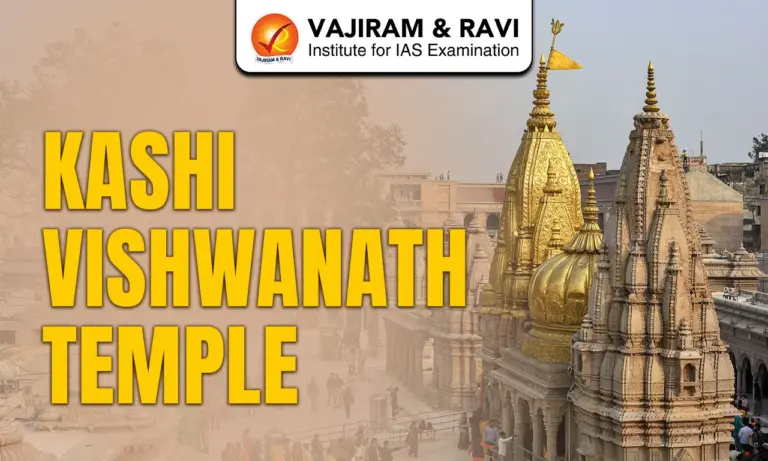
Kashi Vishwanath Temple is one of the most sacred Hindu temples dedicated to Lord Shiva and located in Varanasi, Uttar Pradesh situated on the western bank of the holy River Ganga. It is among the twelve Jyotirlingas considered the holiest shrines of Shiva worship. The temple has immense historical, cultural, and spiritual significance and has been rebuilt multiple times across centuries by various rulers and devotees, reflecting the enduring faith of pilgrims. Known as the Golden Temple because of its gold plated spire, it continues to attract millions of devotees every year.
Kashi Vishwanath Temple Historical Background
The history of Kashi Vishwanath Temple reflects centuries of faith, destruction, and reconstruction, supported by rulers, merchants, and devotees.
- The temple is mentioned in ancient Hindu scriptures such as the Skanda Purana, especially in the Kashi Khanda section. Archaeological excavations at Rajghat indicate that Varanasi existed as early as the 9th-10th century BCE, highlighting the antiquity of the sacred site associated with Lord Shiva worship.
- The earliest known structure of the temple was destroyed in 1194 when the army of Qutb-ud-Din Aibak defeated the Raja of Kannauj. Aibak served as the slave general of Muhammad Ghori, and the temple suffered major damage during this conquest.
- Around 1230, a Gujarati merchant rebuilt the temple during the reign of Sultan Iltutmish of the Slave Dynasty. However, the structure was again destroyed during the rule of regional rulers such as Hussain Shah Sharqi or Sikandar Lodhi in the late medieval period.
- The temple complex saw restoration efforts by Raja Man Singh of Amer. In 1585, during Emperor Akbar’s reign, Raja Todar Mal carried out significant renovations that revived temple worship and supported the religious traditions of the city.
- In 1669, Mughal emperor Aurangzeb ordered the demolition of the temple and constructed the Gyanvapi Mosque at the site. The mosque derived its name from the nearby Gyan Vapi well, where devotees reportedly hid the Jyotirlinga to protect it.
- The current temple was built in 1780 by the Maratha queen Ahilyabai Holkar of Indore adjacent to the mosque complex. Later contributions included a one-ton gold plating on the temple dome donated by Maharaja Ranjit Singh in 1835.
Kashi Vishwanath Temple Corridor Project
The Kashi Vishwanath Corridor Project aims to improve pilgrim access and restore the temple’s historic connection with the Ganga riverfront.
- Foundation and Budget: The project foundation was laid in March 2019 with a financial allocation of about ₹800 crore. It represents the largest redevelopment effort around the temple since the reconstruction undertaken by Ahilyabai Holkar in the eighteenth century.
- Inauguration of Phase One: On 13 December 2021, Prime Minister Narendra Modi inaugurated the first phase of the corridor in Varanasi. The initiative created a direct and spacious connection between the temple complex and the ghats of the River Ganga.
- Infrastructure and Buildings: The project includes 23 newly constructed buildings such as a tourist facilitation centre, Vedic Kendra, Mumukshu Bhavan, Bhogshala, city museum, viewing gallery, and food court designed to improve facilities for pilgrims and visitors.
- Rediscovery of Ancient Temples: During construction work, more than 40 previously hidden temples were discovered within the congested neighbourhood surrounding the shrine. These structures were carefully restored while preserving their original architectural forms and historical character.
- Tourism and Urban Development: The corridor transformed narrow lanes into wider walkways and improved lighting, drinking water supply, and visitor movement. It is expected to increase tourism in Varanasi and nearby religious centres such as the Buddhist pilgrimage site of Sarnath.
- Cultural Interpretation Facilities: Smart signages and digital displays were installed across the city to explain the historical significance of Varanasi’s heritage sites and its famous 84 ghats, enhancing the educational experience for visitors.





Kashi Vishwanath Temple Architecture
The temple’s architectural design follows the traditional Nagara style of North Indian temple construction with distinctive religious and artistic elements.
- Nagara Style Structure: The temple is constructed according to the Nagara architectural style commonly found in northern India. The sacred Jyotirlinga made of dark brown stone is installed inside the sanctum on a silver platform, symbolizing Lord Shiva as the cosmic ruler.
- Temple Layout and Quadrangle Design: The main shrine is built in a quadrangular layout surrounded by smaller shrines dedicated to several deities. These include Kaalbhairav, Dhandapani, Avimukteshwara, Vishnu, Vinayaka, Sanishwara, Virupaksha, and Virupaksha Gauri within the temple complex.
- Sanctum and Sabha Griha: A Sabha Griha or congregation hall leads devotees toward the Garbha Griha, the innermost sanctum where the Shiva lingam is placed. This arrangement allows pilgrims to gather for worship before entering the sacred inner chamber.
- Golden Spire and Domes: The temple skyline features three domes and a prominent golden shikhara. In 1835, Sikh ruler Maharaja Ranjit Singh donated nearly one tonne of gold to cover the temple tower, giving it the famous title of the Golden Temple of Varanasi.
- Jnana Vapi Well: To the north of the temple lies the Jnana Vapi well, meaning “Well of Wisdom.” Historically, it holds religious importance and is believed to have sheltered the Jyotirlinga during periods of invasion and destruction.

 Last updated on March, 2026
→ UPSC Final Result 2025 is now out.
→ UPSC has released UPSC Toppers List 2025 with the Civil Services final result on its official website.
→ Anuj Agnihotri secured AIR 1 in the UPSC Civil Services Examination 2025.
→ UPSC Marksheet 2025 is now out.
→ UPSC Notification 2026 & UPSC IFoS Notification 2026 is now out on the official website at upsconline.nic.in.
→ UPSC Calendar 2026 has been released.
→ Check out the latest UPSC Syllabus 2026 here.
→ UPSC Prelims 2026 will be conducted on 24th May, 2026 & UPSC Mains 2026 will be conducted on 21st August 2026.
→ The UPSC Selection Process is of 3 stages-Prelims, Mains and Interview.
→ Prepare effectively with Vajiram & Ravi’s UPSC Prelims Test Series 2026 featuring full-length mock tests, detailed solutions, and performance analysis.
→ Enroll in Vajiram & Ravi’s UPSC Mains Test Series 2026 for structured answer writing practice, expert evaluation, and exam-oriented feedback.
→ Join Vajiram & Ravi’s Best UPSC Mentorship Program for personalized guidance, strategy planning, and one-to-one support from experienced mentors.
→ Shakti Dubey secures AIR 1 in UPSC CSE Exam 2024.
→ Also check Best UPSC Coaching in India
Kashi Vishwanath Temple FAQs
Q1. Where is Kashi Vishwanath Temple located? +
Q2. Why is Kashi Vishwanath Temple famous? +
Q3. Who built the present structure of Kashi Vishwanath Temple? +
Q4. What is the Kashi Vishwanath Corridor Project? +
Q5. What architectural style is used in Kashi Vishwanath Temple? +
Tags: history kashi vishwanath temple