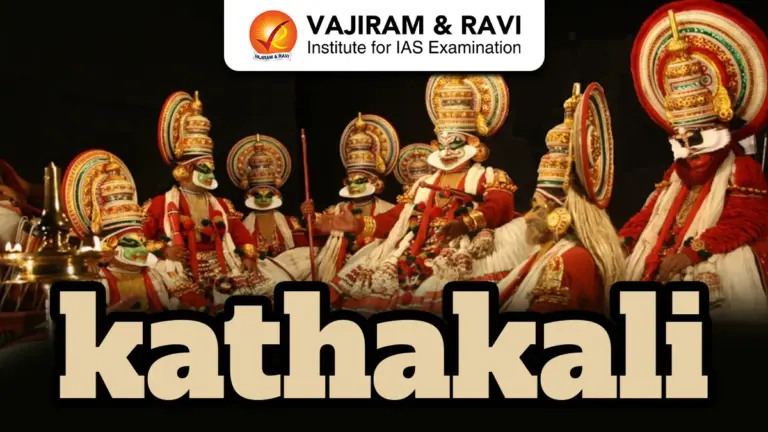
Kathakali is a world renowned traditional Indian classical dance-drama originating from the Malayalam speaking state of Kerala. As one of the most complex forms of Indian theatre, it is often described as a “play of verses” or ‘Attakatha’. This magnificent art form is traditionally performed in temple festivals and royal courts, earning it the title of a “Suvarna” or golden art form. It represents a unique blending of Aryan and Dravidian cultures, synthesizing music, vocal performance, choreography and hand gestures to tell stories of eternal conflict between good and evil.
Kathakali
The term Kathakali is derived from the Malayalam words Katha (story) and Kali (performance or play). It is one of the eight primary classical dances of India and is deeply rooted in the Natya Shastra, the ancient treatise on performing arts authored by Sage Bharata. Unlike many other classical dances that originated primarily in Hindu temples, Kathakali evolved significantly in the courts and theatres of Hindu principalities. It is distinguished by its heavy athletic movements, which draw inspiration from Kalaripayattu, the ancient martial art of Kerala and symbolizes the element of sky or ether.
Kathakali Origin and Evolution
While its fully developed style emerged around the 16th century, the roots of Kathakali can be traced back nearly 1,500 years.
- Ancient Links: It evolved from older Kerala art forms like Koodiyattom (Sanskrit theatre), Krishnanattam, Mudiyettu and the ritualistic dance form known as Theyyam.
- Ramanattam Roots: Legend suggests Kottarakkara Thampuran created Ramanattam after being denied a Krishnanattam troupe, which eventually evolved into the broader Kathakali repertoire.
- Revival Movement: In the early 20th century, poet Vallaththol Narayana Menon founded the Kerala Kalamandalam to save the art form from extinction.
- Modern Adaptation: Today, Kathakali has expanded to include women performers and has adapted Western classics like Shakespearean plays and Christian doctrines.




Kathakali Features
Kathakali is a highly stylized “total theatre” that combines literature, music, painting, acting and dance into a single powerful performance.
- Narrative Structure: The performance is based on Attakatha, which are plays written in Manipravalam, a sophisticated mixture of Malayalam and Sanskrit languages.
- Navarasas: Dancers master nine facial expressions to convey emotions: Sringara (love), Hasya (comic), Karuna (pathos), Raudra (anger), Vira (valor), Bhayanaka (fear), Bibhatsa (disgust), Adbhuta (wonder) and Shanta (peace).
- Hand Gestures: The dance relies on the Hastha Lakshanadeepika text, featuring 24 main mudras (signs) to communicate complex dialogues without speaking.
- Performance Sequence: A recital begins with Kelikottu (drumming), followed by Todayam (devotional prayer), Purappadu (pure dance) and Melappada (musical exhibition) before the drama starts.
- Themes: Most recitals depict the grand struggle between gods and demons, drawing from the Mahabharata, Ramayana and the Puranas.
Kathakali Costumes
The elaborate makeup known as Chutti and the heavy, colorful costumes are the most striking visual elements of a Kathakali performance.
- Pacha (Green): This color represents noble, heroic and divine characters such as Krishna, Rama, Arjuna and virtuous philosopher kings.
- Katti (Knife): Featuring green faces with red streaks, this makeup depicts anti-heroes or villains who possess streaks of nobility or bravery.
- Thadi (Beard): Characters are categorized by beard color; Vella Thadi (white) for divine beings like Hanuman and Chuvanna Thadi (red) for evil.
- Kari (Black): This style is used for forest dwellers, hunters and treacherous characters, often including demonesses painted with patches of red.
- Minukku (Radiant): A warm yellow or saffron tone used for virtuous feminine characters like Sita and Mohini, as well as sages.
Kathakali Exponents
The preservation of Kathakali is credited to legendary masters and dedicated institutions that have maintained the rigorous Gurukula training system.
- Guru Kunchu Kurup: A legendary figure whose contributions were instrumental in bringing international recognition and technical precision to the dance form.
- Kavungal Chathunni Panicker: A celebrated exponent known for his mastery over the Kalluvazhi style, which emphasizes rigorous discipline and refined movements.
- V.N. Menon and M.M. Raja: These visionaries were responsible for the institutionalization of the dance through the establishment of the Kerala Kalamandalam.
- Modern Artists: Notable performers like Gopi Nath and Rita Ganguly have helped bridge the gap between traditional roots and modern audiences.
Kathakali Musical Instruments
The music of Kathakali, performed in the Carnatic style, is essential for setting the emotional tempo and rhythmic structure of the play.
- Chenda: A cylindrical percussion instrument played with curved sticks, used to create loud, powerful sounds during intense or heroic scenes.
- Maddalam: A barrel shaped drum held horizontally, providing a deep, rich bass tone that complements the dancer’s footwork and rhythmic patterns.
- Idakka: An hourglass shaped drum with melodious notes, typically played during the entrance and performance of female characters or gentle scenes.
- Chengila and Elaththalam: These are cymbals and gongs used by the vocalists to maintain the tala (rhythm) throughout the night long performance.
Kathakali Awards
Recognition of excellence in Kathakali has ensured the survival of the art and provided prestige to its most dedicated practitioners.
- Sangeet Natak Akademi Award: This national level honor has been bestowed upon numerous Kathakali maestros since 1956 for their contribution to Indian heritage.
- Nari Shakti Puraskar: The Tripunithura Kathakali Kendram Ladies Troupe received this prestigious award for breaking gender barriers in a traditionally male dominated art.
- International Centre for Kathakali Award: A specific honor dedicated to recognizing scholars and artists who promote the global understanding of the dance theatre.

 Last updated on April, 2026
→ UPSC Final Result 2025 is now out.
→ UPSC has released UPSC Toppers List 2025 with the Civil Services final result on its official website.
→ Anuj Agnihotri secured AIR 1 in the UPSC Civil Services Examination 2025.
→ UPSC Marksheet 2025 is now out.
→ UPSC Notification 2026 & UPSC IFoS Notification 2026 is now out on the official website at upsconline.nic.in.
→ UPSC Calendar 2026 has been released.
→ Check out the latest UPSC Syllabus 2026 here.
→ UPSC Prelims 2026 will be conducted on 24th May, 2026 & UPSC Mains 2026 will be conducted on 21st August 2026.
→ The UPSC Selection Process is of 3 stages-Prelims, Mains and Interview.
→ Prepare effectively with Vajiram & Ravi’s UPSC Prelims Test Series 2026 featuring full-length mock tests, detailed solutions, and performance analysis.
→ Enroll in Vajiram & Ravi’s UPSC Mains Test Series 2026 for structured answer writing practice, expert evaluation, and exam-oriented feedback.
→ Join Vajiram & Ravi’s Best UPSC Mentorship Program for personalized guidance, strategy planning, and one-to-one support from experienced mentors.
→ Shakti Dubey secures AIR 1 in UPSC CSE Exam 2024.
→ Also check Best UPSC Coaching in India
Kathakali FAQs
Q1. What is the Kathakali Dance Form? +
Q2. Why do the Kathakali dancers wear heavy makeup and bright colors? +
Q3. Do Kathakali dancers use their voices to tell the story? +
Q4. How long does a traditional Kathakali performance last? +
Q5. Can women perform Kathakali? +
Tags: kathakali