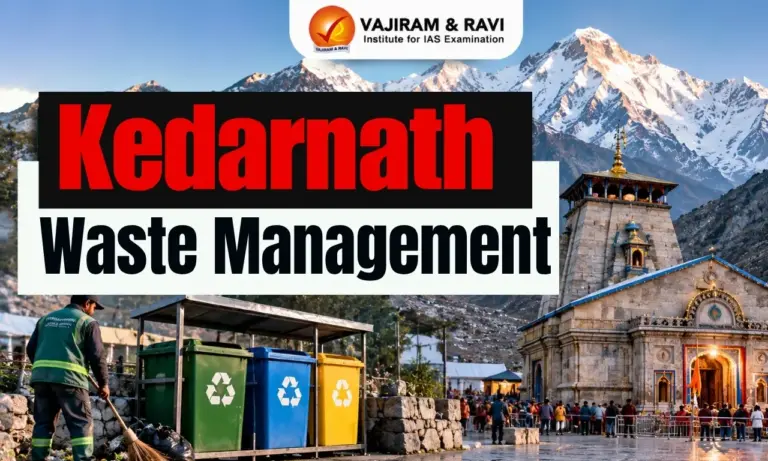
Kedarnath Waste Management has emerged as an important environmental governance issue because the rapid increase in pilgrimage and tourism is putting pressure on the fragile Himalayan ecosystem. In 2026, authorities introduced the ‘Carry Me Back’ policy to involve pilgrims directly in carrying dry waste back from Kedarnath to Gaurikund for scientific disposal.
Why is Waste Management Difficult in Kedarnath?
Kedarnath is located in a high-altitude and ecologically fragile Himalayan region, making conventional waste collection and transportation difficult.
- High pilgrim footfall: Large numbers of pilgrims generate significant quantities of plastic, packaging and other waste.
- Difficult terrain: Steep trekking routes increase the cost and difficulty of transporting waste.
- Limited infrastructure: Waste-processing and landfill capacity is limited in comparison with seasonal waste generation.
- Fragile ecosystem: Improper disposal can affect soil, water bodies and the wider Himalayan ecosystem.
- Seasonal pressure: Waste generation rises sharply during the pilgrimage season.
- Sewage concerns: Wastewater management is also a challenge because untreated sewage can affect the Mandakini river system.
Carry Me Back Policy
The ‘Carry Me Back’ policy was launched in 2026 by the Rudraprayag district administration and Kedarnath Nagar Panchayat, in collaboration with the Healing Himalayas Foundation and Sulabh International.
Key Features
- Pilgrims are provided bags with a capacity of around 400–500 grams of dry waste.
- They are encouraged to collect their dry waste during their stay.
- The collected waste is carried back along the route to Gaurikund.
- Waste is then taken for proper segregation and disposal.
- The initiative follows a reverse waste transportation model, reducing the need to transport waste uphill.
- It promotes Jan Bhagidari by making pilgrims active participants in environmental conservation.


Other Waste Management Measures
Apart from the Carry Me Back Policy, authorities are adopting a combination of waste segregation, scientific processing, sewage treatment and eco-friendly pilgrimage management measures in the Kedarnath region.
- Organic Waste Treatment: Use of modern machinery for the scientific processing of biodegradable waste.
- Waste Segregation: Separate collection and processing of wet, dry, recyclable and plastic waste.
- Plastic Waste Management: Measures to reduce single-use plastic and improve collection of plastic waste.
- Sewage Treatment: Strengthening sewage treatment facilities to prevent untreated wastewater from entering nearby water bodies.
- Waste Transportation: Improving systems for the safe transportation of collected waste from high-altitude areas to suitable processing facilities.
- Swachh Dham–Harit Dham: Promoting clean and environmentally sustainable pilgrimage centres through better sanitation and waste management.
- Carrying Capacity Assessment: Linking pilgrimage infrastructure and tourist inflow with the ecological carrying capacity of the fragile Himalayan region.
Legal and Policy Framework
Kedarnath’s waste management is governed by a combination of solid-waste, plastic-waste, water-pollution and environmental protection laws, along with broader cleanliness and river-conservation programmes.
- Solid Waste Management Rules, 2016: Focus on waste segregation, collection, transportation, processing and scientific disposal.
- Plastic Waste Management Rules, 2016: Regulate plastic waste management and promote reduction of single-use plastics.
- Environment (Protection) Act, 1986: Provides the overarching framework for environmental protection and pollution control.
- Water (Prevention and Control of Pollution) Act, 1974: Regulates the discharge of sewage and pollutants into water bodies.
- Swachh Bharat Mission: Promotes sanitation, cleanliness, waste segregation and scientific waste management.
- Namami Gange Programme: Supports river conservation and pollution control in the Ganga river basin, including its tributaries.
- Extended Producer Responsibility (EPR): Makes producers responsible for the collection and environmentally sound management of plastic packaging waste.

 Last updated on Oct, 2026
→ UPSC 2027 Notification will be released on 13 January 2027 at upsconline.nic.in.
→ Check Nobel Prize 2026 Winners List here.
→ Download PIB PRiSM Monthly Magazine 2026 here.
→ Check UPSC Monthly Current Affairs Magazine The Recitals here.
→ Check out the latest UPSC Syllabus here.
→ Download UPSC Model Answers for Mains 2026
→ UPSC Mains Question Paper 2026 is out now for Essay & GS Paper 1, 2, 3 & 4.
→ UPSC Calendar 2027 has been released.
→ Enroll in Vajiram & Ravi’s UPSC Mains Test Series 2027 for structured answer writing practice, expert evaluation, and exam-oriented feedback.
→ Join Vajiram & Ravi’s UPSC Mentorship Program 2027 for personalized guidance, strategy planning, and one-to-one support from experienced mentors.
→ Go through the UPSC Mains Previous Year Papers to enhance your preparation.
→ UPSC has released UPSC Toppers List 2025 with the Civil Services final result on its official website.
→ Also check Best UPSC Coaching in India
Kedarnath Waste Management FAQs
Q1. What is the Carry Me Back Policy in Kedarnath?+
Q2. Why is waste management a challenge in Kedarnath?+
Q3. What type of waste is mainly generated in Kedarnath?+
Q4. How does the Carry Me Back Policy work?+
Q5. Which organisations are involved in the initiative?+
Tags: kedarnath waste management waste management