What’s in today’s article?
- Why in News?
- Ken-Betwa Link Project (KBLP)
- Environmental and social concerns
- Controversies and Criticism Surrounding the Project
Why in News?
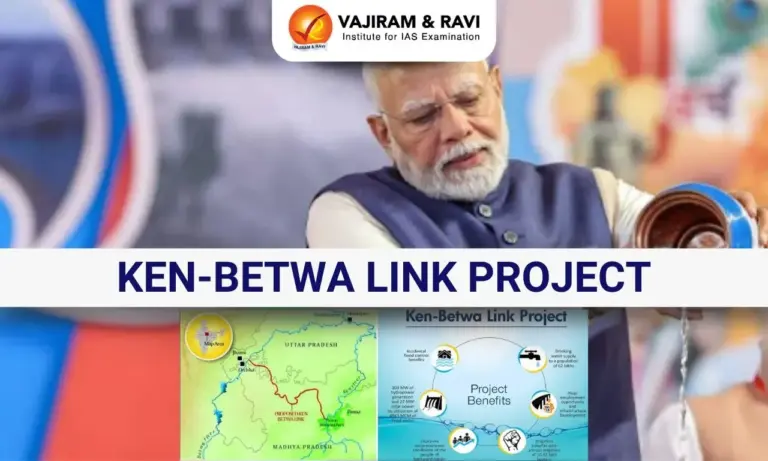
Prime Minister Narendra Modi laid the foundation stone for the Ken-Betwa river-linking project in Madhya Pradesh’s Khajuraho.
The project aims to transfer excess water from the Ken River in Madhya Pradesh to the Betwa River. It is expected to bring prosperity to the Bundelkhand region.





Ken-Betwa Link Project (KBLP)
- About
- The Ken-Betwa Link Project (KBLP) aims to transfer water from the Ken River to the Betwa River, both tributaries of the Yamuna.
- The project includes a 221-km canal with a 2-km tunnel.
- The project also includes a 73.8-meter-high dam on Ken at Daudhan in Madhya Pradesh’s Chhattarpur district.
- History of the Ken-Betwa interlinking project
- The project was conceptualised in the 1980s but the water-sharing agreement could not be reached between the two states.
- The work on the project was originally slated to begin in 2015 but only got a fresh push last year with the government making a revised deal with the two states.
- Finally, On March 22, 2021, a memorandum of agreement was signed among the Ministry of Jal Shakti and the governments of Madhya Pradesh and Uttar Pradesh to implement the Project.
- Project Phases
- Phase-I: Construction of the Daudhan Dam complex, Low Level Tunnel, High Level Tunnel, Ken-Betwa Link Canal, and powerhouses.
- Phase-II: Construction of Lower Orr Dam, Bina Complex Project, and Kotha Barrage.
- Completion of project
- According to the Jal Shakti Ministry, the KBLP project is proposed to be implemented in eight years.
- Regions Benefiting from the project
- The project will benefit the Bundelkhand region, which spans 13 districts in Uttar Pradesh and Madhya Pradesh. Key beneficiary districts include:
- Madhya Pradesh: Panna, Tikamgarh, Chhatarpur, Sagar, Damoh, Datia, Vidisha, Shivpuri, and Raisen.
- Uttar Pradesh: Banda, Mahoba, Jhansi, and Lalitpur.
- The project aims to address water scarcity in this drought-prone region, fostering development and paving the way for future river interlinking initiatives.
- The project will benefit the Bundelkhand region, which spans 13 districts in Uttar Pradesh and Madhya Pradesh. Key beneficiary districts include:
- Benefits of the Project
- Irrigation: Annual irrigation for 10.62 lakh hectares (8.11 lakh ha in Madhya Pradesh and 2.51 lakh ha in Uttar Pradesh).
- Drinking Water: Supply for approximately 62 lakh people.
- Power Generation: 103 MW of hydropower and 27 MW of solar power.
Environmental and social concerns
- Environmental Impacts
- Deforestation in Panna National Park: The project will result in large-scale deforestation, with around 98 sq km of the park submerged and 2–3 million trees felled.
- Threat to Wildlife:
- Tigers: The Daudhan Dam, located inside the Panna National Park, could undermine the successful tiger reintroduction program that revived the population after local extinction in 2009.
- Gharials and Vultures: Likely to affect the Gharial population in the Ken Gharial Sanctuary and disrupt vulture nesting sites downstream.
- Hydrological Concerns:
- IIT-Bombay scientists warn the project could reduce September rainfall by up to 12% due to disruptions in land-atmosphere feedback.
- Experts demand transparency in Ken River’s hydrological data for a thorough review.
- Social Impacts
- Displacement: The dam will displace 5,228 families in Chhatarpur district and 1,400 families in Panna district due to submergence and land acquisition.
- Inadequate Compensation: Protests have erupted over perceived inadequate compensation and minimal benefits for affected communities, particularly in Panna district.
Controversies and Criticism Surrounding the Project
- Wildlife and Environmental Clearance: The Supreme Court’s Central Empowered Committee (CEC) questioned the wildlife clearance and the project’s economic viability.
- Violation of Precedents: The Union Environment Ministry approved construction within the core of the Panna Tiger Reserve, despite no precedent for such heavy infrastructure in national parks or tiger reserves.
Q.1. What is the Ken-Betwa Link Project?
The Ken-Betwa Link Project transfers water from the Ken River to the Betwa River, addressing water scarcity in Bundelkhand. It involves the Daudhan Dam and a 221-km canal. It aims to irrigate 10.62 lakh hectares and supply drinking water to 62 lakh people.
Q.2. What are the environmental concerns surrounding the Ken-Betwa Project?
The project threatens wildlife in Panna Tiger Reserve, affects Gharials and vultures, and involves deforestation of 98 sq km. Scientists warn of reduced September rainfall and hydrological disruptions. Displacement of 6,628 families raises social concerns.

 Last updated on March, 2026
→ UPSC Final Result 2025 is now out.
→ UPSC has released UPSC Toppers List 2025 with the Civil Services final result on its official website.
→ Anuj Agnihotri secured AIR 1 in the UPSC Civil Services Examination 2025.
→ UPSC Marksheet 2025 is now out.
→ UPSC Notification 2026 & UPSC IFoS Notification 2026 is now out on the official website at upsconline.nic.in.
→ UPSC Calendar 2026 has been released.
→ Check out the latest UPSC Syllabus 2026 here.
→ UPSC Prelims 2026 will be conducted on 24th May, 2026 & UPSC Mains 2026 will be conducted on 21st August 2026.
→ The UPSC Selection Process is of 3 stages-Prelims, Mains and Interview.
→ Prepare effectively with Vajiram & Ravi’s UPSC Prelims Test Series 2026 featuring full-length mock tests, detailed solutions, and performance analysis.
→ Enroll in Vajiram & Ravi’s UPSC Mains Test Series 2026 for structured answer writing practice, expert evaluation, and exam-oriented feedback.
→ Join Vajiram & Ravi’s Best UPSC Mentorship Program for personalized guidance, strategy planning, and one-to-one support from experienced mentors.
→ Shakti Dubey secures AIR 1 in UPSC CSE Exam 2024.
→ Also check Best UPSC Coaching in India