Khwaja Moinuddin Chishti Latest News
The Supreme Court recently declined urgent hearing of a plea against the practice of state-sponsored ceremonial honours or offering a ‘Chadar’ by the Prime Minister at the Dargah of Khwaja Moinuddin Chishti, in Ajmer.
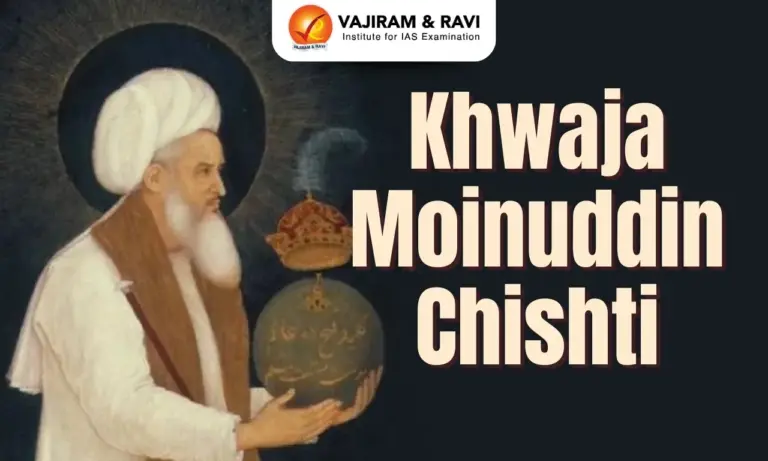
About Khwaja Moinuddin Chishti
- He was a very important Sufi saint.
- People often call him Gharīb Nawāz, which means ‘Benefactor of the Poor’.
- He was born in 1141 CE in Sistan, a province in Persia (Iran) which borders present-day Afghanistan.
- His deep inclination towards spirituality led him to study in Samarkand and Bukhara, the great centres of Islamic learning.
- A follower of Sunni Hanafi theology, he became the disciple of Hazrat Khwaja Usman Harooni, who later declared him his spiritual successor at the age of 52.
- He came to India around the year 1192 AD. He finally settled in the city of Ajmer during the reign of Sultan Iltutmish in Delhi and Prithviraj Chauhan in Ajmer.
- He is famous for bringing the Chishti Order of Sufism to India.
- He preached love, tolerance, charity, and detachment from materialism, and established a Khanqah in Ajmer to serve the poor.
- After his death in 1236 CE, Moinuddin Chishti was buried in Ajmer.
- His tomb became a very important place. It is now known as the Dargah Sharif, or the Ajmer Sharif Dargah.
- The architectural style of Dargah Sharif purely reflects the Mughal style of architecture.
- All Mughal rulers from Humayun to Shah Jahan have made modifications in the structure.





The Chishti Order’s Beliefs
- The Chishti Order is a group within Sufism.
- Sufism is a way of life in Islam that focuses on finding a deeper, more personal connection with God.
- The Chishti Order was started by a saint named Abu Ishaq Shami in Chisht, a town in Afghanistan.
- The Chishti Order is mostly followed in Afghanistan and South Asia.
- Moinuddin Chishti brought this order to India.
- The Chishti Order teaches several important things:
- Love for all people.
- Helping the poor and needy.
- Living a simple life.
- Being tolerant and peaceful.
- Listening to spiritual music, called Qawwali, to feel closer to God.
Source: ET

 Last updated on April, 2026
→ UPSC Final Result 2025 is now out.
→ UPSC has released UPSC Toppers List 2025 with the Civil Services final result on its official website.
→ Anuj Agnihotri secured AIR 1 in the UPSC Civil Services Examination 2025.
→ UPSC Marksheet 2025 is now out.
→ UPSC Notification 2026 & UPSC IFoS Notification 2026 is now out on the official website at upsconline.nic.in.
→ UPSC Calendar 2026 has been released.
→ Check out the latest UPSC Syllabus 2026 here.
→ UPSC Prelims 2026 will be conducted on 24th May, 2026 & UPSC Mains 2026 will be conducted on 21st August 2026.
→ The UPSC Selection Process is of 3 stages-Prelims, Mains and Interview.
→ Prepare effectively with Vajiram & Ravi’s UPSC Prelims Test Series 2026 featuring full-length mock tests, detailed solutions, and performance analysis.
→ Enroll in Vajiram & Ravi’s UPSC Mains Test Series 2026 for structured answer writing practice, expert evaluation, and exam-oriented feedback.
→ Join Vajiram & Ravi’s Best UPSC Mentorship Program for personalized guidance, strategy planning, and one-to-one support from experienced mentors.
→ Shakti Dubey secures AIR 1 in UPSC CSE Exam 2024.
→ Also check Best UPSC Coaching in India
Khwaja Moinuddin Chishti FAQs
Q1. Who is popularly known as Gharib Nawaz?+
Q2. Around which year did Moinuddin Chishti come to India?+
Q3. In which Indian city did Khwaja Moinuddin Chishti finally settle?+
Q4. Which Sufi order did Khwaja Moinuddin Chishti introduce to India?+
Q5. Where was Khwaja Moinuddin Chishti buried?+
Tags: prelims pointers upsc current affairs upsc prelims current affairs