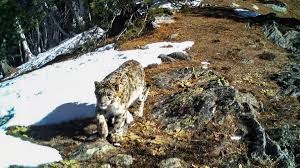
About Kishtwar High Altitude National Park:
- It is located in the Kishtwar district of union territory of Jammu and Kashmir.
- The area was declared as a Kishtwar High Altitude National Park in 1980.
- It was majorly founded to protect the Snow Leopards that are now slowly vanishing from the nature.
- Physical Features:
- The area lies in the central crystalline belt of the great Himalayas and the tract is situated on the high altitudes i.e., sub-alpine and alpine zone.
- The National Park encompasses the catchment area of Kiber, Nanth and Kiyar Nallas, all of which drain south-west into Marwah River (locally called Mariv Sudir) which later joins Chenab.
- The terrain is generally rugged and steep with narrow valleys bounded by high ridges opening out in their upper glacial parts.
- It encompasses breathtaking alpine meadows, snow-capped peaks, and lush green forests, serving as a vital ecological corridor for many wildlife species.
- It is renowned for its diverse array of flora and fauna, including several rare and endangered species.
- Flora:
- It has a variety of temperature conifer forests. These include Fir, Himalayan Yew, Deodar, Blue Pine, or Kail and Spruce.
- In the alpine regions of the park extensive alpine scrub and meadows are present.
- Fauna:
- The park is a renowned snow leopard reserve. Besides, it provides a habitat for Brown bear, Himalayan musk deer, Hangul, Ibex, Wild boar, Indian muntjac, Serow Capricornis, Himalayan Tahr, Bharal etc.
Q1) Which national park is famous for Nilgiri tahr?
The Eravikulam National Park has the highest density and largest surviving population of Nilgiri tahr. The Nilgiri tahr was formerly called Hemitragus hylocrius. Its generic name was changed to Nilgiritragus after the phylogenic research by Ropiquet and Hassanin in 2005.
Source: Camera trap confirms presence of snow leopard at Kishtwar National Park






 Last updated on March, 2026
→ UPSC Final Result 2025 is now out.
→ UPSC has released UPSC Toppers List 2025 with the Civil Services final result on its official website.
→ Anuj Agnihotri secured AIR 1 in the UPSC Civil Services Examination 2025.
→ UPSC Marksheet 2025 is now out.
→ UPSC Notification 2026 & UPSC IFoS Notification 2026 is now out on the official website at upsconline.nic.in.
→ UPSC Calendar 2026 has been released.
→ Check out the latest UPSC Syllabus 2026 here.
→ UPSC Prelims 2026 will be conducted on 24th May, 2026 & UPSC Mains 2026 will be conducted on 21st August 2026.
→ The UPSC Selection Process is of 3 stages-Prelims, Mains and Interview.
→ Prepare effectively with Vajiram & Ravi’s UPSC Prelims Test Series 2026 featuring full-length mock tests, detailed solutions, and performance analysis.
→ Enroll in Vajiram & Ravi’s UPSC Mains Test Series 2026 for structured answer writing practice, expert evaluation, and exam-oriented feedback.
→ Join Vajiram & Ravi’s Best UPSC Mentorship Program for personalized guidance, strategy planning, and one-to-one support from experienced mentors.
→ Shakti Dubey secures AIR 1 in UPSC CSE Exam 2024.
→ Also check Best UPSC Coaching in India