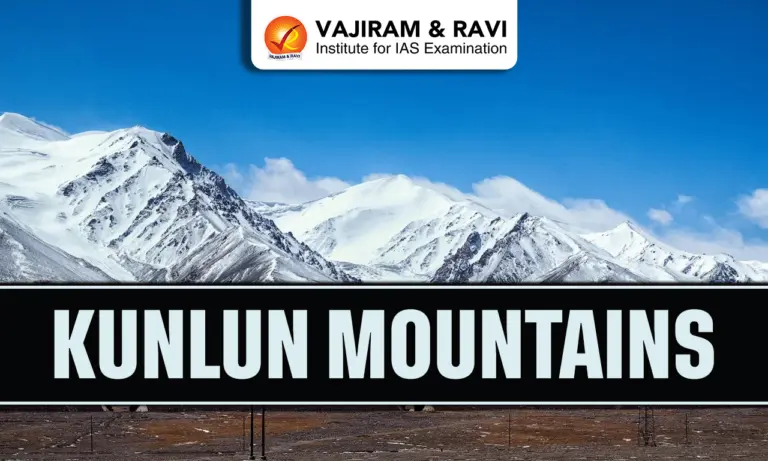
The Kunlun Mountains are one of the longest and most important mountain systems in Asia, forming the northern boundary of the Tibetan Plateau. Stretching across western China and Central Asia, they act as a natural barrier between the Tibetan Plateau and the arid basins of Central Asia. Despite their great height, the region is extremely dry and sparsely populated, making it a classic example of a cold desert mountain environment.
Kunlun Mountains Location and Extent
- The Kunlun Mountains extend for about 2000 km from the Pamir Mountains in Tajikistan in the west to central Qinghai province in China in the east.
- They form a major geographical boundary between the Tibetan Plateau in the south and the Tarim Basin in the north.
- The width of the range varies but generally does not exceed 200 km.
- In the north, associated ranges like the Altun (Altyn Tagh) Mountains extend the system further eastward.
Kunlun Mountains Physiography and Geology
- The Kunlun Mountains consist of multiple parallel ranges rather than a single continuous ridge, especially in the western section.
- The mountains rise sharply from the Tarim Basin, forming a massive barrier, while their southern slope rises gently from the Tibetan Plateau.
- The region contains several high peaks, many rising above 7000 metres.
- Between the ranges lie basins such as the Qaidam Basin, which contain saline lakes and desert features.
- Geologically, the mountains were formed during major tectonic movements around 250 million years ago and continue to experience seismic activity, particularly along fault zones like the Altun fault.





Kunlun Mountains Drainage System
- The Kunlun Mountains lie in a region dominated by internal drainage, where rivers do not reach the sea but end in inland basins.
- Most rivers flow northwards into the Tarim Basin or southwards into the Tibetan Plateau basins.
- Only the easternmost part contributes to external drainage, as it is the source region of the Yellow River.
- Rivers are mainly fed by snow and glacial melt, leading to seasonal variation in water flow.
- High evaporation rates result in the formation of salt pans and saline lakes in the basins.
Kunlun Mountains Climate
- The Kunlun Mountains experience an extremely arid continental climate due to their isolation from both the Indian and Pacific monsoons.
- Annual rainfall is very low, often less than 50 mm in some regions, making it one of the driest high mountain areas in the world.
- Temperature variation is extreme, with warm summers and very cold winters, especially at higher elevations.
- Strong winds and large daily temperature fluctuations lead to intense physical weathering of rocks.
- The dryness limits snow accumulation, resulting in limited glaciation despite high elevations.
Kunlun Mountains Soils
- Soils in the Kunlun region are poorly developed due to harsh climatic conditions and low biological activity.
- Desert and steppe soils dominate, with very low organic content and limited fertility.
- Saline soils are common in intermontane basins due to high evaporation and mineral accumulation.
- Wind erosion is significant, leading to the formation of sand deposits and barren landscapes.
Kunlun Mountains Natural Vegetation
- Vegetation is sparse due to extreme aridity and cold conditions.
- Most areas consist of desert or steppe vegetation with limited grass cover.
- In relatively moist western areas, alpine grasslands support limited grazing.
- Vegetation is mainly found near water sources such as river valleys and seasonal pools.
- Overall, plant life is highly adapted to cold and dry conditions.
Kunlun Mountains Fauna
- The Kunlun Mountains support a limited but well-adapted range of wildlife.
- Herbivores include species like Tibetan antelope, wild yak, and kiang (wild ass), which survive in harsh conditions.
- Carnivores such as wolves and the rare snow leopard are found in higher altitudes.
- Migratory birds visit seasonal lakes, adding to biodiversity.
- Animals are adapted to cold climates, low oxygen levels, and scarce vegetation.
Kunlun Mountains Human Geography
- The region is sparsely populated due to extreme climatic and topographic conditions.
- The northern slopes are inhabited by Uighur communities, while Tibetan nomads occupy the southern side.
- Nomadic pastoralism is common, with people moving in search of grazing land.
- Settlements are mostly found in valleys and near water sources.
- Infrastructure development is limited but improving in some areas.
Kunlun Mountains Economic Activities
- Pastoralism, particularly the rearing of yaks, sheep, and goats, is the primary economic activity.
- Limited agriculture is practiced in areas with irrigation, mainly growing barley, wheat, and potatoes.
- Mining of minerals such as coal, petroleum, and salts is important in some regions.
- Transport routes like the Qinghai-Tibet road facilitate trade and connectivity.
- Economic development remains constrained due to harsh environmental conditions.

 Last updated on March, 2026
→ UPSC Final Result 2025 is now out.
→ UPSC has released UPSC Toppers List 2025 with the Civil Services final result on its official website.
→ Anuj Agnihotri secured AIR 1 in the UPSC Civil Services Examination 2025.
→ UPSC Marksheet 2025 is now out.
→ UPSC Notification 2026 & UPSC IFoS Notification 2026 is now out on the official website at upsconline.nic.in.
→ UPSC Calendar 2026 has been released.
→ Check out the latest UPSC Syllabus 2026 here.
→ UPSC Prelims 2026 will be conducted on 24th May, 2026 & UPSC Mains 2026 will be conducted on 21st August 2026.
→ The UPSC Selection Process is of 3 stages-Prelims, Mains and Interview.
→ Prepare effectively with Vajiram & Ravi’s UPSC Prelims Test Series 2026 featuring full-length mock tests, detailed solutions, and performance analysis.
→ Enroll in Vajiram & Ravi’s UPSC Mains Test Series 2026 for structured answer writing practice, expert evaluation, and exam-oriented feedback.
→ Join Vajiram & Ravi’s Best UPSC Mentorship Program for personalized guidance, strategy planning, and one-to-one support from experienced mentors.
→ Shakti Dubey secures AIR 1 in UPSC CSE Exam 2024.
→ Also check Best UPSC Coaching in India
Kunlun Mountains FAQs
Q1. Where are the Kunlun Mountains located?+
Q2. What type of climate is found in the Kunlun Mountains?+
Q3. What kind of drainage system exists in the Kunlun Mountains?+
Q4. Why is there limited glaciation in the Kunlun Mountains?+
Q5. What vegetation is found in the Kunlun Mountains?+
Q6. What animals are found in the Kunlun Mountains?+
Q7. What are the main economic activities in the Kunlun Mountains?+
Tags: kunlun mountains