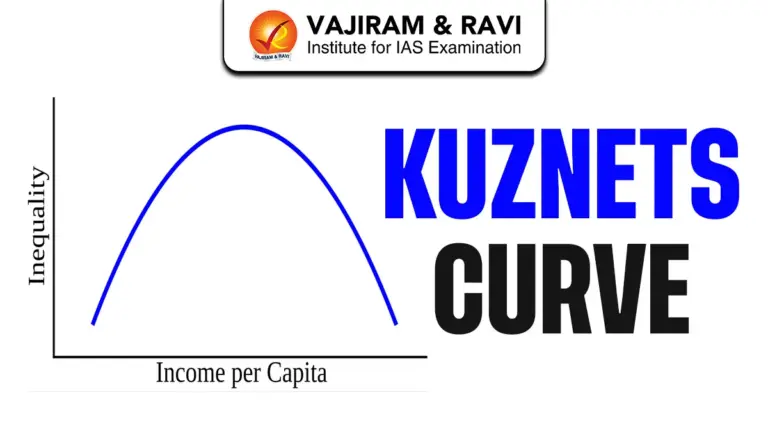
The Kuznets Curve is one of the most important concepts in economics used to explain the relationship between economic growth and income inequality. Proposed by economist Simon Kuznets, this theory helps policymakers understand how income distribution changes as an economy develops. Over time, the idea was also extended to environmental studies, leading to the Environmental Kuznets Curve (EKC).
This article explains the Kuznets Curve in detail, its relationship with income inequality, environmental implications, and criticisms.
What is Kuznets Curve?
The Kuznets Curve is a theoretical model that shows an inverted U-shaped relationship between economic development and income inequality.
According to this theory, when a country begins to develop, income inequality first increases, but after reaching a certain level of economic growth, inequality starts decreasing. This happens due to structural transformation, urbanization, and better access to education and welfare policies.
Kuznets Curve and Income Inequality
The Kuznets Curve explains how income inequality changes at different stages of economic development. It suggests that inequality does not remain constant but follows a predictable pattern as an economy grows.
- The Kuznets Curve shows an inverted U-shaped relationship between economic growth and income inequality.
- In the early stage of development, income inequality is low because most people depend on
- agriculture and earn similar incomes.
- During industrialization, inequality rises as urban and industrial sectors grow faster than rural areas.
- Skilled workers and capital owners earn more, widening the income gap.
- With further development, education, welfare policies, and social security expand.
- Government intervention and economic diversification help reduce inequality.
- Thus, in the long run, income inequality declines as the economy becomes more developed and inclusive.





Environmental Kuznets Curve
- The Environmental Kuznets Curve (EKC) explains the relationship between economic growth and environmental degradation.
- It shows an inverted U-shaped curve, similar to the Kuznets Curve for income inequality.
- In the early stage of development, pollution increases due to industrialization and lack of environmental regulations.
- As income rises, industrial expansion and urbanization lead to higher emissions and resource exploitation.
- At higher income levels, countries adopt cleaner technologies and stricter environmental laws.
- Increased public awareness and investment in renewable energy help reduce pollution.
- Thus, environmental degradation first rises and then declines with sustained economic development.
Criticism of Kuznets Curve
The Kuznets Curve has been widely debated because it oversimplifies the relationship between economic growth and income inequality.
- The Kuznets Curve is not universally applicable, as many developing countries continue to face rising inequality despite economic growth.
- It is based on limited historical data from a few developed countries, making it less relevant for modern economies.
- The theory ignores the role of government policies, such as taxation, welfare programs, and labor laws, in reducing inequality.
- Economic growth alone does not ensure equitable income distribution; political and social factors also matter.
- Globalisation and technological change often increase income gaps, contradicting the Kuznets hypothesis.
- In many cases, inequality does not decline automatically and requires active state intervention.

 Last updated on April, 2026
→ UPSC Final Result 2025 is now out.
→ UPSC has released UPSC Toppers List 2025 with the Civil Services final result on its official website.
→ Anuj Agnihotri secured AIR 1 in the UPSC Civil Services Examination 2025.
→ UPSC Marksheet 2025 is now out.
→ UPSC Notification 2026 & UPSC IFoS Notification 2026 is now out on the official website at upsconline.nic.in.
→ UPSC Calendar 2026 has been released.
→ Check out the latest UPSC Syllabus 2026 here.
→ UPSC Prelims 2026 will be conducted on 24th May, 2026 & UPSC Mains 2026 will be conducted on 21st August 2026.
→ The UPSC Selection Process is of 3 stages-Prelims, Mains and Interview.
→ Prepare effectively with Vajiram & Ravi’s UPSC Prelims Test Series 2026 featuring full-length mock tests, detailed solutions, and performance analysis.
→ Enroll in Vajiram & Ravi’s UPSC Mains Test Series 2026 for structured answer writing practice, expert evaluation, and exam-oriented feedback.
→ Join Vajiram & Ravi’s Best UPSC Mentorship Program for personalized guidance, strategy planning, and one-to-one support from experienced mentors.
→ Shakti Dubey secures AIR 1 in UPSC CSE Exam 2024.
→ Also check Best UPSC Coaching in India
Kuznets Curve FAQs
Q1. Who proposed the Kuznets Curve?+
Q2. What does the Kuznets Curve show?+
Q3. What is the Environmental Kuznets Curve?+
Q4. Is the Kuznets Curve valid today?+
Q5. Why is the Kuznets Curve important?+
Tags: kuznets curve