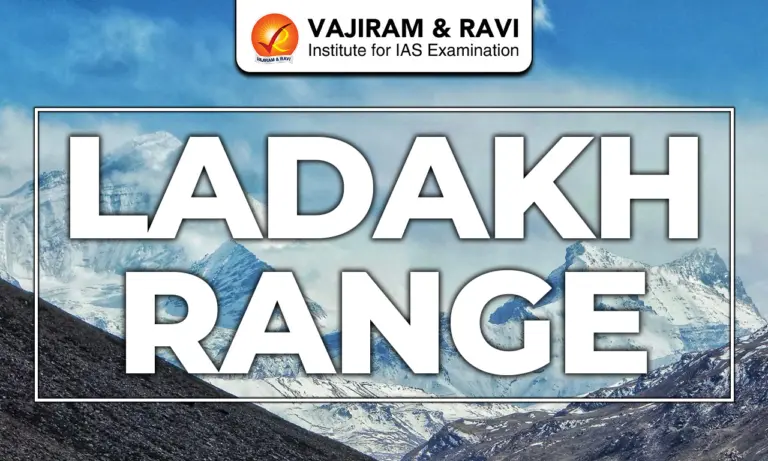
The Ladakh Range is a significant mountain system located in central Ladakh in India, extending into Baltistan in Pakistan. It runs parallel to the Indus River and forms a major geographical barrier influencing regional drainage, climate and human settlement patterns across Ladakh. This range forms a part of the Trans-Himalayan system and is considered a southeastern extension of the Karakoram Range. It plays a key role in shaping Ladakh’s terrain and climate.
Ladakh Range
The Ladakh Range is a high altitude mountain system with an average elevation of about 6,000 metres and limited prominent peaks.
- Location: It is located in the Ladakh Union territory of India.
- Extent: The range extends around 370 km from Baltistan to the Tibetan border, positioned between the Indus and Shyok valleys, forming a natural boundary in central Ladakh.
- Rivers: It lies between the Indus River and Shyok River valleys and stretches for about 370 km.
- Geological Composition: It is mainly composed of granitic rocks of the Ladakh batholith, bounded by the Shyok suture zone in the north and Indus suture zone in the south.
- Elevation and Relief: The average height is about 6,000 metres, with crest lines reaching nearly 6,100 metres, though it lacks very high peaks compared to nearby ranges.
- Major Passes: Important high passes include Chorbat (5,090 m), Digar La (5,400 m), Khardung La (5,602 m), Chang La (5,599 m) and Tsaka La (4,724 m).
- Climatic Conditions: The region experiences a cold desert climate with less than 100 mm annual rainfall, extreme winters below 0°C and summer temperatures exceeding 30°C on lower slopes.
Ladakh Range Biodiversity
The Ladakh Range supports limited but specialized biodiversity due to its harsh cold desert conditions, low precipitation and extreme temperatures.
- Vegetation Type: Vegetation is sparse, consisting mainly of short grasses, scrub and drought resistant plants adapted to arid and cold climatic conditions with very low soil moisture.
- Floral Adaptations: Plants such as shrubs and alpine grasses survive through deep root systems, short growing seasons and resistance to frost and strong winds.
- Faunal Diversity: The region supports limited animal life, including species adapted to cold desert conditions, with low biomass but specialized survival mechanisms.
- Ecological Constraints: Low precipitation, extreme cold and high altitude significantly restrict biodiversity, resulting in fragile ecosystems with slow regeneration rates.
Also Check: Mountain Ranges in India





Ladakh Range Significance
The Ladakh Range shapes Ladakh’s landscape, influences climate patterns and historically supported important trade routes linking Central Asia, Tibet and the Indian subcontinent.
- Climatic Barrier: The range creates a rain shadow effect by blocking monsoon winds, making Ladakh a high altitude cold desert with very low annual rainfall.
- Trade Route: Historic routes passed through passes like Khardung La, connecting Leh to Yarkand, Tibet and Srinagar, facilitating trade and cultural exchange.
- Economic Role: Trade in pashmina wool from Tibet, especially after the Treaty of Tingmosgang (1684), contributed significantly to Ladakh’s prosperity.
- Strategic Importance: The range provides natural defense and controls access routes in a geopolitically sensitive region between India, Pakistan and China.
Also Check: Aravalli Range
Ladakh Range Challenges
The Ladakh Range faces multiple environmental and developmental challenges due to its fragile ecosystem, extreme climate and increasing human activities in recent decades.
- Harsh Climate: Extreme temperatures, low oxygen levels and minimal precipitation make habitation and infrastructure development difficult in most parts of the range.
- Environmental Fragility: Sparse vegetation and thin soil cover lead to high vulnerability to erosion, landslides and ecological imbalance.
- Limited Resources: Water scarcity and poor soil fertility restrict agriculture and economic activities, affecting livelihoods of local populations.
- Climate Change Impact: Rising temperatures and irregular precipitation patterns increase risks of flash floods and ecological disturbances in the cold desert environment.
- Infrastructure Constraints: Rugged terrain and high passes limit connectivity, making transportation and development projects costly and difficult.
Also Check: Vindhya Range
Ladakh Range Conservation Measures
Conservation of the Ladakh Range focuses on protecting its fragile ecosystem, promoting sustainable development and preserving its unique geographical and cultural features.
- Sustainable Tourism: Regulating tourism activities helps reduce environmental pressure while supporting local livelihoods through eco friendly practices.
- Water Resource Management: Traditional water conservation methods and modern techniques are used to manage scarce water resources efficiently.
- Controlled Development: Infrastructure projects are planned carefully to avoid ecological damage and maintain the natural stability of the region.
Also Check: Balaghat Range

 Last updated on March, 2026
→ UPSC Final Result 2025 is now out.
→ UPSC has released UPSC Toppers List 2025 with the Civil Services final result on its official website.
→ Anuj Agnihotri secured AIR 1 in the UPSC Civil Services Examination 2025.
→ UPSC Marksheet 2025 is now out.
→ UPSC Notification 2026 & UPSC IFoS Notification 2026 is now out on the official website at upsconline.nic.in.
→ UPSC Calendar 2026 has been released.
→ Check out the latest UPSC Syllabus 2026 here.
→ UPSC Prelims 2026 will be conducted on 24th May, 2026 & UPSC Mains 2026 will be conducted on 21st August 2026.
→ The UPSC Selection Process is of 3 stages-Prelims, Mains and Interview.
→ Prepare effectively with Vajiram & Ravi’s UPSC Prelims Test Series 2026 featuring full-length mock tests, detailed solutions, and performance analysis.
→ Enroll in Vajiram & Ravi’s UPSC Mains Test Series 2026 for structured answer writing practice, expert evaluation, and exam-oriented feedback.
→ Join Vajiram & Ravi’s Best UPSC Mentorship Program for personalized guidance, strategy planning, and one-to-one support from experienced mentors.
→ Shakti Dubey secures AIR 1 in UPSC CSE Exam 2024.
→ Also check Best UPSC Coaching in India
Ladakh Range FAQs
Q1. What is the Ladakh Range?+
Q2. What is the average height of the Ladakh Range?+
Q3. Which rivers surround the Ladakh Range?+
Q4. Name some important passes in the Ladakh Range.+
Q5. What type of climate is found in the Ladakh Range?+
Tags: ladakh range Mountain Ranges in India