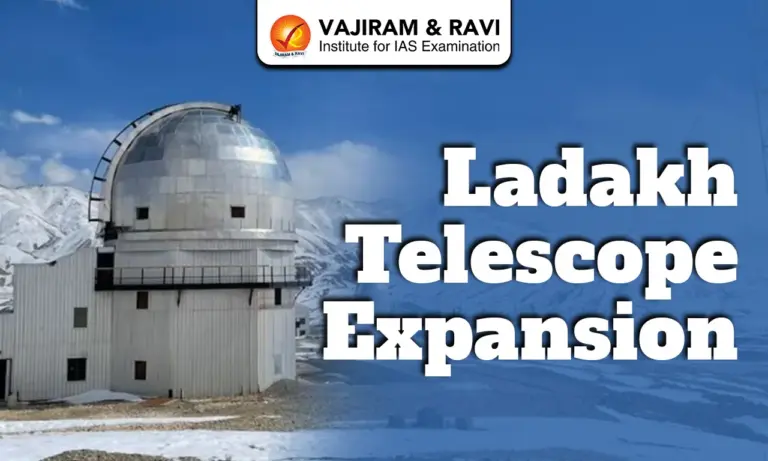
Ladakh Telescope Expansion Latest News
- The Union Budget has approved the establishment of two new telescopes in Ladakh—one to study the Sun and another to explore the origins of the universe—alongside the upgradation of an existing telescope.
- Ladakh, already a key astronomy hub, hosts multiple observatories and includes Hanle, India’s first Dark Sky Reserve, designated to preserve optimal night-sky conditions.
- The move is expected to significantly strengthen India’s observational astronomy capabilities, positioning the country—and the Global South—more prominently in cutting-edge space research and deep-sky exploration.
National Large Solar Telescope (NLST): India’s Next Solar Observatory
- The NLST is a 2-metre aperture solar telescope planned in the Merak region near Pangong Tso in Ladakh.
- It will operate in the visible and near-infrared wavelengths, allowing detailed observation of solar activity from the ground.
- Since different parts of the electromagnetic spectrum behave differently and not all radiation penetrates Earth’s atmosphere, telescopes must be carefully designed based on their observational goals.
Scientific Objectives
- The NLST will enable scientists to study:
- Solar dynamics and magnetism
- Energetic solar events such as flares and eruptions
- Space weather processes affecting Earth
- These studies are crucial for protecting satellites, communication systems, and space missions, as solar disturbances can disrupt national space assets.
Strengthening India’s Solar Research Network
- Once operational—expected within 5–6 years—NLST will become India’s third ground-based solar observatory, joining:
- Kodaikanal Solar Observatory (Tamil Nadu, established 1899)
- Udaipur Solar Observatory (Rajasthan, established 1975)
- It will complement Indian Space Research Organisation (ISRO)’s space-based solar mission, Aditya-L1, launched in 2023.
- Together with Aditya-L1, the NLST will enhance India’s capabilities in heliophysics, reinforcing its position as a significant contributor to global solar research and space-weather forecasting.





National Large Optical–Near Infrared Telescope (NLOT): India’s Giant Eye on the Cosmos
- The NLOT will be a 13.7-metre aperture segmented-mirror telescope built in Hanle, Ladakh.
- Its primary mirror will consist of 90 hexagonal segments, functioning together as a single, large mirror to collect faint cosmic light with high precision.
- Projected to be completed within the next decade, NLOT will rank among the world’s largest optical–infrared telescopes.
Why Ladakh Is Ideal
- Ladakh’s high altitude, cold and dry climate, and clear skies provide near-ideal observing conditions.
- These reduce atmospheric distortion and diffraction, allowing sharper, more accurate astronomical observations compared to many global sites.
Scientific Objectives
- NLOT will enable frontier research in:
- Exoplanet detection
- Stellar and galactic evolution
- Supernovae studies
- Investigating the origins of the universe
- Its optical–infrared capability allows it to observe distant and faint cosmic objects, crucial for deep-space research.
Leveraging Experience from TMT
- India’s participation in the Thirty Meter Telescope (TMT) project strengthens its technical capability. TMT’s 30-metre mirror uses 494 hexagonal segments, and India plays a key role by:
- Designing the Segment Support Assembly
- Supplying 80 hexagonal mirror segments
- This expertise in precision engineering and mirror alignment will ease the construction of NLOT’s complex components.
Upgraded Himalayan Chandra Telescope: Strengthening India’s Transient Astronomy
- Legacy of the Himalayan Chandra Telescope (HCT) – The 2-metre Himalayan Chandra Telescope (HCT) was among the first major observatories established in Ladakh. Over 25 years, it has contributed valuable data, particularly in transient astronomy, studying short-lived cosmic events such as supernovae.
- Major Upgrade: Enhanced Capabilities – The approved upgrade will transform HCT into a 3.7-metre segmented-mirror telescope, operating in the optical–infrared wavelengths. This enhancement will significantly improve its sensitivity and observational power.
Complementing Global Scientific Facilities
- The upgraded HCT will work in synergy with major international projects such as:
- LIGO-India, an Indo-US gravitational-wave observatory coming up in Hingoli, Maharashtra
- Square Kilometre Array, the world’s largest radio telescope project, based in Australia and South Africa
- By coordinating with these facilities, HCT will help identify and study cosmic events detected through gravitational waves and radio signals.
Why the New Telescopes Are Game-Changers for Indian Astronomy
- Unique Geographic Advantage – Both the NLST and the NLOT will be unique in their respective wavelengths at this longitude and region. Their location in Ladakh offers observational windows not fully covered by existing global facilities.
- Unprecedented Scientific Data – The telescopes are expected to generate new, high-quality data that was previously unavailable, strengthening India’s contribution to solar physics, deep-space studies, and cosmology.
- Greater Access to Observation Time – Unlike many international telescopes where observation time is limited and prioritised for partner countries, these facilities will provide Indian scientists with assured and preferential access, boosting domestic research output.
- Global Impact – Together, NLST and NLOT are poised to be transformational projects, enhancing India’s standing in global astronomy while contributing critical insights to the international scientific community.

 Last updated on March, 2026
→ UPSC Final Result 2025 is now out.
→ UPSC has released UPSC Toppers List 2025 with the Civil Services final result on its official website.
→ Anuj Agnihotri secured AIR 1 in the UPSC Civil Services Examination 2025.
→ UPSC Marksheet 2025 is now out.
→ UPSC Notification 2026 & UPSC IFoS Notification 2026 is now out on the official website at upsconline.nic.in.
→ UPSC Calendar 2026 has been released.
→ Check out the latest UPSC Syllabus 2026 here.
→ UPSC Prelims 2026 will be conducted on 24th May, 2026 & UPSC Mains 2026 will be conducted on 21st August 2026.
→ The UPSC Selection Process is of 3 stages-Prelims, Mains and Interview.
→ Prepare effectively with Vajiram & Ravi’s UPSC Prelims Test Series 2026 featuring full-length mock tests, detailed solutions, and performance analysis.
→ Enroll in Vajiram & Ravi’s UPSC Mains Test Series 2026 for structured answer writing practice, expert evaluation, and exam-oriented feedback.
→ Join Vajiram & Ravi’s Best UPSC Mentorship Program for personalized guidance, strategy planning, and one-to-one support from experienced mentors.
→ Shakti Dubey secures AIR 1 in UPSC CSE Exam 2024.
→ Also check Best UPSC Coaching in India
Ladakh Telescope Expansion FAQs
Q1. Why is Ladakh Telescope Expansion in the news?+
Q2. What projects are part of Ladakh Telescope Expansion?+
Q3. How does Ladakh Telescope Expansion strengthen solar research?+
Q4. Why is Hanle crucial for Ladakh Telescope Expansion?+
Q5. What is the global significance of Ladakh Telescope Expansion?+
Tags: Ladakh Telescope Expansion mains articles upsc current affairs upsc mains current affairs