What is a Dark Sky Reserve?
- The International Dark Sky Association (IDSA) defines an international dark sky reserve (IDSR) as “a public or private land of substantial size (at least 700 km², or about 173,000 acres) possessing an exceptional or distinguished quality of starry nights and nocturnal environment, and that is specifically protected for its scientific, natural, educational, cultural heritage, and/or public enjoyment”.
- A dark sky reserve requires a “core” area that has clear sky without any light pollution, which can enable telescopes to see the sky in its natural darkness.
- To support the core, it should be surrounded by a “peripheral” or “buffer” area that supports dark sky values in the core while receiving the same benefits.
How are dark sky reserves identified?
- According to IDSA, it considers land suitable for dark sky sites only if it is on public or private land, is publicly accessible all or part of the year, protected for scientific, natural, educational, cultural, cultural and/or public purposes.
- The central part of the core offers exceptional dark sky resources compared to the communities and cities that surround it, and the core limits the brightness of the night sky to either reserves, parks, or sanctuaries.
- The IDSR also needs to have a comprehensive lighting management plan (LMP) “which should be adopted by a sufficient number of communities within the entire IDSR (core and periphery) corresponding to at least 80 percent of population and 80 percent of designated area of protection”.
- It also needs a description of current and suspected future threats to dark skies over the core zone, and a plan to address these threats.
- This is particularly important as Hanle is particularly close to Chinese territories, which makes it highly sensitive.
- The reserve must also submit a detailed annual report to IDA by October 1 each year.





Why Ladakh?
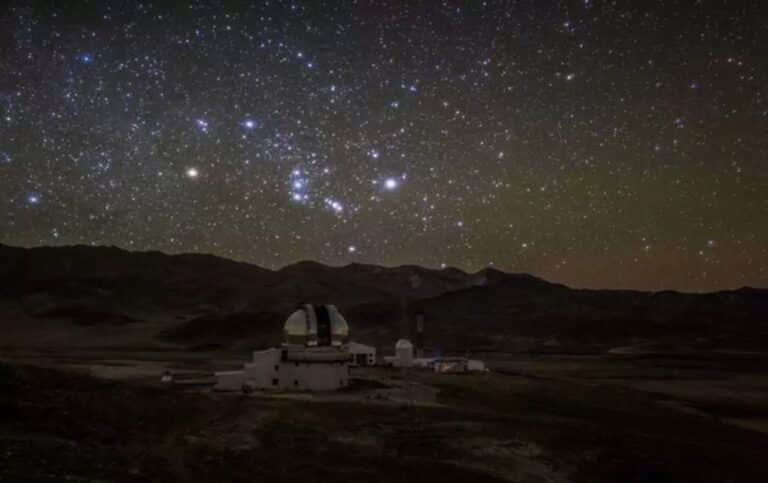
- The Hanle Dark Sky Reserve (HDSR) will come up within the Changthang Wildlife Sanctuary, situated 4,500 metres above sea level, which makes it a perfect host for telescopes.
- Ladakh is also ideal for long-term observatories and dark-sky sites because of its large arid area, high elevation, and sparse population.
- The Milky Way Galaxy is visible through the night in the Hanle region due to its cloudless skies and lower atmospheric disturbance.
- Hanley is home for the second-highest optical telescope in the world, established in 2001 by Indian Institute of Astrophysics.
- The Department of Science and Technology and Indian Institute of Astrophysics (IIA) in Bengaluru are providing support for the facility.
How many such reserves exist in the world?
- A dark sky reserve is only one of the designations given by the IDSA, others being international dark sky parks, communities, reserves, sanctuaries, and urban night sky places.
- At present, there are 20 dark sky reserves around the world, seven in the United Kingdom; four in France; two each in the USA and Germany; and one each in New Zealand, Canada, Namibia, and Australia.
Q1) Which country is the world’s first International dark sky place?
The Pacific Island of Niue is the world’s first whole country to become an International Dark Sky Place which has received formal accreditation from the International Dark-Sky Association (IDA) as an International Dark Sky Sanctuary and International Dark Sky Community, thus covering the whole country with Dark Sky protection and recognition and deeming it a ‘dark sky nation’.
Source: All India Radio

 Last updated on March, 2026
→ UPSC Final Result 2025 is now out.
→ UPSC has released UPSC Toppers List 2025 with the Civil Services final result on its official website.
→ Anuj Agnihotri secured AIR 1 in the UPSC Civil Services Examination 2025.
→ UPSC Marksheet 2025 is now out.
→ UPSC Notification 2026 & UPSC IFoS Notification 2026 is now out on the official website at upsconline.nic.in.
→ UPSC Calendar 2026 has been released.
→ Check out the latest UPSC Syllabus 2026 here.
→ UPSC Prelims 2026 will be conducted on 24th May, 2026 & UPSC Mains 2026 will be conducted on 21st August 2026.
→ The UPSC Selection Process is of 3 stages-Prelims, Mains and Interview.
→ Prepare effectively with Vajiram & Ravi’s UPSC Prelims Test Series 2026 featuring full-length mock tests, detailed solutions, and performance analysis.
→ Enroll in Vajiram & Ravi’s UPSC Mains Test Series 2026 for structured answer writing practice, expert evaluation, and exam-oriented feedback.
→ Join Vajiram & Ravi’s Best UPSC Mentorship Program for personalized guidance, strategy planning, and one-to-one support from experienced mentors.
→ Shakti Dubey secures AIR 1 in UPSC CSE Exam 2024.
→ Also check Best UPSC Coaching in India