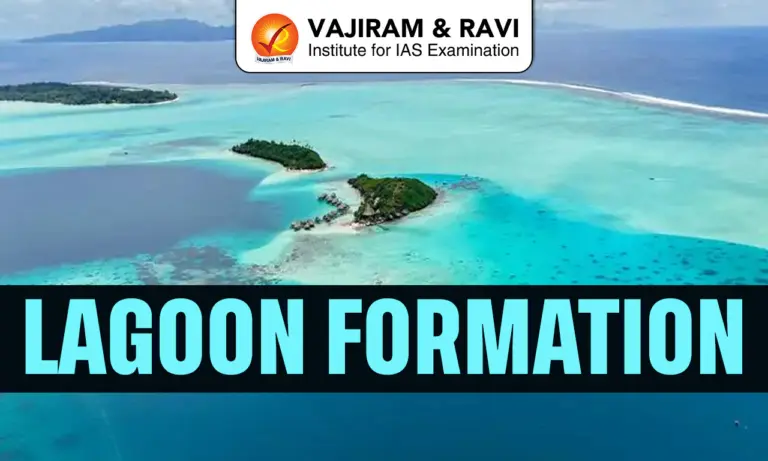
A Lagoon is a shallow water body that forms along coastal areas when a part of the sea becomes separated from the main ocean by natural barriers such as sandbars, barrier islands, or coral reefs. These barriers are created by the continuous action of waves and coastal currents that deposit sand and sediments along the shore. As a result, a water body gets enclosed between the land and the barrier, forming a lagoon. The water in lagoons is usually brackish, as it contains a mixture of sea water and fresh water from nearby rivers or rainfall. Lagoon Formation has been discussed in detail in this article.
Types of Lagoons
Lagoons are generally classified into two main types: atoll lagoons and coastal lagoons.
Atoll Lagoons: An Atoll lagoon forms in tropical oceans when a volcanic island slowly sinks below sea level over a long period of time.
- Coral reefs grow around the island and continue to grow upward even as the island gradually disappears beneath the ocean. Over time, the coral reefs form a circular ring, and the water trapped in the centre of this ring becomes a Lagoon. This process happens very slowly and may take hundreds of thousands of years to develop.
- Many marine species such as fish, jellyfish, and corals live in these lagoons. However, large predators are less common because food sources are limited within the enclosed reef area.
Coastal Lagoons: Coastal lagoons develop along gently sloping coastlines. They are usually shallow and are separated from the sea by features such as sandbars, barrier islands, or reefs. In many cases, these lagoons remain connected to the sea through narrow inlets, allowing exchange of water between the lagoon and the ocean. This creates a brackish ecosystem, which supports rich biodiversity such as fish, birds, and aquatic plants.
- The depth and size of coastal lagoons depend largely on sea level.
- When sea level is low, lagoons may appear like swamps or wetlands.
- When sea level is high, they may resemble bays or coastal lakes.
- These lagoons often support fisheries, tourism, and boating activities, making them economically important.
- Lake Nokoue, is a good example of Coastal Lagoon, where salinity changes seasonally. During the rainy season, freshwater from rivers dominates, while during the dry season seawater increases the salinity.
- Coastal lagoons also serve as natural harbours because they protect boats from strong waves. For example, Lake Piso has been used as a harbour in the past.
Factors Affecting Formation: Several factors influence the formation and development of coastal lagoons, including:
- Sea level changes
- Deposition of sediments by waves and currents
- Tidal range and coastal processes
- Coastal lagoons are generally younger and more dynamic than atoll lagoons. Because they are located close to the shoreline, they may change shape or even disappear over time due to erosion, sediment deposition, and sea-level changes.
Lagoons Formation
A lagoon forms when a shallow part of the sea becomes separated from the open ocean by natural barriers such as sandbars, barrier islands, or coral reefs. Lagoons usually develop along low-energy, gently sloping coasts, where waves and currents slowly deposit sand and other sediments. The formation of lagoons takes place through several coastal processes:
- Barrier Island Formation: Waves and coastal currents carry sand along the shoreline through a process known as longshore drift. Over time, this sand accumulates to form offshore sandbars or barrier islands parallel to the coast. As these barriers grow, they enclose a portion of seawater between the land and the barrier, creating a lagoon.
- Spit Formation: Sometimes, sand spits develop when sediments are deposited in a narrow strip connected to the mainland at one end. As the spit continues to extend across a bay, it may eventually cut off the bay from the open sea, forming a lagoon behind it.
- Coral Reef Growth (Atoll Lagoons): In tropical regions, lagoons may also form inside an Atoll. This happens when coral reefs grow around a volcanic island. Over thousands of years, the volcanic island slowly sinks beneath the ocean, while the coral reefs continue to grow upward. The circular reef surrounds a central water body, which becomes the lagoon.
- Sea-Level Changes: Changes in sea level can also lead to lagoon formation. When sea levels rise, seawater floods low-lying coastal areas, creating shallow bays. Later, waves and sediments build barrier beaches that separate these bays from the open sea, turning them into lagoons.





Some Important Lagoons in India
- Chilika Lake (Odisha): It is the largest coastal lagoon in India and the second largest in the world. It is famous for migratory birds and the endangered Irrawaddy dolphins.
- Pulicat Lake (Andhra Pradesh/Tamil Nadu): It is the second-largest lagoon in India. The lake lies between Andhra Pradesh and Tamil Nadu and is known for the Pulicat Bird Sanctuary.
- Vembanad Lake (Kerala): This lagoon is part of the Kerala backwater system and is the longest lake in India. It supports fishing, tourism, and houseboat activities.
- Kolleru Lake (Andhra Pradesh): Although mainly a freshwater lake, it acts like a lagoon-like wetland between the Krishna and Godavari river deltas and supports rich bird life.
- Ashtamudi Lake (Kerala): It is a palm-shaped lagoon connected to the Arabian Sea and is important for fisheries and inland water transport.
Significance of Lagoons
Lagoons are important natural features found along many coastal regions. They play a significant role in supporting ecosystems, protecting coastlines, and supporting human livelihoods.
- Rich Biodiversity: Lagoons provide habitat for many species of fish, birds, plants, and marine organisms. They often act as nurseries for fish and other aquatic species, making them important for maintaining marine biodiversity.
- Coastal Protection: Lagoons help reduce the impact of strong ocean waves, storms, and coastal erosion. The natural barriers such as sandbars and reefs protect the coastline and nearby settlements.
- Support for Fisheries: Many local communities depend on lagoons for fishing and aquaculture. The calm and nutrient-rich waters support the growth of many commercially important fish and shellfish.
- Economic Importance: Lagoons contribute to tourism and recreation, including activities like boating, bird watching, and water sports. Famous lagoons also attract visitors and support local economies.
- Environmental Importance: Lagoons help in maintaining ecological balance by filtering pollutants, storing nutrients, and supporting wetlands and mangrove ecosystems.
- Climate and Coastal Regulation: Lagoons play a role in coastal climate regulation and groundwater recharge, and they help maintain the stability of coastal ecosystems.

 Last updated on March, 2026
→ UPSC Final Result 2025 is now out.
→ UPSC has released UPSC Toppers List 2025 with the Civil Services final result on its official website.
→ Anuj Agnihotri secured AIR 1 in the UPSC Civil Services Examination 2025.
→ UPSC Marksheet 2025 is now out.
→ UPSC Notification 2026 & UPSC IFoS Notification 2026 is now out on the official website at upsconline.nic.in.
→ UPSC Calendar 2026 has been released.
→ Check out the latest UPSC Syllabus 2026 here.
→ UPSC Prelims 2026 will be conducted on 24th May, 2026 & UPSC Mains 2026 will be conducted on 21st August 2026.
→ The UPSC Selection Process is of 3 stages-Prelims, Mains and Interview.
→ Prepare effectively with Vajiram & Ravi’s UPSC Prelims Test Series 2026 featuring full-length mock tests, detailed solutions, and performance analysis.
→ Enroll in Vajiram & Ravi’s UPSC Mains Test Series 2026 for structured answer writing practice, expert evaluation, and exam-oriented feedback.
→ Join Vajiram & Ravi’s Best UPSC Mentorship Program for personalized guidance, strategy planning, and one-to-one support from experienced mentors.
→ Shakti Dubey secures AIR 1 in UPSC CSE Exam 2024.
→ Also check Best UPSC Coaching in India
Lagoon Formation FAQs
Q1. What is a Lagoon?+
Q2. What are the main types of lagoons?+
Q3. How does an Atoll lagoon form?+
Q4. How are coastal lagoons formed?+
Q5. What factors influence the formation of lagoons?+
Tags: geography geography notes Lagoon Formation