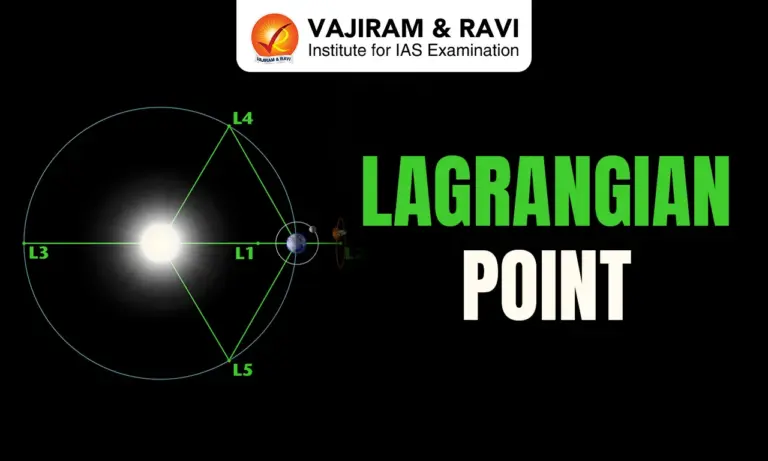
Lagrange Points are special positions in space where objects placed there tend to stay in a stable or nearly stable position. At these points, the gravitational pull of two large bodies, such as the Sun and Earth, balances the centripetal force required for a smaller object to move along with them in orbit.
Because of this balance of forces, spacecraft placed at these points require very little fuel to remain in position, making them extremely useful for satellites, telescopes, and space observatories.
What are Lagrange Points?
Lagrange Points are locations in space where the gravitational forces of a two-body system create regions of enhanced attraction and repulsion. These regions allow a smaller object, such as a satellite, to maintain a constant position relative to the two larger bodies.
The concept was developed in 1772 by the Italian-French mathematician Joseph-Louis Lagrange. In this work, he studied the mathematical problem known as the General Three-Body Problem, which examines how three bodies interact gravitationally in space.
Number of Lagrange Points
In any system of two large celestial bodies, there are five special Lagrange Points where a smaller mass can move in a constant pattern with them. These points are labeled: L1, L2, L3, L4 and L5. Among these five points:
- Three points (L1, L2, L3) are unstable
- Two points (L4, L5) are stable





Lagrange Points Importance
Lagrange Points are extremely important in space exploration because they provide locations where spacecraft can remain in position with very little fuel. These points help scientists observe the Sun, Earth, and deep space continuously without frequent orbital adjustments.
- Spacecraft placed at Lagrange points require less fuel for station-keeping, which increases mission life.
- They provide stable or semi-stable locations for satellites and space observatories.
- L1 helps scientists continuously monitor the Sun and space weather.
- L2 offers an ideal environment for deep space telescopes and astronomical observations.
- L4 and L5 are stable regions where asteroids and cosmic dust can accumulate.
- These points are useful for future space missions, communication satellites, and space stations.
- They allow uninterrupted observation of Earth, the Sun, and distant galaxies.
About Aditya L1 Mission
The Aditya-L1 Mission is India’s first dedicated solar mission launched to study the Sun and its outer atmosphere. It was developed by the Indian Space Research Organisation (ISRO) to observe solar activities such as solar flares, solar wind, and space weather from the L1 Lagrange Point of the Sun–Earth system.
- The mission was launched in September 2023 by the Indian Space Research Organisation.
- It is positioned near the L1 Lagrange Point, about 1.5 million km from Earth.
- The spacecraft continuously observes the solar corona, solar wind, and solar radiation.
- It carries seven scientific payloads to study different layers of the Sun.
- The mission helps scientists predict space weather and solar storms that can affect satellites and communication systems on Earth.
- It provides important data to understand solar heating, magnetic fields, and solar eruptions.

 Last updated on March, 2026
→ UPSC Final Result 2025 is now out.
→ UPSC has released UPSC Toppers List 2025 with the Civil Services final result on its official website.
→ Anuj Agnihotri secured AIR 1 in the UPSC Civil Services Examination 2025.
→ UPSC Marksheet 2025 is now out.
→ UPSC Notification 2026 & UPSC IFoS Notification 2026 is now out on the official website at upsconline.nic.in.
→ UPSC Calendar 2026 has been released.
→ Check out the latest UPSC Syllabus 2026 here.
→ UPSC Prelims 2026 will be conducted on 24th May, 2026 & UPSC Mains 2026 will be conducted on 21st August 2026.
→ The UPSC Selection Process is of 3 stages-Prelims, Mains and Interview.
→ Prepare effectively with Vajiram & Ravi’s UPSC Prelims Test Series 2026 featuring full-length mock tests, detailed solutions, and performance analysis.
→ Enroll in Vajiram & Ravi’s UPSC Mains Test Series 2026 for structured answer writing practice, expert evaluation, and exam-oriented feedback.
→ Join Vajiram & Ravi’s Best UPSC Mentorship Program for personalized guidance, strategy planning, and one-to-one support from experienced mentors.
→ Shakti Dubey secures AIR 1 in UPSC CSE Exam 2024.
→ Also check Best UPSC Coaching in India
Lagrangian Point FAQs
Q1. What is a Lagrangian Point?+
Q2. Who discovered Lagrangian Points?+
Q3. How many Lagrangian Points are there?+
Q4. Which Lagrangian Points are stable?+
Q5. Which space missions use Lagrangian Points?+
Tags: lagrangian point physics