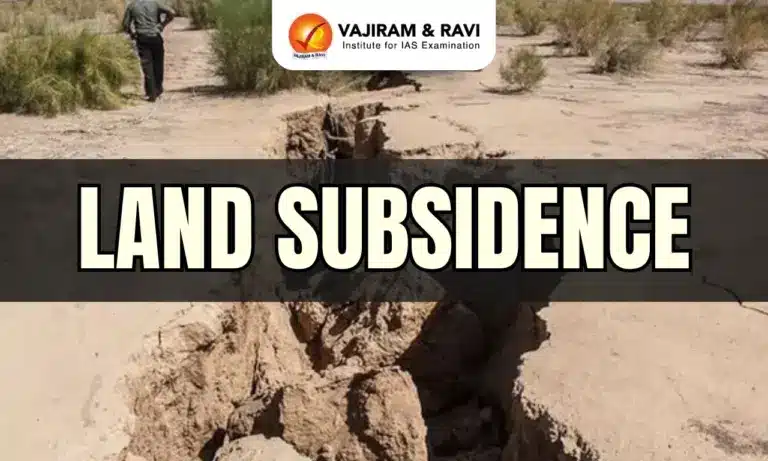
Land Subsidence Latest News
Uttarakhand, already battered by natural calamities including cloudbursts, flash floods, and landslides across its mountainous regions, is now facing a new and terrifying phenomenon: widespread land subsidence in Chamoli’s Nanda Nagar.
About Land Subsidence
- Land subsidence is a gradual settling or sudden sinking of the Earth’s surface.
- This geotechnical phenomenon occurs when the ground loses its ability to support the weight above it, leading to a downward shift.
- It can occur as a result of natural factors (e.g., volcanic or seismic activity, collapse of subsurface cavities, compaction of loose fine-grained deposits) or anthropogenic activities (e.g., excessive groundwater (GW) abstraction, mining, subsurface energy extraction).
- Although it is a gradual process, taking years to decades to develop, land subsidence presents serious socioeconomic, environmental, and security challenges globally.
- Impacts:
- Land subsidence can cause damage to infrastructure and lead to increased flood risks and permanent reduction in aquifers’ storage capacity.
- It can also cause disturbance to water management and possible repercussions such as increased saltwater intrusion as a result of reduction in land elevation and changes in the gradient of streams and drains.
- High maintenance costs for roads, railways, pipelines, and buildings are only a few examples of stresses brought upon by land subsidence.
- Although land subsidence has been historically observed in low deltaic areas or coastal regions, it is being increasingly observed in large inland areas near densely urban, agricultural, and industrial areas with high groundwater demand.
- Excess groundwater extraction is believed to be one of the main causes of large-scale and high-magnitude land subsidence.
- Groundwater overexploitation compacts the underground reservoirs because water is the element partly responsible for holding up the ground.
- The excess water withdrawal leads to compaction of the underlying depleted porous formation, thus inducing land subsidence.
- The total global extent of land surface susceptible to subsidence has been estimated to be 12 million sq.km.
- Land subsidence has been observed all around the world, with major sites in the USA, China, Iran, Indonesia, Taiwan, Vietnam, Egypt, Japan, Mexico, and Italy.
Source: NIE






 Last updated on April, 2026
→ UPSC Final Result 2025 is now out.
→ UPSC has released UPSC Toppers List 2025 with the Civil Services final result on its official website.
→ Anuj Agnihotri secured AIR 1 in the UPSC Civil Services Examination 2025.
→ UPSC Marksheet 2025 is now out.
→ UPSC Notification 2026 & UPSC IFoS Notification 2026 is now out on the official website at upsconline.nic.in.
→ UPSC Calendar 2026 has been released.
→ Check out the latest UPSC Syllabus 2026 here.
→ UPSC Prelims 2026 will be conducted on 24th May, 2026 & UPSC Mains 2026 will be conducted on 21st August 2026.
→ The UPSC Selection Process is of 3 stages-Prelims, Mains and Interview.
→ Prepare effectively with Vajiram & Ravi’s UPSC Prelims Test Series 2026 featuring full-length mock tests, detailed solutions, and performance analysis.
→ Enroll in Vajiram & Ravi’s UPSC Mains Test Series 2026 for structured answer writing practice, expert evaluation, and exam-oriented feedback.
→ Join Vajiram & Ravi’s Best UPSC Mentorship Program for personalized guidance, strategy planning, and one-to-one support from experienced mentors.
→ Shakti Dubey secures AIR 1 in UPSC CSE Exam 2024.
→ Also check Best UPSC Coaching in India
Land Subsidence FAQ's
Q1. What is meant by land subsidence?+
Q2. Which regions have historically been most prone to land subsidence?+
Q3. Which anthropogenic activity is a major cause of land subsidence?+
Tags: land subsidence