Why in news?
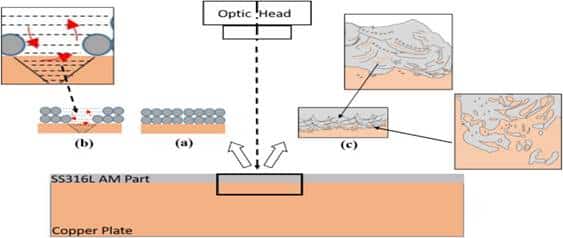
- Researchers have developed a novel bi-metallic joining process to create a bimetallic composite made from copper and steel by using the Laser powder bed fusion (L-PBF) technique.
- One such bimetallic composite, made from copper and steel, has high thermal and electrical conductivity, exceptional corrosion resistance, and mechanical properties.
- The researchers have successfully demonstrated the formation of the interfacial microstructure and bonding mechanism and investigated the reason for achieving a strong interfacial bond.
- Why it is significant? In the world of technological advancements, high-performing and multifunctional structures and components are in great demand.
- To cater to this demand, the development of bimetallic structures has gained significant attention.
What is the powder bed fusion Technique?
- Powder bed fusion (PBF) is a 3D printing method that joins powdered material point by point using an energy source, typically a laser beam or an electron beam.
- It is one of the most common 3D printing techniques used for industrial additive manufacturing (AM).
- PBF is possible with both metals and polymers, although not all materials are compatible.
- Due to the combustible nature of the metal powders, LPBF is usually performed under inert gas such as argon, or under a vacuum.
Q1) What is additive manufacturing?
Additive manufacturing is the process of creating an object by building it one layer at a time. It is the opposite of subtractive manufacturing, in which an object is created by cutting away at a solid block of material until the final product is complete.Technically, additive manufacturing can refer to any process where a product is created by building something up, such as molding, but it typically refers to 3-D printing.






 Last updated on March, 2026
→ UPSC Final Result 2025 is now out.
→ UPSC has released UPSC Toppers List 2025 with the Civil Services final result on its official website.
→ Anuj Agnihotri secured AIR 1 in the UPSC Civil Services Examination 2025.
→ UPSC Marksheet 2025 is now out.
→ UPSC Notification 2026 & UPSC IFoS Notification 2026 is now out on the official website at upsconline.nic.in.
→ UPSC Calendar 2026 has been released.
→ Check out the latest UPSC Syllabus 2026 here.
→ UPSC Prelims 2026 will be conducted on 24th May, 2026 & UPSC Mains 2026 will be conducted on 21st August 2026.
→ The UPSC Selection Process is of 3 stages-Prelims, Mains and Interview.
→ Prepare effectively with Vajiram & Ravi’s UPSC Prelims Test Series 2026 featuring full-length mock tests, detailed solutions, and performance analysis.
→ Enroll in Vajiram & Ravi’s UPSC Mains Test Series 2026 for structured answer writing practice, expert evaluation, and exam-oriented feedback.
→ Join Vajiram & Ravi’s Best UPSC Mentorship Program for personalized guidance, strategy planning, and one-to-one support from experienced mentors.
→ Shakti Dubey secures AIR 1 in UPSC CSE Exam 2024.
→ Also check Best UPSC Coaching in India