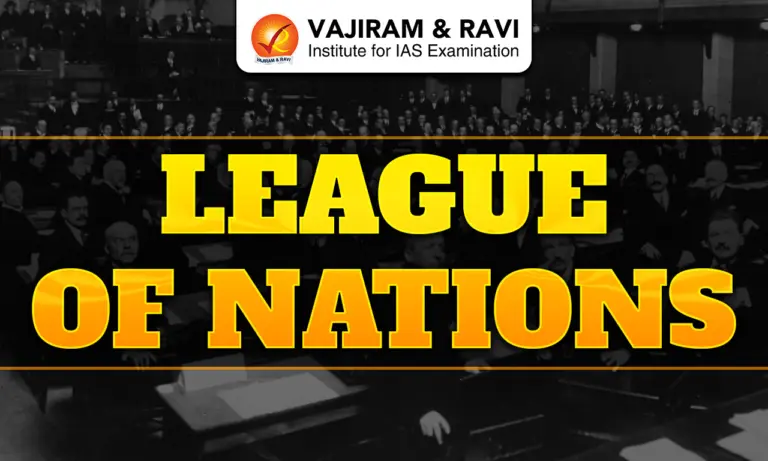
The League of Nations was an international organization established in 1920 after World War I to maintain global peace and prevent future wars. It aimed to resolve disputes through discussion, cooperation, and collective security among nations. Although it achieved success in humanitarian work and settling minor conflicts, it failed to stop major aggression in the 1930s. Its failure eventually led to the creation of the United Nations in 1945.
League of Nations Objectives
The League of Nations was established with the primary goal of ensuring global peace and preventing future wars through cooperation and diplomacy. It aimed to replace military conflict with dialogue and collective action.
- Maintain International Peace and Security: The League sought to prevent wars by resolving disputes peacefully and discouraging aggression through collective security.
- Promote Disarmament: It encouraged countries to reduce their military strength and arms production to minimize the chances of war.
- Peaceful Settlement of Disputes: Nations were urged to settle conflicts through negotiation, arbitration, and legal procedures instead of war.
- Collective Security System: An attack on one member was considered an attack on all, ensuring joint action against aggressors.
- Improve Global Welfare: Focused on better labor conditions, public health, and humanitarian issues through various agencies.
- Supervise Mandated Territories: Managed former colonies of defeated nations until they were ready for self-governance.
League of Nations History
The League of Nations was established in 1920 after the devastation of the World War I as part of the Treaty of Versailles to maintain global peace. It functioned as the first international organization for dispute resolution but declined in the 1930s and was replaced by the United Nations in 1946.
- Establishment (1920): Formally created on 10 January 1920 under the Treaty of Versailles to prevent future wars through collective security.
- Headquarters: Located in Geneva, Switzerland, serving as the center for international diplomacy.
- Initial Membership: Began with 42 founding members and expanded to 58 countries by 19347-35.
- Early Success (1920s): Successfully resolved minor disputes and promoted cooperation in health, labor, and refugee welfare.
- Absence of Major Powers: The United States never joined, weakening its global authority from the beginning.
- Major Crises in the 1930s: Failed to stop aggressive actions such as the Japanese invasion of Manchuria and Italian invasion of Abyssinia.
- Withdrawal of Members: Key countries like Germany and Japan withdrew, further weakening the League.
- Decline and Ineffectiveness: Lack of enforcement power and unity led to failure in preventing global conflicts.
- Dissolution (1946): Officially dissolved after World War II, transferring responsibilities to the United Nations.





League of Nations Structure
The League of Nations had a structured system of institutions to maintain peace and promote cooperation after World War I. It included main organs and specialized agencies that worked together to resolve disputes and address global issues.
- Assembly: Included all member nations, each with one vote, and met annually to discuss global matters.
- Council: Executive body handling peace and security issues, consisting of permanent and non-permanent members.
- Secretariat: Administrative body responsible for daily operations, reports, and coordination.
- Permanent Court of International Justice: Settled legal disputes and provided advisory opinions on international law.
- Health Committee: Worked to control diseases and improve global health conditions.
- Disarmament Commission: Promoted reduction of weapons to prevent future wars.
- Mandates Commission: Supervised former colonies until they were ready for independence.
- Refugee Commission: Assisted refugees and displaced persons with relief and resettlement.
- Slavery Commission: Worked towards ending slavery and human trafficking globally.
Success of the League of Nations
The League of Nations achieved notable success in resolving minor disputes and promoting international cooperation, especially during the 1920s after World War I. Although it failed in preventing major wars, its humanitarian and diplomatic efforts laid the groundwork for the modern United Nations.
- Peaceful Settlement of Disputes: Successfully resolved conflicts like the Aaland Islands dispute between Finland and Sweden and the Upper Silesia dispute between Germany and Poland.
- Prevention of Small Wars: Intervened in conflicts such as the Greece–Bulgaria dispute (1925), preventing escalation into larger wars.
- Humanitarian Work: Helped millions of refugees and prisoners of war return to their home countries and provided relief support.
- Health Improvements: Controlled the spread of deadly diseases like typhus and worked to improve global public health systems.
- Labor Reforms: Improved working conditions, wages, and working hours through international cooperation and standards.
- Control of Slavery and Human Trafficking: Took steps to abolish slavery and reduce exploitation in various parts of the world.
- Management of Mandated Territories: Supervised former colonies of defeated powers and guided them toward self-governance.
- Promotion of International Cooperation: Encouraged dialogue and diplomacy among nations, reducing tensions in many regions.
Failure of the League of Nations
The League of Nations ultimately failed to achieve its main goal of maintaining global peace, especially during the 1930s when aggressive expansion by powerful nations went unchecked. Its weaknesses became evident as it could not prevent the outbreak of World War II, leading to its eventual collapse and replacement by the United Nations.
- Absence of Major Powers: The United States never joined, reducing the League’s authority and global influence from the beginning.
- Lack of Military Power: The League had no independent armed force, so it could not enforce its decisions or take action against aggressor nations.
- Unanimous Decision-Making: Important decisions required agreement from all members, causing delays and weakening effectiveness.
- Failure to Stop Aggression: Could not prevent major events such as:
- Japanese invasion of Manchuria
- Italian invasion of Abyssinia
- Withdrawal of Key Members: Powerful countries like Germany and Japan left the League, weakening its strength.
- Weak Enforcement of Sanctions: Economic sanctions imposed by the League were often ineffective and not strictly followed by member states.
- Dominance of Britain and France: The League was largely controlled by United Kingdom and France, leading to bias and lack of trust among other nations.
- Focus on National Interests: Member countries prioritized their own interests over collective security, reducing cooperation.
- Slow and Inefficient Response: The League often reacted too late to crises, allowing situations to worsen.
- Failure to Prevent Global War: Its inability to control rising militarism and aggression directly contributed to the outbreak of World War II.

 Last updated on April, 2026
→ UPSC Final Result 2025 is now out.
→ UPSC has released UPSC Toppers List 2025 with the Civil Services final result on its official website.
→ Anuj Agnihotri secured AIR 1 in the UPSC Civil Services Examination 2025.
→ UPSC Marksheet 2025 is now out.
→ UPSC Notification 2026 & UPSC IFoS Notification 2026 is now out on the official website at upsconline.nic.in.
→ UPSC Calendar 2026 has been released.
→ Check out the latest UPSC Syllabus 2026 here.
→ UPSC Prelims 2026 will be conducted on 24th May, 2026 & UPSC Mains 2026 will be conducted on 21st August 2026.
→ The UPSC Selection Process is of 3 stages-Prelims, Mains and Interview.
→ Prepare effectively with Vajiram & Ravi’s UPSC Prelims Test Series 2026 featuring full-length mock tests, detailed solutions, and performance analysis.
→ Enroll in Vajiram & Ravi’s UPSC Mains Test Series 2026 for structured answer writing practice, expert evaluation, and exam-oriented feedback.
→ Join Vajiram & Ravi’s Best UPSC Mentorship Program for personalized guidance, strategy planning, and one-to-one support from experienced mentors.
→ Shakti Dubey secures AIR 1 in UPSC CSE Exam 2024.
→ Also check Best UPSC Coaching in India
League of Nations FAQs
Q1. What was the League of Nations?+
Q2. Why was the League of Nations formed?+
Q3. Who proposed the League of Nations?+
Q4. Why did the League of Nations fail?+
Q5. When was the League of Nations established?+
Tags: history history notes league of nations