Marriage is a socially and legally recognized union between two individuals that establishes rights, duties, and responsibilities between them, their families, and society.
Levirate marriage is an ancient social custom practiced in several traditional societies across the world. It mainly aims to provide social security to a widow and ensure continuity of the family lineage. Though the practice has declined in modern times, it still exists in some rural and tribal communities.
What is a Levirate Marriage?
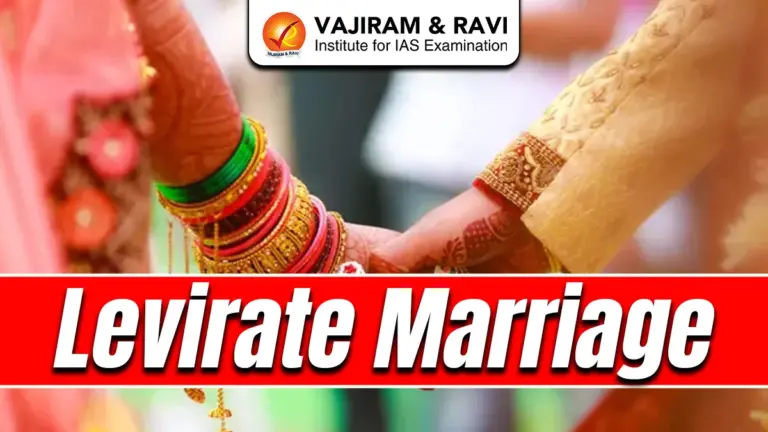
Levirate marriage is a form of marriage in which a widow marries the brother of her deceased husband. The term levirate comes from the Latin word “levir”, meaning husband’s brother.
Features of Levirate Marriage
- The widow marries her late husband’s brother.
- Children born from this marriage are traditionally considered part of the deceased husband’s lineage.
- The practice ensures economic and social protection for the widow.
- It prevents fragmentation of family property and inheritance.
What Are DNA Profiles?
A DNA profile, also known as DNA fingerprinting, is a scientific method used to identify individuals based on their unique genetic makeup. Except for identical twins, every person has a distinct DNA profile.
- DNA is extracted from blood, saliva, hair, or other body tissues.
- It is widely used in forensic science, paternity testing, and criminal investigations.
- DNA profiling helps establish biological relationships between individuals.
- In legal contexts, it plays an important role in inheritance and identity disputes.





Levirate Marriages in India
In India, levirate marriage is traditionally known as “Niyoga” in ancient texts and has been practiced among certain tribal and rural communities.
- Vedic Age: Levirate marriage existed as Niyoga, practiced to continue lineage and secure inheritance, with children considered heirs of the deceased husband.
- Later Vedic Period: The practice began declining due to growing emphasis on monogamy, ritual purity, and ideals of female chastity.
- Gupta Age: Levirate marriage was largely stopped in mainstream society as Smriti texts discouraged Niyoga and widow renunciation was promoted.
- Medieval Period: The practice survived only among certain tribal and lower-caste communities, disappearing from orthodox Hindu society.
Modern India: Levirate marriage is not legally recognized as a custom, occurs rarely and voluntarily in some rural or tribal areas, and is declining due to education and women’s rights.

 Last updated on March, 2026
→ UPSC Final Result 2025 is now out.
→ UPSC has released UPSC Toppers List 2025 with the Civil Services final result on its official website.
→ Anuj Agnihotri secured AIR 1 in the UPSC Civil Services Examination 2025.
→ UPSC Marksheet 2025 is now out.
→ UPSC Notification 2026 & UPSC IFoS Notification 2026 is now out on the official website at upsconline.nic.in.
→ UPSC Calendar 2026 has been released.
→ Check out the latest UPSC Syllabus 2026 here.
→ UPSC Prelims 2026 will be conducted on 24th May, 2026 & UPSC Mains 2026 will be conducted on 21st August 2026.
→ The UPSC Selection Process is of 3 stages-Prelims, Mains and Interview.
→ Prepare effectively with Vajiram & Ravi’s UPSC Prelims Test Series 2026 featuring full-length mock tests, detailed solutions, and performance analysis.
→ Enroll in Vajiram & Ravi’s UPSC Mains Test Series 2026 for structured answer writing practice, expert evaluation, and exam-oriented feedback.
→ Join Vajiram & Ravi’s Best UPSC Mentorship Program for personalized guidance, strategy planning, and one-to-one support from experienced mentors.
→ Shakti Dubey secures AIR 1 in UPSC CSE Exam 2024.
→ Also check Best UPSC Coaching in India
Levirate Marriage FAQs
Q1. What is levirate marriage?+
Q2. What was levirate marriage called in ancient India?+
Q3. Why was levirate marriage practiced?+
Q4. During which period did levirate marriage decline in India?+
Q5. Is levirate marriage legal in India today?+
Tags: levirate marriage