Lichen Latest News
Researchers recently discovered four new lichen species, enhancing biodiversity understanding in the Western Ghats.
Why in News?
- The newly identified species – Parmotrema sahyadricum (discovered from Wayanad), Solenopsora rhizomorpha (from Eravikulam and Mathikettanshola National Parks), Buelloa ghattensis (Mathikettanshola National Park) and Pyxine janakiae (Mathikettanshola National Park) – have been published in international scientific journals.
- The work that started in 2022 resulted in these discoveries.
- The team also recorded more than 50 species of lichens, which are new reports to the Kerala part of the Western Ghats.





About Lichen
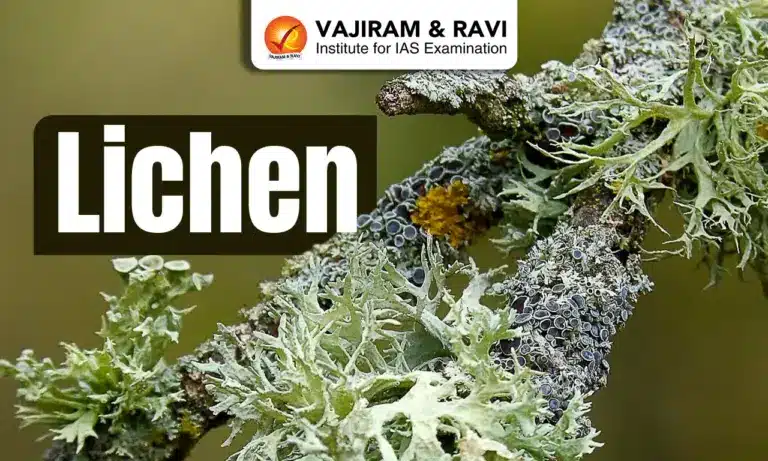
- A lichen is a symbiosis between different organisms — a fungus and an algae or cyanobacterium.
- The basis of their relationship is the mutual benefit that they provide each other.
- The photosynthetic algae or cyanobacteria form simple carbohydrates that, when excreted, are absorbed by fungi cells and transformed into a different carbohydrate.
- They also produce vitamins that the fungi need.
- Fungi contribute to the symbiosis by absorbing water vapour from the air and by providing much-needed shade for the light-sensitive algae beneath.
- The composite body of a lichen is called a thallus (plural thalli); the body is anchored to its substrate by hairlike growths called rhizines.
- Lichens are found worldwide and occur in a variety of environmental conditions.
- A diverse group of organisms, they can colonize a wide range of surfaces and are frequently found on tree bark, exposed rock, and as a part of biological soil crust.
Benefits that Lichen Give to Nature
- They are a keystone species in many ecosystems.
- They serve as a food source and habitat for many animals, such as deer, birds, and rodents.
- They provide nesting materials for birds.
- They protect trees and rocks from extreme elements such as rain, wind, and snow.
- Pioneers of Colonization:
- Lichens are considered as primary colonisers.
- These invade bare areas and contribute to soil formation by breaking down rock minerals both physically and chemically and thus creating conditions for other species such as mosses and liverworts to follow.
Source: TH

 Last updated on April, 2026
→ UPSC Final Result 2025 is now out.
→ UPSC has released UPSC Toppers List 2025 with the Civil Services final result on its official website.
→ Anuj Agnihotri secured AIR 1 in the UPSC Civil Services Examination 2025.
→ UPSC Marksheet 2025 is now out.
→ UPSC Notification 2026 & UPSC IFoS Notification 2026 is now out on the official website at upsconline.nic.in.
→ UPSC Calendar 2026 has been released.
→ Check out the latest UPSC Syllabus 2026 here.
→ UPSC Prelims 2026 will be conducted on 24th May, 2026 & UPSC Mains 2026 will be conducted on 21st August 2026.
→ The UPSC Selection Process is of 3 stages-Prelims, Mains and Interview.
→ Prepare effectively with Vajiram & Ravi’s UPSC Prelims Test Series 2026 featuring full-length mock tests, detailed solutions, and performance analysis.
→ Enroll in Vajiram & Ravi’s UPSC Mains Test Series 2026 for structured answer writing practice, expert evaluation, and exam-oriented feedback.
→ Join Vajiram & Ravi’s Best UPSC Mentorship Program for personalized guidance, strategy planning, and one-to-one support from experienced mentors.
→ Shakti Dubey secures AIR 1 in UPSC CSE Exam 2024.
→ Also check Best UPSC Coaching in India
Lichen FAQs
Q1. A lichen is a symbiotic association between which organisms?+
Q2. In lichens, what is the role of algae or cyanobacteria?+
Q3. In lichens, what is the role of fungi?+
Q4. Why are lichens considered keystone species in many ecosystems?+
Tags: prelims current affairs prelims pointers upsc prelims current affairs