Linguistic Reorganisation of States Latest News
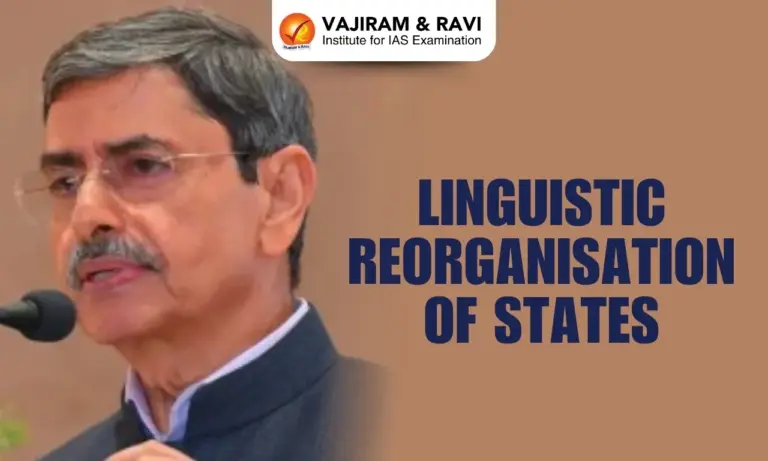
- Tamil Nadu Governor R N Ravi recently sparked controversy by claiming that the linguistic reorganisation of Indian states turned large sections of people into “second-class citizens”.
- Speaking at an event in Gandhinagar, he suggested that the reorganisation, which began within a decade of Independence, undermined national unity.
India’s Political Geography Before Linguistic Reorganisation
- At the time of Independence in 1947, India inherited a complex administrative setup shaped by British colonial rule.
- The British governed India through two parallel systems — direct control in provinces and indirect control over 565 princely states.
- The boundaries drawn were dictated largely by administrative convenience rather than cultural or linguistic coherence.
Four-Part Division under the 1950 Constitution
- When the Constitution came into effect on January 26, 1950, India was described as a “Union of States,” comprising 28 states grouped into four categories:
- Part A States: These included nine former British governor’s provinces like Bombay, Madras, and Uttar Pradesh, each with an elected legislature and a governor.
- Part B States: Comprising eight former princely states or their groupings, these were governed by an elected legislature and a rajpramukh (a governor-like figure), and included states like Hyderabad, Jammu & Kashmir, and Rajasthan.
- Part C States: Ten territories including both former Chief Commissioners’ provinces and some princely states were placed under the direct control of the President through a Chief Commissioner. Examples: Delhi, Himachal Pradesh, and Manipur.
- Part D State: The sole territory under this category was the Andaman and Nicobar Islands, administered by a Lieutenant Governor appointed by the President.





Linguistic Reorganisation of States in 1956
- In 1949, the JVP Committee — comprising Prime Minister Jawaharlal Nehru, Sardar Vallabhbhai Patel, and Congress president Pattabhi Sitaramayya — warned that reorganising states based on language might have disintegrative effects on national unity.
Catalyst: Potti Sriramulu’s Martyrdom
- The turning point came when Potti Sriramulu, a Telugu-speaking Gandhian and former railway engineer, died in December 1952, after a 58-day hunger strike demanding a separate state for Telugu speakers.
- His death triggered widespread protests, forcing PM Nehru to announce the creation of Andhra on December 17, 1952.
- The state was officially formed on October 1, 1953.
Formation of the States Reorganisation Commission (SRC)
- The formation of Andhra Pradesh unleashed a wave of demands for linguistic statehood across India.
- Recognising the complexity of the issue, the Centre established the SRC in December 1953, under the chairmanship of Justice Fazl Ali, to comprehensively examine the matter.
The 1956 Reorganisation
- In its report submitted on September 30, 1955, the SRC acknowledged that the growing importance of regional languages and political awareness made linguistic reorganisation inevitable.
- Following the SRC’s recommendations, the States Reorganisation Act of 1956 was enacted.
- It redrew India’s political map, reducing the existing divisions and reorganising the country into 14 states and six Union Territories, primarily along linguistic lines — marking a turning point in India’s federal structure.
Language Was Not the Sole Criterion for State Reorganisation
- In its December 1953 resolution in Parliament while setting up the SRC, the Centre emphasized that although language and culture reflect a shared way of life in a region, factors such as national unity, security, and administrative, financial, and economic viability were equally critical.
- The final SRC report echoed this balanced approach, stating that relying solely on language or culture was neither possible nor desirable for state reorganisation.
- Despite strong movements for Marathi- and Gujarati-speaking states, the SRC recommended a bilingual Bombay state covering vast linguistic diversity.
- Similarly, it advised against dividing Punjab’s Punjabi- and Hindi-speaking areas.
- During the 1956 debate on the State Reorganisation Bill, Nehru rejected the idea of “unilingualism” as the foundation of India’s federal structure.
- He argued that cooperation among different linguistic groups was essential for India’s survival and progress, urging unity in diversity rather than linguistic separatism.
Linguistic Reorganisation: A Story of Unity, Not Division
- When India undertook the reorganisation of states on linguistic lines, several Western observers predicted it would lead to fragmentation and eventual collapse.
- Many thought this “profusion of tongues” would fuel secessionist impulses and create internal disunity.
- However, India’s experience defied these fears — linguistic states, rather than dividing the country, became tools for integration and administrative efficiency.
Pluralism That Prevented Secessionism
- India’s decision to embrace linguistic pluralism “tamed and domesticated secessionist tendencies.”
- This approach stands in stark contrast to nations like Pakistan and Sri Lanka, where the imposition of a single official language sparked deep divisions and violent conflicts.
ARC Recognised Linguistic Reorganisation as a Milestone
- The Second Administrative Reforms Commission (ARC) in its 2008 report hailed the successful resolution of linguistic conflicts as a major post-independence achievement.
- It observed that linguistic states helped ensure administrative unity and effectiveness.
- Notably, the few major secessionist movements in India — in Nagaland, Punjab, and Kashmir — were based on issues of ethnicity, religion, or territory, not language.
- This demonstrates how linguistic federalism contributed to national cohesion instead of undermining it.
Source: IE

 Last updated on March, 2026
→ UPSC Final Result 2025 is now out.
→ UPSC has released UPSC Toppers List 2025 with the Civil Services final result on its official website.
→ Anuj Agnihotri secured AIR 1 in the UPSC Civil Services Examination 2025.
→ UPSC Marksheet 2025 is now out.
→ UPSC Notification 2026 & UPSC IFoS Notification 2026 is now out on the official website at upsconline.nic.in.
→ UPSC Calendar 2026 has been released.
→ Check out the latest UPSC Syllabus 2026 here.
→ UPSC Prelims 2026 will be conducted on 24th May, 2026 & UPSC Mains 2026 will be conducted on 21st August 2026.
→ The UPSC Selection Process is of 3 stages-Prelims, Mains and Interview.
→ Prepare effectively with Vajiram & Ravi’s UPSC Prelims Test Series 2026 featuring full-length mock tests, detailed solutions, and performance analysis.
→ Enroll in Vajiram & Ravi’s UPSC Mains Test Series 2026 for structured answer writing practice, expert evaluation, and exam-oriented feedback.
→ Join Vajiram & Ravi’s Best UPSC Mentorship Program for personalized guidance, strategy planning, and one-to-one support from experienced mentors.
→ Shakti Dubey secures AIR 1 in UPSC CSE Exam 2024.
→ Also check Best UPSC Coaching in India
Linguistic Reorganisation of States FAQs
Q1. Why was the linguistic reorganisation of states implemented in India?+
Q2. What was the outcome of the States Reorganisation Act, 1956?+
Q3. Was language the sole factor in state reorganisation?+
Q4. What did critics fear about linguistic states?+
Q5. What role did linguistic pluralism play in India’s unity?+
Tags: linguistic reorganisation of states mains articles upsc current affairs upsc mains current affairs