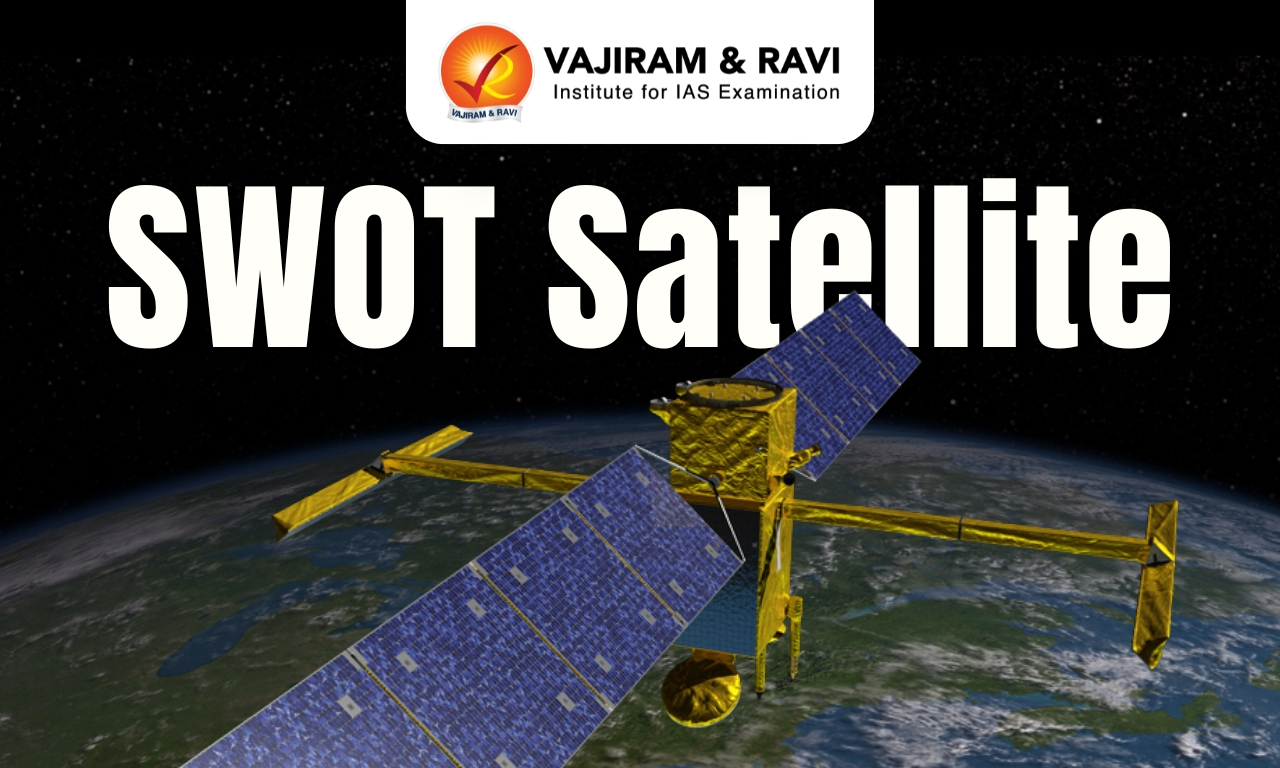
About LISA Mission:
- The Laser Interferometer Space Antenna (Lisa) mission is a collaborative effort between Nasa and the European Space Agency (ESA) set to launch in the mid-2030s.
- The main objective of the mission is to detect and study gravitational waves by putting three spacecrafts into the Earth’s orbit and positioning them in a triangular format with 1.6 million miles on each side.
- It will be the “first gravitational wave detector in space” and will “explore the fundamental nature of gravity and black holes”. It will also probe the rate of expansion of the Universe.
- All three spacecraft will have two telescopes each. The LISA mission will use lasers to detect gravitational waves.
- The LISA mission will comprise three spacecraft. These three spacecraft will fly in a triangular formation behind the Earth as our planet orbits the Sun.
- The spacecraft will sit in a heliocentric orbit, about 50 million km from Earth, with a distance of around 2.5 million km between each spacecraft.
- LISA will detect ripples in spacetime through subtle changes in the distances between free-floating cubes nestled within each spacecraft.
- Changes in the relative distances between these golden cubes will be tracked with extreme accuracy using laser interferometry.
Q1: What are Gravitational waves?
Gravitational waves are distortions in spacetime caused by energetic events involving dense objects with strong gravitational fields. They were first predicted by Albert Einstein’s theory of general relativity. They are weak and interact minimally with matter, allowing them to penetrate cosmic distances undistorted and leaving pristine signatures on source dynamics and local spacetime structure.
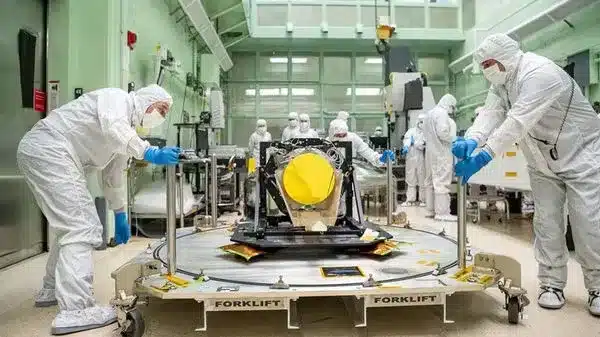
News: Nasa reveals first look at six telescopes tasked with detecting gravitational waves






 Last updated on March, 2026
→ UPSC Final Result 2025 is now out.
→ UPSC has released UPSC Toppers List 2025 with the Civil Services final result on its official website.
→ Anuj Agnihotri secured AIR 1 in the UPSC Civil Services Examination 2025.
→ UPSC Marksheet 2025 is now out.
→ UPSC Notification 2026 & UPSC IFoS Notification 2026 is now out on the official website at upsconline.nic.in.
→ UPSC Calendar 2026 has been released.
→ Check out the latest UPSC Syllabus 2026 here.
→ UPSC Prelims 2026 will be conducted on 24th May, 2026 & UPSC Mains 2026 will be conducted on 21st August 2026.
→ The UPSC Selection Process is of 3 stages-Prelims, Mains and Interview.
→ Prepare effectively with Vajiram & Ravi’s UPSC Prelims Test Series 2026 featuring full-length mock tests, detailed solutions, and performance analysis.
→ Enroll in Vajiram & Ravi’s UPSC Mains Test Series 2026 for structured answer writing practice, expert evaluation, and exam-oriented feedback.
→ Join Vajiram & Ravi’s Best UPSC Mentorship Program for personalized guidance, strategy planning, and one-to-one support from experienced mentors.
→ Shakti Dubey secures AIR 1 in UPSC CSE Exam 2024.
→ Also check Best UPSC Coaching in India