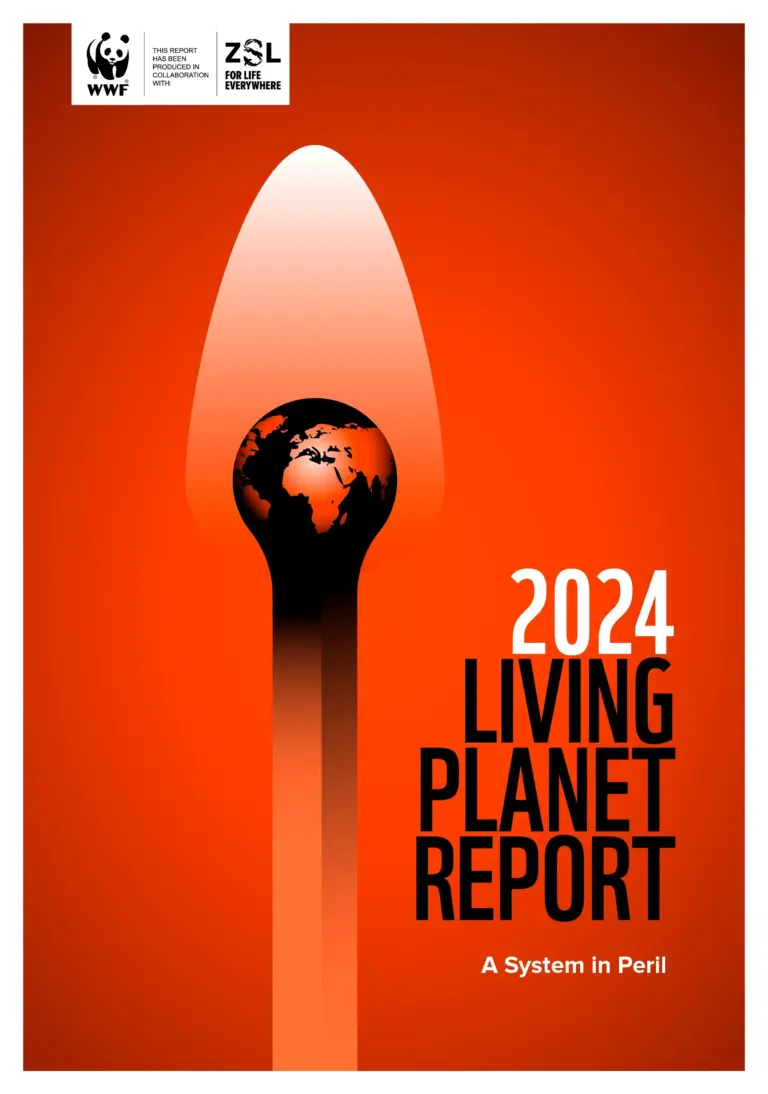
About Living Planet Report:
- It is published biennially by World Wide Fund for Nature (WWF).
- It is a comprehensive study of trends in global biodiversity and the health of the planet.
- The Living Planet Report 2024 is the 15th edition of the report.
- The WWF uses the Living Planet Index (LPI), which tracks the average trends in wildlife populations rather than focusing on increases or declines in individual species numbers.
- By monitoring changes in species population sizes over time, the LPI serves as an early warning indicator of extinction risk and helps assess ecosystem efficiency.
Highlights of the Living Planet Report 2024
- The sharpest decline is reported in freshwater ecosystems at 85%, followed by terrestrial ecosystems at 69% and marine ecosystems at 56%.
- WWF highlighted declines in monitored animal populations around the world as follows
- Latin America and the Caribbean, where populations have dropped by 95 per cent
- Africa: 76 % decline.
- Asia-Pacific region: 60 % decline.
- Central Asia and: 35% decline
- North America: 39 % decline.
- Major threats to wildlife include: Habitat loss, over exploitation, climate change, pollution, invasive species, diseases were the dominant drivers of the decline of wildlife.
- Habitat loss was driven by unsustainable agriculture, fragmentation, logging, mining, to name a few causes.
- Ongoing mass coral reef bleaching, affecting over 75 per cent of the world’s reefs, the Amazon rainforest, the collapse of the subpolar gyre and the melting of the Greenland and West Antarctic ice sheets are all nearing critical tipping points.
- More than half of the United Nations-mandated Sustainable Development Goals for 2030 are unlikely to meet their targets, with 30 percent of them either already missed or worse off than their 2015 baseline.
Q1: What is the mandate of the World Wide Fund for Nature (WWF) ?
It is dedicated to protecting the world’s wildlife by directing its conservation efforts toward protecting endangered spaces and addressing global threats. WWF operates at the forefront of science and policy debates, but also on the frontlines of marine conservation where people’s source of income depends exclusively on there being enough fish in the sea.
Source: Wildlife population declined by 73% in 50 years: WWF report





 Last updated on March, 2026
→ UPSC Final Result 2025 is now out.
→ UPSC has released UPSC Toppers List 2025 with the Civil Services final result on its official website.
→ Anuj Agnihotri secured AIR 1 in the UPSC Civil Services Examination 2025.
→ UPSC Marksheet 2025 is now out.
→ UPSC Notification 2026 & UPSC IFoS Notification 2026 is now out on the official website at upsconline.nic.in.
→ UPSC Calendar 2026 has been released.
→ Check out the latest UPSC Syllabus 2026 here.
→ UPSC Prelims 2026 will be conducted on 24th May, 2026 & UPSC Mains 2026 will be conducted on 21st August 2026.
→ The UPSC Selection Process is of 3 stages-Prelims, Mains and Interview.
→ Prepare effectively with Vajiram & Ravi’s UPSC Prelims Test Series 2026 featuring full-length mock tests, detailed solutions, and performance analysis.
→ Enroll in Vajiram & Ravi’s UPSC Mains Test Series 2026 for structured answer writing practice, expert evaluation, and exam-oriented feedback.
→ Join Vajiram & Ravi’s Best UPSC Mentorship Program for personalized guidance, strategy planning, and one-to-one support from experienced mentors.
→ Shakti Dubey secures AIR 1 in UPSC CSE Exam 2024.
→ Also check Best UPSC Coaching in India