Living Wage Latest News
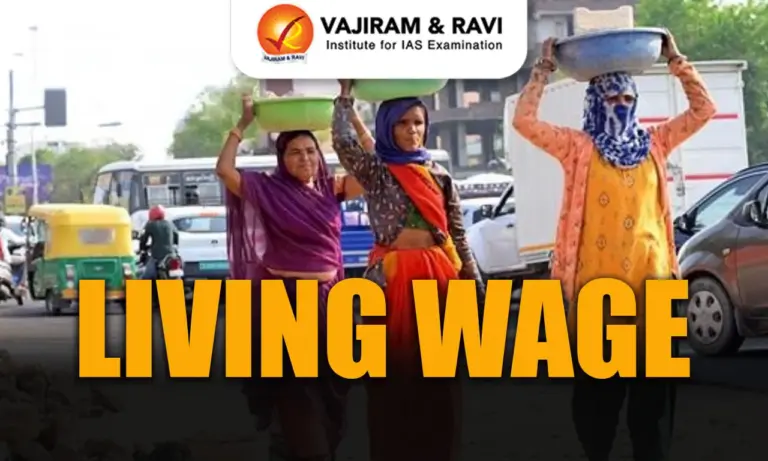
- A new report by Quess Corp and the Udaiti Foundation reveals that over half of blue- and grey-collar women workers in India are dissatisfied with their low wages, with 80% saving less than ₹2,000 per month.
- These inadequate earnings are a key reason why many women leave formal employment, especially when weighed against the high opportunity costs of working.
- The report highlights a significant gap between the minimum wage and the actual “living wage” needed to cover essential expenses like health and education.
- Recognising this, the Labour Ministry is now considering the inclusion of these costs in wage standards to make formal work more viable for women.
Living Wages
- A living wage is the minimum income necessary for a worker to meet their basic needs such as food, housing, clothing, healthcare, education, and some level of financial security.
- Unlike minimum wages, which are set by law and often do not account for actual living costs, living wages are calculated based on the cost of living in a specific region.
- Living wages ensure that workers and their families can live with dignity without falling into poverty.





Low Pay and High Costs Forcing Women Out of Workforce
- A recent survey by Quess Corp reveals that blue- and grey-collar women workers earn only 70% of what their male counterparts make.
- Blue- and grey-collar women workers are women employed in roles traditionally considered manual labor or technical/skilled trades, respectively.
- Blue-collar work often involves physical labor, while grey-collar jobs require specialized skills and may involve a combination of physical and intellectual tasks.
- Coupled with high opportunity costs such as unpaid caregiving, long commutes, and migration expenses, many women struggle to remain in formal employment.
- The study highlights that women in peri-urban manufacturing zones often face lower minimum wages despite higher living costs.
- Notably, one in five women earn less than ₹20,000 per month, the typical minimum wage in Tier 1 cities.
- The data also shows that women earning above ₹20,000 are 21% less likely to exit the workforce soon, indicating that better pay significantly improves retention.
Government Explores Expanding Minimum Wage Definition to Support Women
- The government is considering broadening the definition of minimum wage to include expenses on health and education—currently excluded from wage calculations.
- Presently, the minimum wage is based only on nutrition, housing, and clothing.
- From a women’s perspective, including childcare and healthcare costs would help reduce the opportunity cost of working.
- Experts acknowledged the challenge of implementing this in a diverse country like India, where conditions vary by state, and stressed the importance of initiating a social dialogue with both employers and employees.
- While the move is still in early stages, she welcomed the fact that discussions have begun.
Beyond Wages: Structural Barriers Hindering Women’s Workforce Participation
- While implementing living wage standards would benefit all workers, the impact on women could be especially transformative due to their higher opportunity costs.
- India’s female labour force participation rate (LFPR) remains low at 32%, compared to 77.1% for men, as per the June PLFS data.
- Economists argue that raising women’s LFPR above 50% is essential for India to reach developed nation status.
- However, women face multiple challenges beyond wages, including unsafe or unaffordable housing, poor work culture, limited mobility, and regulatory restrictions.
- Experts noted that 54 existing laws restrict women’s employment, such as those banning night shifts.
- While these are being gradually repealed, they highlighted that responsibility for women’s safety—especially during night shifts—then falls on employers, a burden more easily borne by large firms than small businesses.
- Addressing these layered barriers is critical to enabling more women to join and remain in the workforce.
Manufacturing Hubs Boost Women’s Employment Opportunities
- States with strong industrial and manufacturing bases, such as Tamil Nadu, Karnataka, and Maharashtra, are leading in female workforce participation.
- Modern electronics and auto manufacturing units in these states are increasingly employing women due to their skills in finger dexterity and hand-eye coordination—qualities that are tested and found more often in women.
- As a result, sectors like electronics and automotive manufacturing are actively seeking female workers.

 Last updated on March, 2026
→ UPSC Final Result 2025 is now out.
→ UPSC has released UPSC Toppers List 2025 with the Civil Services final result on its official website.
→ Anuj Agnihotri secured AIR 1 in the UPSC Civil Services Examination 2025.
→ UPSC Marksheet 2025 is now out.
→ UPSC Notification 2026 & UPSC IFoS Notification 2026 is now out on the official website at upsconline.nic.in.
→ UPSC Calendar 2026 has been released.
→ Check out the latest UPSC Syllabus 2026 here.
→ UPSC Prelims 2026 will be conducted on 24th May, 2026 & UPSC Mains 2026 will be conducted on 21st August 2026.
→ The UPSC Selection Process is of 3 stages-Prelims, Mains and Interview.
→ Prepare effectively with Vajiram & Ravi’s UPSC Prelims Test Series 2026 featuring full-length mock tests, detailed solutions, and performance analysis.
→ Enroll in Vajiram & Ravi’s UPSC Mains Test Series 2026 for structured answer writing practice, expert evaluation, and exam-oriented feedback.
→ Join Vajiram & Ravi’s Best UPSC Mentorship Program for personalized guidance, strategy planning, and one-to-one support from experienced mentors.
→ Shakti Dubey secures AIR 1 in UPSC CSE Exam 2024.
→ Also check Best UPSC Coaching in India
Living Wage FAQs
Q1. What is a living wage?+
Q2. Why are women exiting the workforce?+
Q3. How is the government responding?+
Q4. What are the opportunity costs for women?+
Q5. Which states lead in employing women?+
Tags: living wage mains articles upsc current affairs upsc mains current affairs