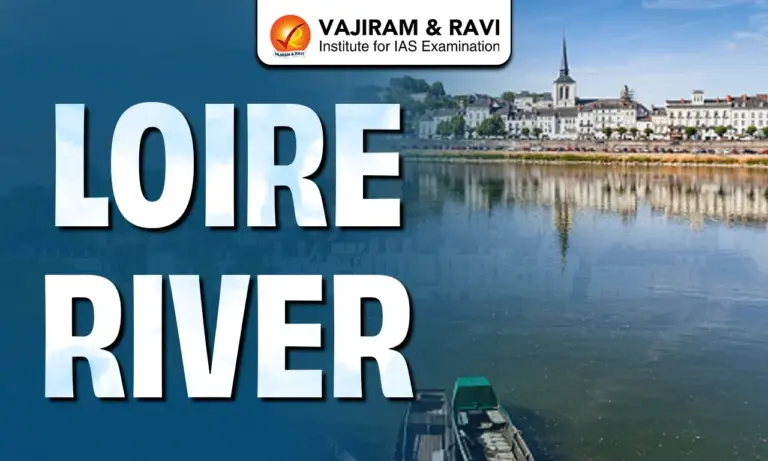
The Loire River is the longest river in France and one of the most geographically and ecologically significant river systems in Western Europe. Stretching across diverse landscapes, it has shaped human settlement, trade, biodiversity and culture for thousands of years. It flows entirely within France and links the Massif Central highlands to the Atlantic Ocean. The river supports agriculture, forests, wetlands and historic towns. Its largely free flowing nature makes it unique among major European rivers. The Loire basin covers more than one-fifth of France’s land area.
Loire River
The Loire River is 1,006 kilometres long, making it the longest river in France and the 171st longest river in the world. It originates at about 1,350 to 1,408 metres above sea level near Mont Gerbier de Jonc in the Cévennes range of the Massif Central. From there, it flows north through central France and then west, finally entering the Atlantic Ocean at the Bay of Biscay near Saint-Nazaire. The river drains an area of about 117,054 square kilometres, yet its average discharge of around 863 cubic metres per second is relatively modest compared to the Rhône.
Also Read: Danube River
Loire River Features
The Loire River displays remarkable physical diversity from source to sea, shaped by geology, climate, tributaries and human interaction.
- Length: The Loire flows for 1,006 km and drains 117,054 km², covering over 20 percent of France’s land surface.
- Source: It rises from multiple springs near Mont Gerbier de Jonc at over 1,350 m elevation, initially forming small converging streams.
- Flow Direction: The river flows northward through Roanne and Nevers, then turns westward at Orléans toward Tours and Nantes.
- River Zones: It is divided into Upper Loire, Middle Loire and Lower Loire, each with distinct valley width, flow speed and land use.
- Tributaries: Major tributaries include the Allier at 410 km, Vienne at 372 km, Cher at 367 km and Indre at 287 km.
- Alluvial Plains: The middle course features broad alluvial plains with sandbanks, islands and braided channels formed by sediment deposition.
- Discharge: Average discharge is about 350 m³/s at Orléans and nearly 900 m³/s at the river mouth near Saint-Nazaire.
- Dams: Only a few dams, including Villerest and Grangent, regulate flow, preserving much of the river’s natural dynamics.
- Estuary Formation: Near Nantes, the river forms a 60 km long tidal estuary with wetlands, mudflats and saline influenced habitats.
Also Read: Bharathapuzha River





Loire River Biodiversity
The Loire River supports one of the richest freshwater ecosystems in France due to its free flowing character and habitat diversity.
- Phytoplankton Diversity: Over 100 algae species occur, dominated by diatoms and green algae, with highest diversity near Orléans.
- Fish Species Richness: Around 57 freshwater fish species from 20 families inhabit the basin, including migratory and resident species.
- Migratory Fish: Atlantic salmon, sea trout, shad, sea lamprey and European eel migrate upstream for spawning.
- Salmon Decline and Recovery: Atlantic salmon numbers dropped from about 100,000 in the 19th century to below 100 in the 1990s.
- Restoration: Conservation efforts increased salmon populations to around 500 individuals by 2005 after dam removal and restocking.
- Endangered Species: Threatened fish include European grayling, burbot and bitterling, sensitive to habitat loss and pollution.
- Amphibian Habitat: Floodplains and oxbow lakes support frogs, toads, salamanders and newts such as Triturus marmoratus.
- Bird Diversity: About 164 bird species, nearly 64 percent of France’s nesting birds, use Loire habitats for breeding or migration.
- Wetland: Lower Loire wetlands provide critical stopover sites for migratory birds along Atlantic flyways.
- Forest and Riparian Flora: Oak, beech, pine, willow and alder forests stabilize banks and support complex food webs.
Also Read: Tamraparni River
Loire River Challenges
Despite its ecological value, the Loire River faces multiple environmental and human induced pressures.
- Flood Risk: Seasonal floods, especially in late winter, threaten towns despite historic dike systems built between the 12th and 19th centuries.
- Low Summer Flows: Discharge can fall below 10 m³/s near Orléans in late summer, stressing aquatic life.
- Climate Change: Increased drought frequency, as seen in 2022, has dried sections of the river, affecting navigation and ecosystems.
- Industrial Pressure: Ports, oil refineries and nuclear power plants near the lower Loire impact water quality and thermal balance.
- Habitat Fragmentation: Past dam construction reduced spawning grounds, especially for salmon and pike.
- Pollution Sources: Agricultural runoff, urban wastewater and industrial effluents degrade water quality in some stretches.
- Navigation Modifications: Groynes and embankments alter sediment transport and channel structure in navigable sections.
- Wetland Loss: Drainage of oxbows and marshes has reduced natural flood buffers and biodiversity hotspots.
- Conservation Conflicts: Proposals for large dams historically clashed with environmental protection goals.
- Management Complexity: Balancing flood control, biodiversity conservation, navigation and regional development remains a major challenge.

 Last updated on April, 2026
→ UPSC Final Result 2025 is now out.
→ UPSC has released UPSC Toppers List 2025 with the Civil Services final result on its official website.
→ Anuj Agnihotri secured AIR 1 in the UPSC Civil Services Examination 2025.
→ UPSC Marksheet 2025 is now out.
→ UPSC Notification 2026 & UPSC IFoS Notification 2026 is now out on the official website at upsconline.nic.in.
→ UPSC Calendar 2026 has been released.
→ Check out the latest UPSC Syllabus 2026 here.
→ UPSC Prelims 2026 will be conducted on 24th May, 2026 & UPSC Mains 2026 will be conducted on 21st August 2026.
→ The UPSC Selection Process is of 3 stages-Prelims, Mains and Interview.
→ Prepare effectively with Vajiram & Ravi’s UPSC Prelims Test Series 2026 featuring full-length mock tests, detailed solutions, and performance analysis.
→ Enroll in Vajiram & Ravi’s UPSC Mains Test Series 2026 for structured answer writing practice, expert evaluation, and exam-oriented feedback.
→ Join Vajiram & Ravi’s Best UPSC Mentorship Program for personalized guidance, strategy planning, and one-to-one support from experienced mentors.
→ Shakti Dubey secures AIR 1 in UPSC CSE Exam 2024.
→ Also check Best UPSC Coaching in India
Loire River FAQs
Q1. Where does the Loire River originate and end?+
Q2. What is the length of the Loire River?+
Q3. What are the main environmental challenges of the Loire River?+
Q4. Which major cities are located along the Loire River?+
Q5. Why was the Loire Valley designated as a UNESCO World Heritage Site?+
Tags: geography loire river