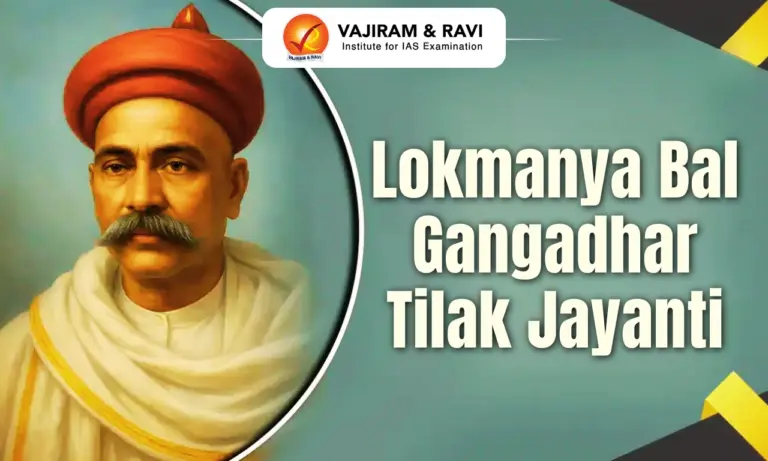
Lokmanya Bal Gangadhar Tilak Jayanti is observed annually on 23 July to mark the birth anniversary of Bal Gangadhar Tilak. The Lokmanya Bal Gangadhar Tilak Jayanti 2026 marks the 170th Jayanti of Lokmanya Bal Gangadhar Tilak, who was born on 23 July 1856. A lawyer, scholar, journalist, and pioneering nationalist leader, Tilak played a decisive role in transforming Indian nationalism from an elite political movement into a broader movement of public mobilisation.
Lokmanya Bal Gangadhar Tilak Early Life and Education
Bal Gangadhar Tilak’s early life and education shaped his later commitment to national education, intellectual awakening and political activism.
- Born as Keshav Gangadhar Tilak on 23 July 1856 in Ratnagiri, Maharashtra, he belonged to a Chitpavan Brahmin family.
- His father, Gangadhar Ramachandra Tilak, was a teacher and Sanskrit scholar, which exposed him to education and classical Indian learning from an early age.
- After completing his early education in Ratnagiri, he moved to Pune for higher studies.
- He graduated in Mathematics from Deccan College, Pune, in 1877 and later obtained a Law degree from Government Law College, Bombay, in 1879.
- His education in modern subjects, combined with his deep engagement with Indian history, Sanskrit and philosophy, shaped his later ideas on national awakening and self-rule.
- Tilak considered education essential for developing political consciousness and national self-confidence.
- Bal Gangadhar Tilak, along with Gopal Ganesh Agarkar and Vishnushastri Chiplunkar, established the New English School in Pune in 1880 and the Deccan Education Society in 1884.
- The initiative sought to provide modern education while cultivating intellectual and national consciousness among Indians.
Lokmanya Bal Gangadhar Tilak and Assertive Nationalism
Tilak emerged as one of the leading voices of the Assertive Nationalist or Extremist faction within the Indian National Congress.
- He joined the Indian National Congress in 1890 and gradually moved from demands for limited reforms towards an unequivocal demand for Swaraj.
- Along with Lala Lajpat Rai and Bipin Chandra Pal, he formed the famous Lal-Bal-Pal leadership of assertive nationalism.
- Their political programme emphasised Swaraj, Swadeshi, Boycott and National Education.
- In 1896, he organised a campaign in Maharashtra to boycott foreign cloth in protest against an excise duty imposed on cotton.
- He promoted Swadeshi and Boycott as instruments of economic resistance and argued that Swadeshi and nationalism were inseparable.
The growing differences between the Moderates and Assertive Nationalists culminated in the Surat Split (1907)
Cultural Mobilisation
- In 1893, he popularised the community celebration of Ganesh Utsav, turning it into a platform for public mobilisation, patriotic songs, and nationalist messaging.
- In 1896, he started the Shivaji Festival to inspire nationalist ideas through historical memory of resistance to foreign rule.
These initiatives helped widen political participation beyond the educated elite.


Lokmanya Bal Gangadhar Tilak Key Works and Nationalist Journalism
Lokmanya Bal Gangadhar Tilak was not only a political leader but also a scholar and prolific writer. Key Works of Lokmanya Bal Gangadhar Tilak include:
- The Orion: Or Researches into the Antiquity of the Vedas (1893) – examined the antiquity of the Vedas through astronomical references.
- The Arctic Home in the Vedas (1903) – presented his theory regarding the ancient homeland of the Vedic people.
- Gita Rahasya (1915) – written during his imprisonment in Mandalay and interpreted the Bhagavad Gita through the philosophy of Karma Yoga and active duty.
Lokmanya Bal Gangadhar Tilak Nationalist Journalism
Lokmanya Bal Gangadhar Tilak also used the press to transform political criticism into a tool of mass political education and anti-colonial mobilisation.
- In 1881, he founded Kesari in Marathi and the Mahratta in English to highlight public grievances, criticise colonial policies and spread nationalist consciousness.
- Kesari addressed the Marathi-speaking public, while The Mahratta carried nationalist arguments to a wider English-reading audience.
Sedition Trials and Imprisonment
- In 1897 he was charged with sedition over articles in Kesari alleged to incite disaffection against the government; sentenced to 18 months’ imprisonment. He was defended by D.D. Davar.
- Following the Muzaffarpur bomb incident in 1908 involving revolutionaries Khudiram Bose and Prafulla Chaki, Tilak published a strong defence of the revolutionaries in Kesari and was arrested on sedition charges. He was defended by M.A. Jinnah; bail was refused, and he was sentenced to six years imprisonment at Mandalay, Burma. Notably, Justice D.D. Davar, who presided over this case, had defended Tilak in his 1897 trial.
- In 1908 (July), a sedition charge was brought over his writings in Kesari alleging incitement of disloyalty toward the government. Tilak declined legal representation and argued his own defence, forcefully challenging the charge of sedition itself.
- He was released from Mandalay in 1914 and returned to active political life
Lokmanya Bal Gangadhar Tilak and Home Rule Movement
After his release from Mandalay in 1914, Tilak rejoined active politics and organised the demand for self-government.
- In April 1916, he established the Indian Home Rule League at Belagavi (then Belgaum), with G.S. Khaparde among his close associates.
- His League operated mainly across Maharashtra, Karnataka, Berar, and the Central Provinces, while Annie Besant ran a separate, parallel Home Rule League focused on other regions of the country.
- The League used public meetings, lectures, and pamphlets in multiple Indian languages to popularise the demand for self-government, building an extensive organisational network that mobilised thousands.
- It is at Belgaum in 1916 that Tilak is believed to have given his famous call: “Swaraj is my birthright, and I shall have it!”
- Tilak also contributed to a phase of wider political cooperation within the national movement.
- The Lucknow Pact of 1916 brought the Indian National Congress and the All-India Muslim League onto a common political platform.
- The agreement reflected direct cooperation between Tilak and Muhammad Ali Jinnah, strengthening the joint demand for greater Indian participation in governance.
Social Reform Debates
Tilak’s political legacy also involved significant, and contested, debates on social reform.
- He opposed the Age of Consent Bill, which sought to raise the age of consent for girls, arguing against colonial intervention in Hindu social practices.
- He has attracted criticism for giving the freedom struggle a communal shade in places, and for his conservative positions on women’s emancipation and caste reform.
Lokmanya Bal Gangadhar Tilak Role in Freedom Struggle
Lokmanya Bal Gangadhar Tilak transformed Indian nationalism from elite political petitioning into a broader movement of public mobilisation by combining political assertion with cultural awakening, economic resistance and organised nationalism.
- Political Nationalism: Made Swaraj a central political objective and popularised self-government as a right rather than a colonial concession.
- Mass Mobilisation: Used public festivals and cultural symbols to expand nationalist participation beyond the educated elite.
- Economic Nationalism: Promoted Swadeshi and Boycott as instruments of resistance to colonial economic domination.
- Nationalist Journalism: Used Kesari and The Mahratta to spread political consciousness and challenge colonial policies.
- National Education: Promoted education as a means of developing intellectual independence and national self-confidence.
- Assertive Nationalism: Strengthened the demand for direct political action through the Lal-Bal-Pal leadership and the Assertive Nationalist phase of Congress politics.
- Home Rule: Organised public support for self-government through the Home Rule League.
- National Unity: Contributed to Congress-Muslim League cooperation through the Lucknow Pact of 1916.
Lokmanya Bal Gangadhar Tilak Legacy and Significance
Lokmanya Bal Gangadhar Tilak’s legacy extended beyond his role as a political leader and freedom fighter.
- The title “Lokmanya”, meaning “accepted by the people as their leader”, reflected his immense popular influence.
- Mahatma Gandhi described him as the “Maker of Modern India” and praised his consistent advocacy of Swaraj.
- Jawaharlal Nehru described him as the “Father of the Indian Revolution”.
- He combined education, journalism, cultural mobilisation, economic nationalism and political organisation to build public consciousness for self-rule.
- He passed away on 1 August 1920 in Bombay, at a crucial phase of transition in India’s freedom struggle.

 Last updated on Oct, 2026
→ UPSC 2027 Notification will be released on 13 January 2027 at upsconline.nic.in.
→ Check Nobel Prize 2026 Winners List here.
→ Download PIB PRiSM Monthly Magazine 2026 here.
→ Check UPSC Monthly Current Affairs Magazine The Recitals here.
→ Check out the latest UPSC Syllabus here.
→ Download UPSC Model Answers for Mains 2026
→ UPSC Mains Question Paper 2026 is out now for Essay & GS Paper 1, 2, 3 & 4.
→ UPSC Calendar 2027 has been released.
→ Enroll in Vajiram & Ravi’s UPSC Mains Test Series 2027 for structured answer writing practice, expert evaluation, and exam-oriented feedback.
→ Join Vajiram & Ravi’s UPSC Mentorship Program 2027 for personalized guidance, strategy planning, and one-to-one support from experienced mentors.
→ Go through the UPSC Mains Previous Year Papers to enhance your preparation.
→ UPSC has released UPSC Toppers List 2025 with the Civil Services final result on its official website.
→ Also check Best UPSC Coaching in India
Lokmanya Bal Gangadhar Tilak Jayanti 2026 FAQs
Q1. When is Lokmanya Bal Gangadhar Tilak Jayanti observed?+
Q2. What are the major works of Lokmanya Bal Gangadhar Tilak?+
Q3. When and where did Lokmanya Bal Gangadhar Tilak establish the Home Rule League?+
Q4. Which newspapers were founded by Lokmanya Bal Gangadhar Tilak?+
Q5. What was the contribution of Lokmanya Bal Gangadhar Tilak to India’s freedom struggle?+
Tags: lokmanya bal gangadhar tilak jayanti 2026