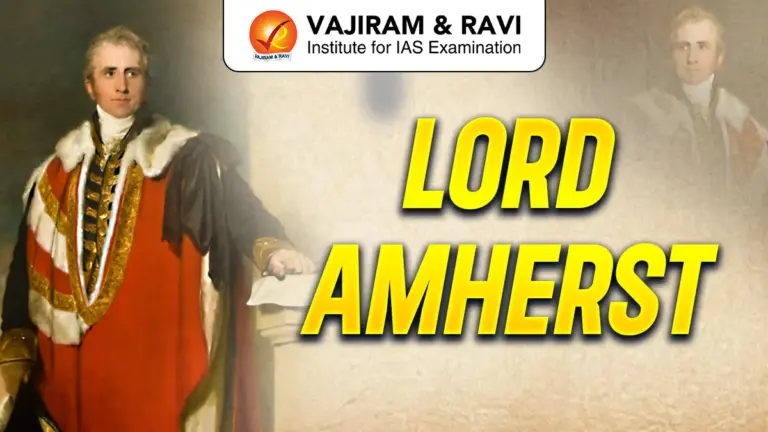
William Pitt Amherst, 1st Earl Amherst, was a British diplomat and colonial administrator. Lord Amherst served as Governor General of India from 1823 to 1828. His tenure marked a decisive phase of British territorial expansion in eastern India and Burma. He is known earlier for his failed diplomatic mission to China in 1816, Amherst entered Indian administration during a fragile period of border tensions, military unrest and imperial consolidation.
Lord Amherst Biography
Lord Amherst was born on 14 January 1773 at Bath, Somerset, into an aristocratic British family and was closely related to General Jeffrey Amherst. Educated at Christ Church, Oxford, he earned his BA in 1793 and MA in 1797. He succeeded to the Amherst title through a special remainder in 1797. Before India, he served as ambassador extraordinary to Qing China in 1816, where diplomatic failure shaped his cautious yet consequential colonial career. After retirement, Amherst lived in England until his death at Knole House, Kent, in 1857 at the age of 84, closing a career marked by diplomacy and war.
Read about: Lord Northbrook
Lord Amherst Contributions
Lord Amherst’s administration reshaped British India’s eastern frontier through war, annexation and institutional development, leaving lasting political, economic and administrative impacts.
- Territorial Expansion in Eastern India: His decisions led to British acquisition of Assam, Arakan and Tenasserim. By policies initiated under Amherst, British control extended over Cachar in 1832 and Upper Assam in 1833.
- Economic Impact on British India: The annexation of Assam during his tenure directly enabled the expansion of tea cultivation, later making India a global tea producer.
- Educational Development: Amherst sanctioned the establishment of Sanskrit College in Calcutta in 1824, supporting classical Indian learning under colonial administration.
- Administrative Precedents: He became the first Governor General to spend summers in Shimla in 1827, setting a precedent for future colonial governance practices.
- Recognition: In 1826, during his tenure, he was elevated to Earl Amherst of Arracan, reflecting imperial approval despite heavy war costs.





Events during Lord Amherst
Major Political, Social and Military events that occurred during the tenure of Lord Amherst have been listed below:
- Anglo-Burmese Border Conflict: Violence erupted on 24 September 1823 along the Naaf River due to Burmese incursions, compelling Amherst to deploy troops to defend British claims.
- The First Anglo-Burmese War 1824-26 lasted two years, involved land and naval campaigns and cost Britain nearly 13 million pounds, triggering financial strain in India.
- The Treaty of Yandaboo 1826 concluded the war and forced Burma to pay one million pounds sterling, accept British diplomatic presence and surrender territories of Arakan, Tenasserim, Assam and Manipur, ending its influence over eastern Bengal frontiers.
- Barrackpore Mutiny 1824: Sepoys of the Bengal Army revolted over forced sea travel to Rangoon, violating the Kaala Pani taboo, combined with grievances over pay and logistics.
- The mutiny was led by sepoy Binda, who expelled British officers from Barrackpore cantonment before being captured and executed as a warning example.
- British troops killed nearly 200 Indian sepoys during the suppression, reinforcing military discipline through extreme punitive measures.
- The execution of Binda left a lasting memory, commemorated today by the Binda Baba Temple at Barrackpore, marking early resistance to colonial authority.
Administrative Transition: Amherst left India in 1828, succeeded temporarily by William Butterworth Bayley and permanently by Lord William Bentinck, signaling a shift toward reformist governance.

 Last updated on March, 2026
→ UPSC Final Result 2025 is now out.
→ UPSC has released UPSC Toppers List 2025 with the Civil Services final result on its official website.
→ Anuj Agnihotri secured AIR 1 in the UPSC Civil Services Examination 2025.
→ UPSC Marksheet 2025 is now out.
→ UPSC Notification 2026 & UPSC IFoS Notification 2026 is now out on the official website at upsconline.nic.in.
→ UPSC Calendar 2026 has been released.
→ Check out the latest UPSC Syllabus 2026 here.
→ UPSC Prelims 2026 will be conducted on 24th May, 2026 & UPSC Mains 2026 will be conducted on 21st August 2026.
→ The UPSC Selection Process is of 3 stages-Prelims, Mains and Interview.
→ Prepare effectively with Vajiram & Ravi’s UPSC Prelims Test Series 2026 featuring full-length mock tests, detailed solutions, and performance analysis.
→ Enroll in Vajiram & Ravi’s UPSC Mains Test Series 2026 for structured answer writing practice, expert evaluation, and exam-oriented feedback.
→ Join Vajiram & Ravi’s Best UPSC Mentorship Program for personalized guidance, strategy planning, and one-to-one support from experienced mentors.
→ Shakti Dubey secures AIR 1 in UPSC CSE Exam 2024.
→ Also check Best UPSC Coaching in India
Lord Amherst FAQs
Q1. Who was Lord Amherst?+
Q2. Why is Lord Amherst historically important?+
Q3. What major war took place during Lord Amherst’s tenure?+
Q4. Which regions were annexed under Lord Amherst?+
Q5. What was the Barrackpore Mutiny of 1824?+
Tags: lord amherst