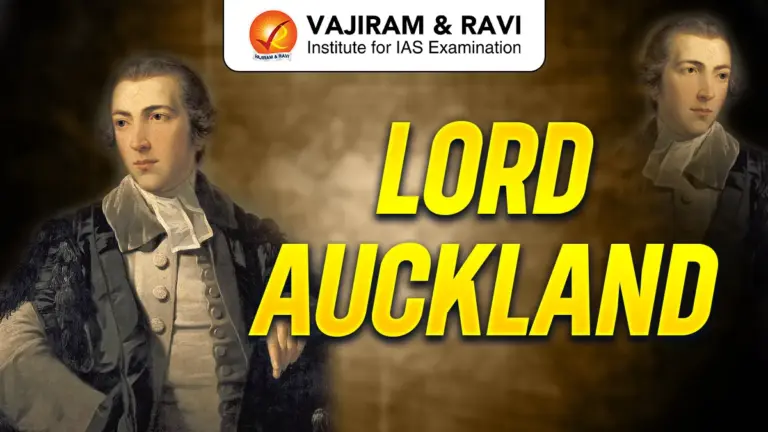
Lord Auckland was formally known as George Eden, 1st Earl of Auckland. He served as the Governor General of India from 1836 to 1842. This period was marked by ambitious diplomacy and severe strategic failures. His tenure is most remembered for the First Anglo Afghan War, which badly damaged British military prestige in India. Although Auckland aimed to secure India’s North-Western Frontier against Russian influence. He contributed meaningfully to education, irrigation and administrative reforms.
Lord Auckland Biography
Lord Auckland was born on 25 August 1784 in Kent, England. He was educated at Eton and Christ Church, Oxford, before joining Lincoln’s Inn in 1809. He inherited his father’s baronies in 1814 and became an influential Whig politician. Before his arrival in India, he served as President of the Board of Trade and thrice as First Lord of the Admiralty. Auckland was appointed as the Governor General of India in 1836 by Lord Melbourne. He governed until 1842, followed by his death on 1 January 1849.
Read about: Lord Northbrook
Lord Auckland Contributions
Lord Auckland’s administration focused on internal development, education reform and economic growth, even while foreign policy failures overshadowed his achievements. His major works included:
- Educational Reforms: Auckland promoted native education by supporting vernacular languages in schools, expanding professional training and funding both Oriental and English institutions equally to widen access to modern knowledge.
- Lord Auckland Minute on Education 1839: His education minute endorsed a balanced approach, combining European knowledge with traditional learning, encouraging translations into local languages and preparation of vernacular textbooks.
- Commercial Expansion: Auckland worked to expand India’s commercial economy by encouraging trade, improving port administration and supporting policies that linked Indian markets with Central Asia.
- Irrigation and Famine Relief: He supported irrigation expansion and early famine relief measures, believing agricultural stability was essential for economic security and revenue generation in British India.
- Administrative Stability: Despite foreign setbacks, his civil administration remained efficient and senior officials like John Russell Colvin rose under his patronage, strengthening provincial governance structures.





Events during Lord Auckland Tenure
These events defined Auckland’s rule, especially his Afghan policy, which reshaped British strategic thinking in Central Asia.
Anglo Russian Tension
Rising rivalry between Britain and Russia directly shaped Auckland’s Afghan decisions.
- Afghanistan lay between expanding Russian influence and British India, making it the focal point of geopolitical rivalry known as the “Great Game”.
- Russia’s victories in multiple Russo-Persian wars strengthened British fears of a possible overland invasion route into India via Persia and Afghanistan.
- Auckland’s policy was driven by intelligence reports exaggerating Russian presence, pushing him toward pre-emptive intervention in Afghan affairs.
Anglo Afghan War
Auckland viewed Afghanistan as essential to protect British India. Following the Forward Policy, he believed that control over Kabul would block Russian or Persian advances through Central Asia .
- Dost Mohammad sought British support to reclaim Peshawar from Sikh ruler Maharaja Ranjit Singh, placing Auckland in a diplomatic dilemma due to Anglo Sikh friendship.
- Simla Manifesto (1838): Auckland formally announced British intervention in Afghanistan, declaring Dost Mohammad unfit to rule and justifying military action to restore Shah Shuja.
- The First Anglo Afghan War (1838 to 1842) started with the declaration by Auckland.
- British forces captured Kabul and Kandahar by 1839, temporarily restoring Shah Shuja and earning Auckland the title of Earl of Auckland.
- Afghan resistance, harsh winters and poor strategy led to the death or capture of nearly 5,000 British and Indian soldiers during the Kabul retreat of 1841.
- Prominent officials like Alexander Burnes, Sir William Macnaghten and General Elphinstone were killed.
- Britain was forced to recognise Dost Mohammad again as Emir of Afghanistan, ending the war in humiliation and heavy financial loss amounting to crores of rupees.
Treaties
Treaties during Auckland’s rule shaped alliances but also limited diplomatic flexibility.
- Treaty of Lahore: This Anglo Sikh treaty was based on mutual non interference and cooperation, ensuring Sikh support against common enemies and securing British north-western interests. The alliance rested on the principle of “enemy’s enemy is friend” and remained stable until Maharaja Ranjit Singh’s death in 1839.
- Tripartite Treaty (1838): Signed by Lord Auckland, Shah Shuja and Ranjit Singh, it aimed to restore Shah Shuja with British and Sikh military assistance. Shah Shuja recognised Sikh claims over Peshawar and surrendered claims to Sind, while British forces controlled Afghan foreign policy indirectly.

 Last updated on March, 2026
→ UPSC Final Result 2025 is now out.
→ UPSC has released UPSC Toppers List 2025 with the Civil Services final result on its official website.
→ Anuj Agnihotri secured AIR 1 in the UPSC Civil Services Examination 2025.
→ UPSC Marksheet 2025 is now out.
→ UPSC Notification 2026 & UPSC IFoS Notification 2026 is now out on the official website at upsconline.nic.in.
→ UPSC Calendar 2026 has been released.
→ Check out the latest UPSC Syllabus 2026 here.
→ UPSC Prelims 2026 will be conducted on 24th May, 2026 & UPSC Mains 2026 will be conducted on 21st August 2026.
→ The UPSC Selection Process is of 3 stages-Prelims, Mains and Interview.
→ Prepare effectively with Vajiram & Ravi’s UPSC Prelims Test Series 2026 featuring full-length mock tests, detailed solutions, and performance analysis.
→ Enroll in Vajiram & Ravi’s UPSC Mains Test Series 2026 for structured answer writing practice, expert evaluation, and exam-oriented feedback.
→ Join Vajiram & Ravi’s Best UPSC Mentorship Program for personalized guidance, strategy planning, and one-to-one support from experienced mentors.
→ Shakti Dubey secures AIR 1 in UPSC CSE Exam 2024.
→ Also check Best UPSC Coaching in India
Lord Auckland FAQs
Q1. Who was Lord Auckland?+
Q2. What was the outcome of the First Anglo Afghan War under Lord Auckland?+
Q3. What was Lord Auckland’s Forward Policy?+
Q4. What were Lord Auckland’s contributions to Indian Education?+
Q5. Who succeeded Lord Auckland as Governor General of India?+
Tags: lord auckland