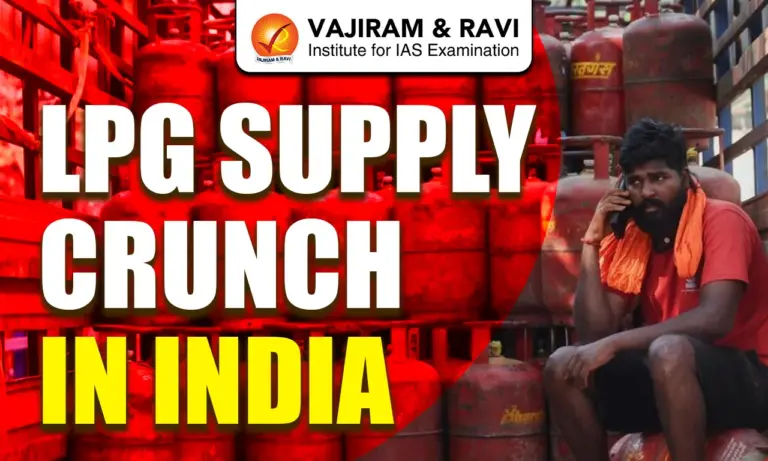
LPG Supply Crunch in India Latest News
- India is facing an LPG supply shortage as the country significantly expanded LPG consumption—especially among poorer households—primarily through increased imports without building adequate long-term storage reserves.
- With over 85% of LPG imports passing through the Strait of Hormuz, disruptions have quickly affected supply due to limited backup storage.
- Unlike crude oil, where India maintains strategic reserves covering about two months of consumption, the LPG system is designed mainly for continuous operational flow rather than stockpiling, which the International Energy Agency (IEA) has identified as a major infrastructure weakness.
Rising LPG Imports in India
- India’s LPG imports have increased threefold, rising to about 20 million tonnes between 2011–12 and 2024–25, with imports now meeting around 60% of domestic demand.
- Import dependency has increased from 47% in 2015 to current levels.
- India consumes about 3 million tonnes of LPG per month, making it the second-largest LPG consumer globally.
- However, existing storage facilities can meet less than half of the monthly requirement, with most storage located in import terminal tanks such as Ennore.





Inadequate Strategic Reserves
- India has only two underground LPG storage caverns at Mangaluru and Visakhapatnam, with a combined capacity of 1.4 lakh tonnes, equivalent to less than two days of national consumption.
- The Mangaluru cavern, with 80,000 tonnes capacity, equals roughly one day’s consumption.
Growth in Domestic LPG Consumption
- India’s daily LPG consumption is about 80,000 tonnes, with over 85% used by households.
- The country has 33 crore domestic LPG connections, including around 10 crore added since 2017 under the Pradhan Mantri Ujjwala Yojana (PMUY).
Role of the Ujjwala Scheme
- The PMUY scheme expanded LPG access to poor households by providing deposit-free connections and subsidies, helping shift from traditional fuels like firewood and kerosene.
- However, it also contributed to the rapid increase in LPG consumption and import dependence.
Import Diversification Efforts
- India has signed an agreement with the United States to import 2.2 million tonnes of LPG annually.
- However, shipments from the U.S. take about 45 days to arrive, compared to much faster supplies from the Persian Gulf region.
Underground Caverns as a Storage Solution
- Expanding underground gas storage caverns is considered a potential solution to India’s LPG supply vulnerability.
- Such facilities allow countries to store large volumes of gas and ensure supply security during disruptions.
Global Practices in Gas Storage
- In Europe, underground gas storage plays a major role in energy security.
- The region can store about 25% of its annual gas consumption, and its underground storage capacity equals around 150% of annual LNG import volumes.
- Following the Ukraine war in 2022, the European Union mandated that storage facilities should reach 90% filling levels before winter to avoid supply shortages.
Geological Zones Suitable for Storage in India
- The Peninsular Shield, covering much of southern India, is the most suitable geological zone for underground storage.
- It consists of stable granite and gneiss formations, which already host the LPG caverns at Visakhapatnam and Mangaluru.
- These caverns use proven engineering techniques and demonstrate that the rock formations are suitable for storage.
Deccan Traps
- The Deccan Traps, a large basalt plateau across western and central India, present more engineering challenges for cavern construction.
- Projects designed by Engineers India Limited (EIL) have faced difficulties due to geological conditions.
Salt Caverns in Rajasthan
- The Bikaner–Barmer salt formations in Rajasthan offer another promising option. Salt caverns are cheaper, quicker to build, naturally impermeable, and allow rapid gas injection and withdrawal.
- EIL has partnered with Germany’s DEEP to develop technology for such storage.
Depleted Gas Reservoirs
- Another potential option under study is the use of depleted gas reservoirs in the Krishna–Godavari, Cambay, and Mumbai offshore basins for underground gas storage.
Conclusion
- Developing underground storage caverns across suitable geological zones could significantly strengthen India’s LPG storage capacity and improve energy security against supply disruptions.
Source: TH

 Last updated on March, 2026
→ UPSC Final Result 2025 is now out.
→ UPSC has released UPSC Toppers List 2025 with the Civil Services final result on its official website.
→ Anuj Agnihotri secured AIR 1 in the UPSC Civil Services Examination 2025.
→ UPSC Marksheet 2025 is now out.
→ UPSC Notification 2026 & UPSC IFoS Notification 2026 is now out on the official website at upsconline.nic.in.
→ UPSC Calendar 2026 has been released.
→ Check out the latest UPSC Syllabus 2026 here.
→ UPSC Prelims 2026 will be conducted on 24th May, 2026 & UPSC Mains 2026 will be conducted on 21st August 2026.
→ The UPSC Selection Process is of 3 stages-Prelims, Mains and Interview.
→ Prepare effectively with Vajiram & Ravi’s UPSC Prelims Test Series 2026 featuring full-length mock tests, detailed solutions, and performance analysis.
→ Enroll in Vajiram & Ravi’s UPSC Mains Test Series 2026 for structured answer writing practice, expert evaluation, and exam-oriented feedback.
→ Join Vajiram & Ravi’s Best UPSC Mentorship Program for personalized guidance, strategy planning, and one-to-one support from experienced mentors.
→ Shakti Dubey secures AIR 1 in UPSC CSE Exam 2024.
→ Also check Best UPSC Coaching in India
LPG Supply Crunch in India FAQs
Q1. Why is an LPG supply crunch in India becoming a concern?+
Q2. How dependent is India on LPG imports?+
Q3. Why is the Strait of Hormuz important for LPG supply to India?+
Q4. What is the main infrastructure weakness in India’s LPG system?+
Q5. What solutions can address the LPG supply crunch in India?+
Tags: LPG Supply Crunch in India mains articles upsc current affairs upsc mains current affairs