Lysosomal Storage Disorders Latest News
Researchers from medical and research institutions across six states and two union territories have compiled the first government-supported national biobank of a sub-section of rare diseases called Lysosomal Storage Disorders (LSDs).
About Lysosomal Storage Disorders
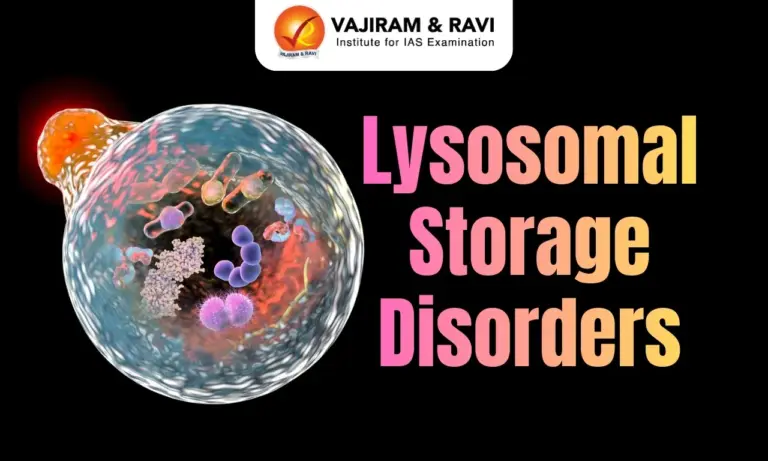
- Lysosomal storage diseases or disorders (LSDs) are rare genetic conditions that cause a buildup of toxic materials in your body’s cells.
- Examples: Gaucher, Pompe, Fabry, MPS I, MPS II, mucopolysaccharidoses, mucolipidoses, oligosaccharidoses, etc.
- LSDs cause a buildup of toxic materials in the body’s cells.
- The majority of the LSDs are caused by mutations in the genes encoding a lysosomal enzyme.
- A lysosome is a membrane-bound cell organelle that contains digestive enzymes.
- Lysosomes are involved with various cell processes. They break down excess or worn-out cell parts.
- People with LSDs lack certain enzymesor a substance that helps the enzyme work (enzyme activator or modifier). Enzymes assist your cells’ lysosomes with metabolism.
- Without functioning enzymes, your body can’t break down fats, sugars and other substances.
- If those build up in your body, they can be harmful. They cause dysfunction of those organs where they accumulate and contribute to great morbidity and mortality.
- All LSDs except Hunter syndrome (MPS II) and Fabry disease are autosomal recessive disorders. This means both parents must carry the abnormal gene that prevents the body from making an enzyme with normal activity.
- LSDs usually appear during pregnancy or soon after birth and rarely, adults may develop LSDs.





Treatment for Lysosomal Storage Disorders
- There are no cures for lysosomal storage diseases.
- But treatments can help you to manage your symptoms and lessen damage to organs and tissues.
Source: IE

 Last updated on April, 2026
→ UPSC Final Result 2025 is now out.
→ UPSC has released UPSC Toppers List 2025 with the Civil Services final result on its official website.
→ Anuj Agnihotri secured AIR 1 in the UPSC Civil Services Examination 2025.
→ UPSC Marksheet 2025 is now out.
→ UPSC Notification 2026 & UPSC IFoS Notification 2026 is now out on the official website at upsconline.nic.in.
→ UPSC Calendar 2026 has been released.
→ Check out the latest UPSC Syllabus 2026 here.
→ UPSC Prelims 2026 will be conducted on 24th May, 2026 & UPSC Mains 2026 will be conducted on 21st August 2026.
→ The UPSC Selection Process is of 3 stages-Prelims, Mains and Interview.
→ Prepare effectively with Vajiram & Ravi’s UPSC Prelims Test Series 2026 featuring full-length mock tests, detailed solutions, and performance analysis.
→ Enroll in Vajiram & Ravi’s UPSC Mains Test Series 2026 for structured answer writing practice, expert evaluation, and exam-oriented feedback.
→ Join Vajiram & Ravi’s Best UPSC Mentorship Program for personalized guidance, strategy planning, and one-to-one support from experienced mentors.
→ Shakti Dubey secures AIR 1 in UPSC CSE Exam 2024.
→ Also check Best UPSC Coaching in India
Lysosomal Storage Disorders FAQs
Q1. What are Lysosomal Storage Disorders (LSDs)?+
Q2. Which process is disrupted in LSDs?+
Tags: lysosomal storage disorders prelims pointers upsc current affairs upsc prelims current affairs