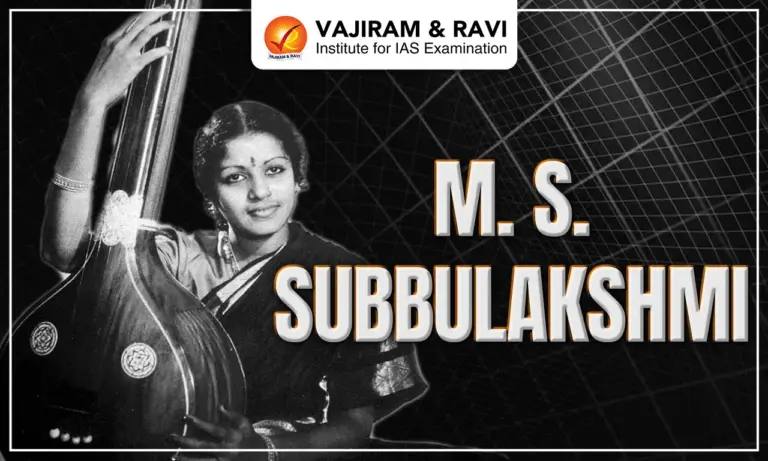
M. S. Subbulakshmi, often called the “Queen of Carnatic Music,” was one of India’s most revered classical singers. Born on 16 September 1916 in Madurai, Tamil Nadu, she became the first musician ever to receive the Bharat Ratna. Her voice represented devotion, purity, and cultural depth, making her not just an artist but a global ambassador of Indian music. Her contribution to Carnatic music, social causes, and India’s cultural diplomacy remains unmatched even decades after her passing.
M. S. Subbulakshmi
Madurai Shanmukhavadivu Subbulakshmi, known as M. S. Subbulakshmi, began her musical journey under her mother, Shanmukhavadivu Ammal, a veena player. She gave her first public performance at Kumbakonam in 1929, at the age of thirteen. Her deep, resonant voice and emotional depth soon drew attention across South India. She broke gender barriers in classical music, earning the title of “Kunjamma” among admirers. Subbulakshmi’s concerts combined technical perfection with spiritual devotion, spreading Indian music to international stages including the United Nations in 1966.
Read About: Atal Bihari Vajpayee
M. S. Subbulakshmi Early Life
Born into a family rooted in musical tradition, M. S. Subbulakshmi’s early exposure to Carnatic music shaped her artistic foundation. Her mother’s veena performances often inspired her. Despite limited formal education, her musical education was intensive and guided by masters like Semmangudi Srinivasa Iyer and Ariyakudi Ramanuja Iyengar. Her early recordings for His Master’s Voice (HMV) label gained immense popularity. By her teenage years, she was performing alongside leading male musicians, uncommon for women of her time, marking the start of her revolutionary journey in Indian classical music.





M. S. Subbulakshmi Rise to Fame
M. S. Subbulakshmi’s rise to fame was gradual yet steady. Her performances at the Madras Music Academy in the 1930s established her as a musical prodigy. She was renowned for her renditions of kritis by Tyagaraja, Muthuswami Dikshitar, and Syama Sastri. Her ability to convey complex ragas with clarity and devotion earned her national recognition. She also ventured into cinema briefly, starring in films like Sevasadanam (1938) and Meera (1945). The film Meera, based on the life of saint-poet Meera Bai, showcased her devotional singing and brought her nationwide fame, making her the musical voice of India’s spiritual renaissance.
M. S. Subbulakshmi Contributions
M. S. Subbulakshmi’s music transcended entertainment; it became a form of spiritual expression and cultural identity. Her concerts were known for their devotional intensity and technical precision. Key contributions include:
- Popularizing Carnatic Music Worldwide- Her performances at the UN General Assembly (1966), Edinburgh Festival, and Carnegie Hall introduced global audiences to Indian classical music.
- Devotional Recordings- Her renditions of the Venkatesa Suprabhatam, Bhajagovindam, and Vishnu Sahasranamam remain benchmarks in devotional music.
- Cultural Diplomacy- She served as India’s cultural ambassador, blending artistry with national representation.
- Preservation of Tradition- By adhering to classic compositions while maintaining emotional sincerity, she ensured the timelessness of Carnatic tradition.
M. S. Subbulakshmi Awards and Recognition
M. S. Subbulakshmi received numerous national and international honors recognizing her unparalleled contribution to music and society. She was the first musician to receive the Bharat Ratna (1998). Earlier, she was honored with the Padma Bhushan (1954), Padma Vibhushan (1975), and Ramon Magsaysay Award (1974) for Public Service, making her the first Indian musician to win it. She also received the Sangeet Natak Akademi Award (1956) and Sangeetha Kalanidhi (1968) from the Madras Music Academy. UNESCO and international universities also recognized her role in promoting India’s musical heritage.
M. S. Subbulakshmi Social Works
Beyond music, Subbulakshmi was deeply committed to philanthropy and social welfare. She performed countless charity concerts to raise funds for causes like education, healthcare, and women’s welfare. Some notable contributions include:
- Donated concert earnings to the Prime Minister’s National Relief Fund and Tirupati Devasthanam.
- Supported Ramakrishna Mission, Bharat Seva Samaj, and Indira Gandhi Memorial Trust.
- Helped establish educational initiatives for underprivileged children in Tamil Nadu.
Her humility and service-oriented approach reflected her belief that music should serve humanity, a philosophy rooted in her devotion and compassion.
M. S. Subbulakshmi International Recognition
Subbulakshmi’s contribution extended beyond India. She was invited by U Thant, the then UN Secretary-General, to perform at the United Nations General Assembly in 1966, where she sang compositions in Sanskrit and regional Indian languages, earning global acclaim. Her performances abroad, particularly in London, New York, Moscow, and Tokyo, showcased the richness of Indian classical traditions. The United States Congress also recognized her for strengthening cultural ties between India and the world. Her efforts established Carnatic music as a respected global art form.
M. S. Subbulakshmi Cultural Impact
M. S. Subbulakshmi redefined the role of women in Indian performing arts. At a time when female artists faced social stigma, she commanded respect through her discipline, humility, and talent. Her impact can be seen in:
- Inspiring generations of female vocalists in South India.
- Bridging classical and devotional music for mass audiences.
- Strengthening India’s soft power through cultural diplomacy.
- Reviving interest in traditional bhajans and kritis across all sections of society.
Her music continues to influence both artists and listeners, symbolizing the union of art and spirituality.
M. S. Subbulakshmi Portrayal in Books and Films
M. S. Subbulakshmi’s life inspired numerous books, documentaries, and research works. Biographies such as M. S. Subbulakshmi: The Definitive Biography by T. J. S. George and films like “M. S. Subbulakshmi- A Life in Music” highlight her artistic journey and human values. Her portrayal in cinema and literature often celebrates her simplicity, devotion, and pioneering role in Indian cultural history. Her song “Hari Tum Haro” was even broadcast on All India Radio during India’s wars, reflecting her emotional connection with the nation.
M. S. Subbulakshmi Philosophy
Subbulakshmi’s life was guided by humility, discipline, and devotion. She maintained a strict routine of practice and meditation, emphasizing that music was a form of worship rather than performance. Her personal integrity and modest lifestyle earned her universal admiration. Despite global fame, she lived a simple life dedicated to her art and faith. For her, music was a medium of bhakti (devotion)- a means to connect with the divine and humanity alike.
M. S. Subbulakshmi UPSC
M. S. Subbulakshmi’s biography reflects the story of a woman who transcended social, gender, and cultural boundaries through her music. Rising from a modest background in Madurai, she became the voice of India’s spiritual and musical identity. From singing at local temples to performing at the United Nations, her journey embodies dedication, humility, and artistic brilliance. Her life remains a testament to India’s cultural richness and the power of devotion expressed through music.
Even today, M. S. Subbulakshmi remains an enduring icon of Indian music. Her songs continue to be broadcast daily on All India Radio and devotional platforms. The M. S. Subbulakshmi Award has been instituted by the Central Sangeet Natak Akademi to honor female musicians carrying forward her legacy. In 2016, on her birth centenary, the Government of India released a commemorative coin and stamp in her honor. Her home in Madurai has been preserved as a cultural heritage site.

 Last updated on March, 2026
→ UPSC Final Result 2025 is now out.
→ UPSC has released UPSC Toppers List 2025 with the Civil Services final result on its official website.
→ Anuj Agnihotri secured AIR 1 in the UPSC Civil Services Examination 2025.
→ UPSC Marksheet 2025 is now out.
→ UPSC Notification 2026 & UPSC IFoS Notification 2026 is now out on the official website at upsconline.nic.in.
→ UPSC Calendar 2026 has been released.
→ Check out the latest UPSC Syllabus 2026 here.
→ UPSC Prelims 2026 will be conducted on 24th May, 2026 & UPSC Mains 2026 will be conducted on 21st August 2026.
→ The UPSC Selection Process is of 3 stages-Prelims, Mains and Interview.
→ Prepare effectively with Vajiram & Ravi’s UPSC Prelims Test Series 2026 featuring full-length mock tests, detailed solutions, and performance analysis.
→ Enroll in Vajiram & Ravi’s UPSC Mains Test Series 2026 for structured answer writing practice, expert evaluation, and exam-oriented feedback.
→ Join Vajiram & Ravi’s Best UPSC Mentorship Program for personalized guidance, strategy planning, and one-to-one support from experienced mentors.
→ Shakti Dubey secures AIR 1 in UPSC CSE Exam 2024.
→ Also check Best UPSC Coaching in India
M. S. Subbulakshmi FAQs
Q1. Who was M. S. Subbulakshmi? +
Q2. When was M. S. Subbulakshmi born? +
Q3. Which award was given to M. S. Subbulakshmi? +
Q4. What was M. S. Subbulakshmi’s famous song? +
Q5. Where did M. S. Subbulakshmi perform internationally? +
Tags: ms subbulakshmi