The Madden Julian Oscillation is a major driver of short term climate variability in the tropics, influencing rainfall, winds, cyclones and monsoon behaviour across continents. Unlike stationary climate patterns, it moves continuously, shaping weather on weekly to monthly scales. Its role has gained importance due to its strong influence on monsoon breaks, extreme rainfall events, tropical cyclogenesis and extended range weather prediction, especially over the Indian Ocean region.
Madden Julian Oscillation
The Madden Julian Oscillation is an eastward moving atmospheric disturbance consisting of clouds, rainfall, winds and pressure anomalies near the equator, recurring every 30 to 60 days. It was discovered in the early 1970s by Roland Madden and Paul Julian while studying tropical wind and pressure variations. Unlike ENSO, which remains fixed over the Pacific, the MJO travels across the globe, making it the dominant form of intra seasonal climate variability.
Madden Julian Oscillation Formation Process
The formation of the Madden Julian Oscillation begins with large scale atmospheric and oceanic interactions in warm tropical waters and evolves into a moving convective system.
- Surface Wind Convergence: Low level winds converge near the equator over warm oceans above 28°C, forcing air to rise and initiating deep convection and cloud formation.
- Upper Level Divergence: Rising air spreads outward at upper atmospheric levels, strengthening convection and maintaining the vertical circulation necessary for sustained rainfall anomalies.
- Coupled Ocean Atmosphere Feedback: Westerly wind bursts modify sea surface temperatures, reinforcing convection and allowing the oscillation to sustain itself across thousands of kilometres.
- Eastward Propagation: The system travels eastward at 4-8 m/s, completing a global circuit in 30-60 days across the Indian and Pacific Oceans.
- Outgoing Longwave Radiation Signal: Satellite measured reductions in outgoing longwave radiation indicate intense thunderstorm activity within the active phase of the MJO.





Madden Julian Oscillation Phases
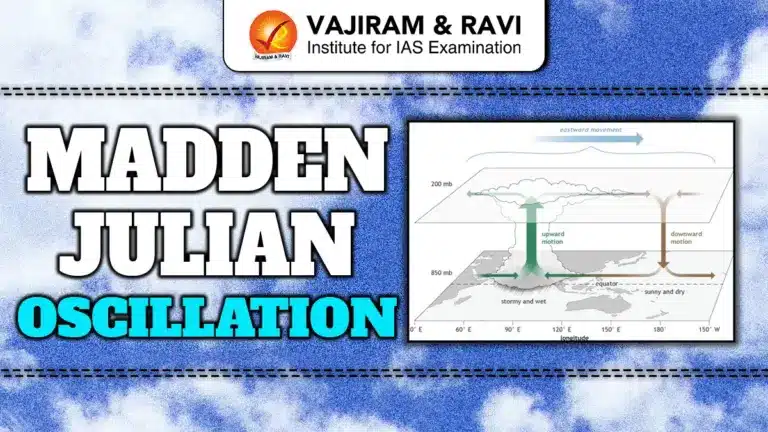
The Madden Julian Oscillation operates through two contrasting atmospheric phases that together form a moving dipole across the tropics. During strong MJO events, the Earth is effectively divided into two longitudinal halves, with one half experiencing enhanced rainfall and the other suppressed conditions, both shifting eastward over time.
Together, this eastward moving dipole structure governs alternating wet and dry spells across tropical regions on 30-60 day time scales.
1. Enhanced Convective Phase:
In this phase, low level surface winds converge near the equator, forcing warm, moist air to rise through the troposphere. At upper atmospheric levels, winds diverge outward, supporting sustained upward motion. This vertical circulation promotes cloud formation, condensation, deep convection, heavy rainfall and increased thunderstorm and cyclone activity.
2. Suppressed Convective Phase:
Here, winds converge in the upper atmosphere, pushing air downward toward the surface. As the descending air compresses, it becomes warmer and drier, inhibiting cloud development. Near the surface, air diverges outward, leading to clearer skies, reduced humidity, minimal rainfall and relatively stable weather conditions.
Madden Julian Oscillation Impact on Indian Monsoon
The Madden Julian Oscillation plays a critical role in determining active and break phases of the Indian monsoon.
- Monsoon Activation Over Indian Ocean: When the active phase lies over the Indian Ocean, it enhances moisture transport and strengthens monsoon rainfall over India.
- Monsoon Breaks: A shift of the active phase toward the Pacific leads to suppressed rainfall and monsoon breaks, commonly observed during July.
- Cycle Duration Effect: A 30 day cycle supports frequent rainfall spells, while cycles exceeding 40 days are associated with weaker monsoons.
- Interaction with ENSO: Presence of MJO over the Pacific combined with El Niño conditions significantly reduces Indian monsoon rainfall.
- Forecasting Utility: The India Meteorological Department uses MJO based models to provide 10-15 day advance forecasts of monsoon activity transitions.
Madden Julian Oscillation Significance
The Madden Julian Oscillation is crucial for understanding and predicting short term climate variability across tropical and extra tropical regions.
- Intra Seasonal Climate Control: It explains week-to-week variability in tropical rainfall that seasonal averages cannot capture.
- Cyclone Formation Influence: Ascending motion during active phases increases tropical cyclone formation across ocean basins.
- Jet Stream Modulation: MJO induced circulation changes alter jet streams, triggering heatwaves, cold spells and flooding events.
- Global Weather Linkages: Its effects extend up to 30° latitude, influencing weather patterns in North America, Africa and East Asia.
- ENSO Interaction: Strong MJO events can accelerate El Niño or La Niña development by triggering oceanic Kelvin waves.
Impact of Climate Change on Madden Julian Oscillation
Climate change is altering the strength, speed and rainfall influence of the Madden Julian Oscillation.
- Warming Indo Pacific Pool: Rising sea surface temperatures above 28°C have intensified MJO related convection.
- Shift in Residence Time: The MJO now spends 3-4 fewer days over the Indian Ocean and 5-6 more days over the western Pacific.
- Stronger Rainfall Extremes: Enhanced convection increases the likelihood of intense rainfall, flooding and cyclone formation.
- Altered Global Rainfall Patterns: Changes in MJO behaviour have contributed to drying trends in regions like the Congo Basin.
- Forecasting Challenges: Increased variability makes simulating and predicting MJO behaviour more complex for climate models.

 Last updated on March, 2026
→ UPSC Final Result 2025 is now out.
→ UPSC has released UPSC Toppers List 2025 with the Civil Services final result on its official website.
→ Anuj Agnihotri secured AIR 1 in the UPSC Civil Services Examination 2025.
→ UPSC Marksheet 2025 is now out.
→ UPSC Notification 2026 & UPSC IFoS Notification 2026 is now out on the official website at upsconline.nic.in.
→ UPSC Calendar 2026 has been released.
→ Check out the latest UPSC Syllabus 2026 here.
→ UPSC Prelims 2026 will be conducted on 24th May, 2026 & UPSC Mains 2026 will be conducted on 21st August 2026.
→ The UPSC Selection Process is of 3 stages-Prelims, Mains and Interview.
→ Prepare effectively with Vajiram & Ravi’s UPSC Prelims Test Series 2026 featuring full-length mock tests, detailed solutions, and performance analysis.
→ Enroll in Vajiram & Ravi’s UPSC Mains Test Series 2026 for structured answer writing practice, expert evaluation, and exam-oriented feedback.
→ Join Vajiram & Ravi’s Best UPSC Mentorship Program for personalized guidance, strategy planning, and one-to-one support from experienced mentors.
→ Shakti Dubey secures AIR 1 in UPSC CSE Exam 2024.
→ Also check Best UPSC Coaching in India
Madden Julian Oscillation FAQs
Q1. What is the Madden Julian Oscillation?+
Q2. How long does one Madden Julian Oscillation cycle last?+
Q3. Why is the Madden Julian Oscillation important for weather prediction?+
Q4. Which regions are most affected by the Madden Julian Oscillation?+
Q5. Does the Madden Julian Oscillation impact India’s monsoon?+
Tags: madden julian oscillation