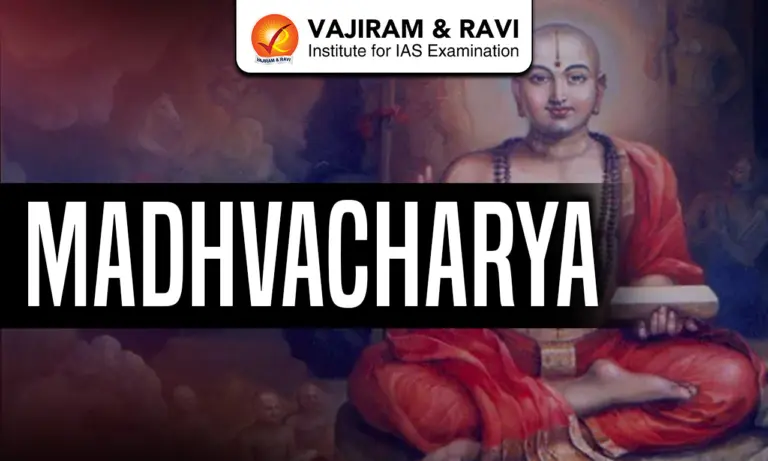
Madhvacharya was a 13th century Hindu philosopher and theologian who propounded the Dvaita or dualism school of Vedanta. He was born as Vasudeva on the day of Vijayadashami in 1238 A.D. in South Kanara, he emerged as a key thinker after Adi Shankaracharya and Ramanujacharya. His teachings emphasized the reality of the world and devotion to Vishnu as the path to liberation.
Madhvacharya Biography
Madhvacharya is also known as Purna Prajna and Ananda Tirtha. He was born at Kalyanapur near Udupi and initiated into sanyasa by Achyutapreksha, who gave him the title ‘Madhva’. Initially trained in Advaita philosophy, he later rejected it and developed Dvaita Sidhhanth. He travelled across India, debated scholars, reached the Himalayas, wrote on Vedanta Sutras and finally settled in Udupi where he established Krishna worship and preached until his disappearance around 1317 C.E.
Also Read: Ramananda
Madhvacharya Contributions
Madhvacharya made significant contributions to philosophy, religion and literature through his teachings, travels and institutional developments across India.
- Literary Works: He authored major texts like Gita Bhashya, Brahma Sutra Bhashya, Anu Bhashya, Karma Nirnaya and Vishnu Tattva Nirnaya, explaining his Tattvavada philosophy in a structured and detailed manner.
- Tattvavada Philosophy: He systematized Dvaita philosophy under the name Tattvavada, presenting a realist viewpoint that rejected illusionism and emphasized the independent reality of God, soul and matter.
- Establishment of Krishna Temple: He established the Krishna temple at Udupi using an idol brought from Dwarka, making it a central hub for Vaishnavism and propagation of his teachings.
- Formation of Madhva Sampradaya: He founded a religious tradition within Vaishnavism based on the Bhagavata Purana and established a strong devotional community centered on Vishnu worship.
- Ashta Mathas System: He appointed eight monks to head eight monasteries in Udupi, ensuring continuity of teachings and structured religious administration after his lifetime.
- Philosophical Debates: He actively participated in debates across regions like Trivandrum, challenging Advaita scholars and defending dualism, which strengthened his intellectual influence.
- Travel Across India: He travelled extensively to Bengal, Varanasi, Dwarka, Goa and Kanyakumari, spreading his philosophy and engaging with various centers of Hindu learning.
- Commentary on Scriptures: He wrote commentaries on Upanishads and a companion volume to the Mahabharata, enriching scriptural interpretation within the Dvaita framework.





Dvaita Vedanta
Dvaita Vedanta developed by Madhvacharya presents a dualistic interpretation of reality, emphasizing clear distinctions between God, soul and matter.
- Core Principle of Dualism: It asserts a fundamental difference between Atman (individual soul) and Brahman (Vishnu), where both are eternal but the soul is always dependent on God.
- Refutation of Mayavada: It rejects the illusion theory of Adi Shankaracharya, stating that the world is real and not a product of ignorance or illusion.
- Panch Bheda: Madhva proposed five distinctions between God and soul, God and matter, soul and matter, among souls and among material objects, defining reality in clear categories.
- Nature of God: Vishnu is the supreme, independent reality who created the universe and governs all worldly affairs, while everything else remains subordinate to Him.
- Concept of Bhakti: Liberation is possible only through devotion to Vishnu and Bhakti is considered the sole path to attain divine grace and freedom from worldly bondage.
- Role of Guru: Understanding sacred texts and attaining spiritual knowledge requires guidance from a Guru, whose grace is essential for proper interpretation and realization.
- Meditation and Discipline: Meditation is necessary for practicing devotion, which requires mental clarity, detachment and study of scriptures to progress spiritually.
- Reality of the Universe: Unlike monistic schools, Dvaita asserts that the universe is real, filled with genuine distinctions and not merely a temporary or illusory phenomenon.
- Classification of Souls: Souls are categorized into those eligible for liberation, those bound to continuous rebirth and those destined for eternal damnation, a unique concept in Hindu philosophy.
- Influence on Vaishnavism: The Dvaita School significantly shaped Vaishnavism and contributed to the Bhakti movement, becoming one of the three major Vedanta traditions alongside Advaita and Vishishtadvaita.

 Last updated on April, 2026
→ UPSC Final Result 2025 is now out.
→ UPSC has released UPSC Toppers List 2025 with the Civil Services final result on its official website.
→ Anuj Agnihotri secured AIR 1 in the UPSC Civil Services Examination 2025.
→ UPSC Marksheet 2025 is now out.
→ UPSC Notification 2026 & UPSC IFoS Notification 2026 is now out on the official website at upsconline.nic.in.
→ UPSC Calendar 2026 has been released.
→ Check out the latest UPSC Syllabus 2026 here.
→ UPSC Prelims 2026 will be conducted on 24th May, 2026 & UPSC Mains 2026 will be conducted on 21st August 2026.
→ The UPSC Selection Process is of 3 stages-Prelims, Mains and Interview.
→ Prepare effectively with Vajiram & Ravi’s UPSC Prelims Test Series 2026 featuring full-length mock tests, detailed solutions, and performance analysis.
→ Enroll in Vajiram & Ravi’s UPSC Mains Test Series 2026 for structured answer writing practice, expert evaluation, and exam-oriented feedback.
→ Join Vajiram & Ravi’s Best UPSC Mentorship Program for personalized guidance, strategy planning, and one-to-one support from experienced mentors.
→ Shakti Dubey secures AIR 1 in UPSC CSE Exam 2024.
→ Also check Best UPSC Coaching in India
Madhvacharya FAQs
Q1. Who was Madhvacharya?+
Q2. What is Dvaita Vedanta?+
Q3. What were the main works of Madhvacharya?+
Q4. What is the concept of Panch Bheda in Dvaita philosophy?+
Q5. How did Madhvacharya influence Indian philosophy?+
Tags: geography geography notes madhvacharya