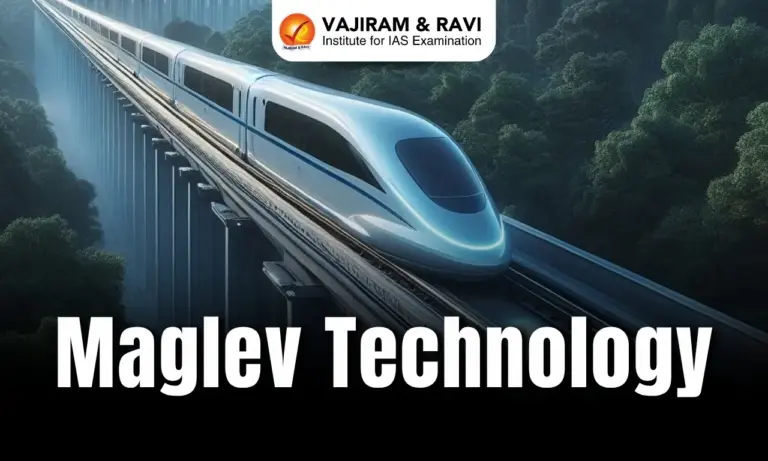
Magnetic Levitation Technology Latest News
Recently, Chinese scientists have achieved a milestone in magnetic levitation (Maglev) technology by successfully propelling a one-tonne vehicle to 700 kilometers per hour in just two seconds.
About Magnetic Levitation Technology
- It is a transportation technology which uses electromagnets to lift, guide and propel trains without wheels, allowing the cars to levitate slightly above the tracks.
- It is achieved through magnets in the guideway walls interacting with magnets on the train, move the train forward in an almost frictionless environment.




Working of Magnetic Levitation Technology
- Maglev trains operate using two key electromagnetic principles: magnetic attraction and repulsion.
- The system typically consists of three main components:
- Levitation: Magnets lift the train above the track, ensuring there is no physical contact. This minimizes wear and tear while providing a smooth ride.
- Guidance: Electromagnets stabilize the train laterally, keeping it centered on the track.
- Propulsion: Linear motors generate magnetic fields that push and pull the train along the track. This replaces the need for traditional engines or fuel.
- The tracks, known as guideways, are embedded with powerful electromagnets, while the trains themselves contain superconducting magnets or electromagnets.
- By carefully controlling the magnetic fields, maglev trains achieve levitation and propulsion with minimal energy loss.
Benefits of Magnetic Levitation Technology
- Reduced Friction: With no physical contact between train and track, maglev systems have significantly lower maintenance costs and higher energy efficiency.
- Eco-Friendly: Maglev trains produce zero direct emissions and can be powered by renewable energy sources, making them a sustainable alternative to fossil fuel-based transport.
Source: TOI

 Last updated on April, 2026
→ UPSC Final Result 2025 is now out.
→ UPSC has released UPSC Toppers List 2025 with the Civil Services final result on its official website.
→ Anuj Agnihotri secured AIR 1 in the UPSC Civil Services Examination 2025.
→ UPSC Marksheet 2025 is now out.
→ UPSC Notification 2026 & UPSC IFoS Notification 2026 is now out on the official website at upsconline.nic.in.
→ UPSC Calendar 2026 has been released.
→ Check out the latest UPSC Syllabus 2026 here.
→ UPSC Prelims 2026 will be conducted on 24th May, 2026 & UPSC Mains 2026 will be conducted on 21st August 2026.
→ The UPSC Selection Process is of 3 stages-Prelims, Mains and Interview.
→ Prepare effectively with Vajiram & Ravi’s UPSC Prelims Test Series 2026 featuring full-length mock tests, detailed solutions, and performance analysis.
→ Enroll in Vajiram & Ravi’s UPSC Mains Test Series 2026 for structured answer writing practice, expert evaluation, and exam-oriented feedback.
→ Join Vajiram & Ravi’s Best UPSC Mentorship Program for personalized guidance, strategy planning, and one-to-one support from experienced mentors.
→ Shakti Dubey secures AIR 1 in UPSC CSE Exam 2024.
→ Also check Best UPSC Coaching in India
Magnetic Levitation Technology FAQs
Q1. What is Magnetic Levitation (Maglev) Technology primarily used for?+
Q2. What is the first commercial high-speed maglev?+