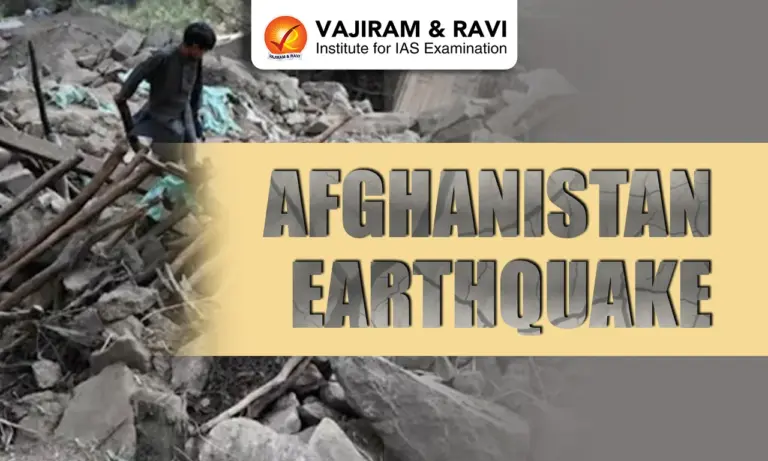
Afghanistan Earthquake Latest News
- Recently, a 6.3-magnitude earthquake struck near Mazar-e-Sharif in northern Afghanistan, killing at least 10 people and injuring around 260.
- The tremor follows a series of deadly quakes in August that claimed over 2,200 lives, highlighting the region’s continuing vulnerability to seismic disasters.
Geographical Location of Mazar-e-Sharif
- Mazar-e-Sharif, the capital of Balkh province, lies in northern Afghanistan, close to the borders with Uzbekistan and Tajikistan.
- It sits at an elevation of about 380 metres (1,250 ft) in a broad alluvial plain of the Amu Darya basin, making it a key urban and economic centre in the region.
Geophysical Characteristics
- Mazar-e-Sharif lies near the boundary zone between the Eurasian and Indian tectonic plates, an area of intense crustal compression caused by the northward movement of the Indian plate.
- This collision zone creates active fault lines running through northern and northeastern Afghanistan, where seismic stress accumulates and releases through frequent earthquakes.
- The recent quake near Mazar-e-Sharif is linked to shallow crustal faults within this convergence zone, where compressional forces generate strike-slip and thrust faulting — common mechanisms for strong tremors in the region.





Afghanistan’s High Earthquake Risk
- Afghanistan, surrounded by rugged mountain ranges, is highly prone to earthquakes, which are its deadliest natural disasters.
- On average, around 560 people die each year, and annual damages exceed $80 million.
- Since 1990, the country has experienced over 355 earthquakes with magnitudes above 5.0, underscoring its extreme seismic vulnerability.
Afghanistan’s Deadliest Earthquakes
- Afghanistan has experienced around 100 damaging earthquakes since 1900, making it one of the world’s most seismically active countries.
- In 2022, a magnitude 6 quake killed about 1,000 people.
- In 2023, multiple quakes in one month claimed another 1,000 lives and flattened entire villages.
- A 7.5-magnitude earthquake in 2015 killed 399 people across Afghanistan, Pakistan, and India.
- The 1998 quakes were the deadliest, with two major shocks just three months apart — the first killing 2,300 and the second 4,700, causing massive destruction across the north.
- These events highlight Afghanistan’s chronic seismic vulnerability and the repeated human toll from major tremors.
Afghanistan Is Prone to Earthquakes
- Afghanistan lies at the junction of three major tectonic plates — the Eurasian, Indian, and Arabian plates.
- The northward movement of the Indian plate and its collision with the Eurasian plate, combined with pressure from the Arabian plate in the south, makes this one of the most seismically active regions on Earth.
- The constant pushing, twisting, and grinding of these plates generates frequent and powerful earthquakes across the region.
Most High-Risk Areas
- The eastern and northeastern regions of Afghanistan — along borders with Pakistan, Tajikistan, and Uzbekistan — are most vulnerable to major tremors.
- Kabul, the capital, faces the highest financial losses, averaging about $17 million annually from earthquake damage.
Added Threat of Landslides
- In Afghanistan’s mountainous terrain, earthquakes often trigger landslides, which can bury entire villages, block vital roads, and delay rescue and relief operations, worsening the human and economic toll.
Building Earthquake Resilience in Afghanistan
- Experts recommend that new buildings follow earthquake-resistant designs and existing structures be retrofitted to prevent collapses during tremors.
- They also stress the need for better monitoring and early warning systems to issue timely alerts.
- There is need for mapping fault lines through geospatial and remote sensing technologies to help relocate vulnerable populations and improve disaster preparedness.

 Last updated on March, 2026
→ UPSC Final Result 2025 is now out.
→ UPSC has released UPSC Toppers List 2025 with the Civil Services final result on its official website.
→ Anuj Agnihotri secured AIR 1 in the UPSC Civil Services Examination 2025.
→ UPSC Marksheet 2025 is now out.
→ UPSC Notification 2026 & UPSC IFoS Notification 2026 is now out on the official website at upsconline.nic.in.
→ UPSC Calendar 2026 has been released.
→ Check out the latest UPSC Syllabus 2026 here.
→ UPSC Prelims 2026 will be conducted on 24th May, 2026 & UPSC Mains 2026 will be conducted on 21st August 2026.
→ The UPSC Selection Process is of 3 stages-Prelims, Mains and Interview.
→ Prepare effectively with Vajiram & Ravi’s UPSC Prelims Test Series 2026 featuring full-length mock tests, detailed solutions, and performance analysis.
→ Enroll in Vajiram & Ravi’s UPSC Mains Test Series 2026 for structured answer writing practice, expert evaluation, and exam-oriented feedback.
→ Join Vajiram & Ravi’s Best UPSC Mentorship Program for personalized guidance, strategy planning, and one-to-one support from experienced mentors.
→ Shakti Dubey secures AIR 1 in UPSC CSE Exam 2024.
→ Also check Best UPSC Coaching in India
Afghanistan Earthquake FAQs
Q1. Where did the 6.3 earthquake strike in Afghanistan?+
Q2. Why is Afghanistan prone to earthquakes?+
Q3. Which were Afghanistan’s deadliest earthquakes?+
Q4. What regions face the highest quake risk?+
Q5. How can Afghanistan build earthquake resilience?+
Tags: Afghanistan earthquake mains articles upsc current affairs upsc mains current affairs