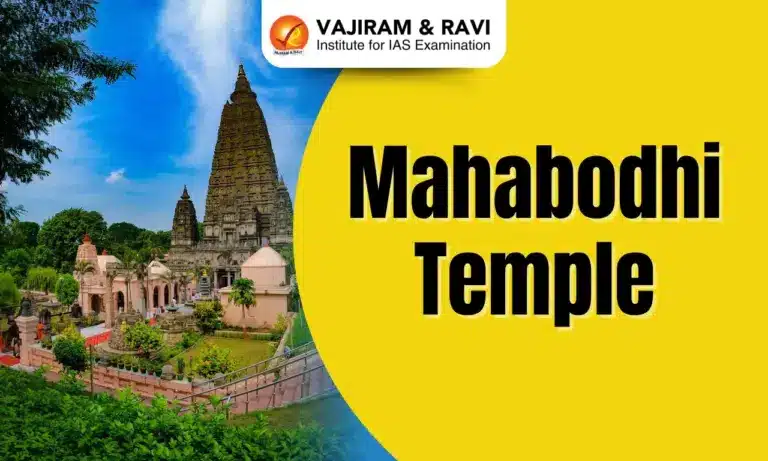
Mahabodhi Temple Latest News
The Supreme Court recently agreed to review a petition seeking the repeal of the Bodh Gaya Temple Act of 1949, advocating for its replacement with a central law to better manage the Mahabodhi Temple in Bihar.
About Mahabodhi Temple
- It is one of the four most sacred sites of Buddhism, marking the location where Buddha attained Enlightenment (Bodhi), along with:
- Lumbini (Buddha’s birthplace)
- Sarnath (Buddha’s first sermon)
- Kushinagar (Buddha’s parinirvana)
- Location: Bodh Gaya, Bihar, on the banks of the Niranjana River.
- The first temple at the site was constructed by the Mauryan emperor Ashoka in the 3rd century BC.
- The present temple was built in the 5th–6th century AD, in the Gupta period.
- It is one of the earliest Buddhist temples built entirely in brick, still standing in India, from the late Gupta period.
- The temple was heavily restored in the 19th century, by Myanmar (Burmese) Buddhists and then by the British archaeologist Sir Alexander Cunningham.
- It was declared a World Heritage site by UNESCO in 2002.





Mahabodhi Temple Architecture
- The temple structure is 180 feet (55 meters) in height. It is dominated by a pyramid-shaped central tower, called a shikhara.
- This tower comprises several layers of niches, arch motifs, and fine engravings.
- Four additional towers, each identical to the main tower but smaller in size, adorn the corners of the two-story structure.
- A shrine inside the temple holds a yellow sandstone statue of the Buddha encased in glass.
- Sacred Bodhi Tree: Believed to be a direct descendant of the original tree under which Buddha attained Enlightenment.
- Vajrasana (Diamond Throne): A stone slab marking the exact spot where Buddha meditated and attained enlightenment.
- Stone railings surround the temple as well as the Bo tree.
- One of the most famous of Ashoka’s many pillars (on which he had engraved his proclamations and his understanding of religious doctrine) stands at the southeast corner of the temple.
- The 4.8-hectare complex includes ancient shrines and modern Buddhist structures built by devotees.
Source: ET

 Last updated on March, 2026
→ UPSC Final Result 2025 is now out.
→ UPSC has released UPSC Toppers List 2025 with the Civil Services final result on its official website.
→ Anuj Agnihotri secured AIR 1 in the UPSC Civil Services Examination 2025.
→ UPSC Marksheet 2025 is now out.
→ UPSC Notification 2026 & UPSC IFoS Notification 2026 is now out on the official website at upsconline.nic.in.
→ UPSC Calendar 2026 has been released.
→ Check out the latest UPSC Syllabus 2026 here.
→ UPSC Prelims 2026 will be conducted on 24th May, 2026 & UPSC Mains 2026 will be conducted on 21st August 2026.
→ The UPSC Selection Process is of 3 stages-Prelims, Mains and Interview.
→ Prepare effectively with Vajiram & Ravi’s UPSC Prelims Test Series 2026 featuring full-length mock tests, detailed solutions, and performance analysis.
→ Enroll in Vajiram & Ravi’s UPSC Mains Test Series 2026 for structured answer writing practice, expert evaluation, and exam-oriented feedback.
→ Join Vajiram & Ravi’s Best UPSC Mentorship Program for personalized guidance, strategy planning, and one-to-one support from experienced mentors.
→ Shakti Dubey secures AIR 1 in UPSC CSE Exam 2024.
→ Also check Best UPSC Coaching in India
Mahabodhi Temple FAQs
Q1. Where is the Mahabodhi Temple located?+
Q2. Who built the first Mahabodhi Temple?+
Q3. What is the significance of the Mahabodhi Temple in Buddhism?+
Q4. In which period was the present Mahabodhi Temple built?+
Q5. What is the Vajrasana in the Mahabodhi Temple complex?+
Tags: mahabodhi temple prelims pointers upsc current affairs upsc prelims current affairs