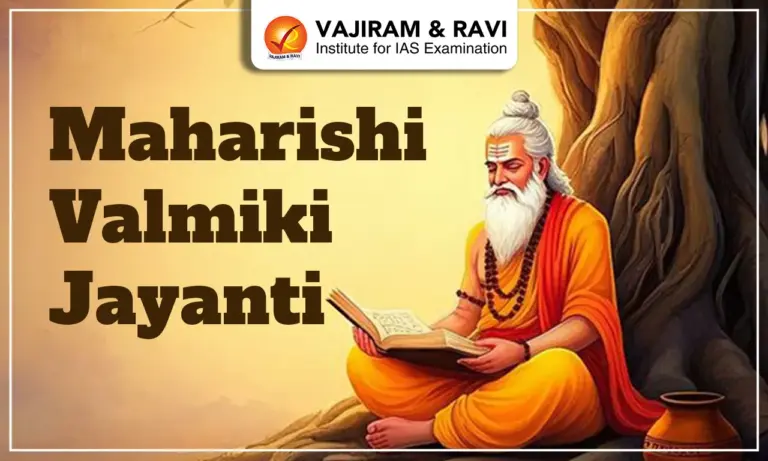
Maharishi Valmiki Jayanti, also known as Pargat Diwas, is celebrated to honor the birth anniversary of Sage Valmiki, the revered author of the epic Ramayana and regarded as the Adi Kavi (first poet) of Sanskrit literature. This occasion highlights India’s deep-rooted literary, cultural, and moral traditions, making it an event of immense religious, historical, and social significance across the country.
Maharishi Valmiki Jayanti 2025
Maharishi Valmiki Jayanti falls on the full moon day (Purnima Tithi) of the Hindu month of Ashwin, corresponding to September-October in the Gregorian calendar. In 2025, the festival will be celebrated on 7 October, with the Purnima Tithi beginning at 12:23 PM on 6 October and ending at 9:16 AM on 7 October (Drik Panchang, 2025). Devotees observe the day with prayers, Ramayana recitations, and charitable activities symbolizing compassion and enlightenment.
Maharishi Valmiki Biography
Valmiki was originally known as Ratnakar, a highway robber who plundered travelers. Legend holds he encountered Narada Muni, who challenged him morally. Ratnakar attempted to chant “Rama” but found it difficult; Narada asked him to chant “Mara” (which reversed becomes Rama). Through prolonged meditation, a divine voice finally acknowledged his penance, and anthills formed around him, giving him the name Valmiki (from Sanskrit valmika meaning “anthill”). In this transformation, he shifted from a life of violence to deep spiritual penance, a powerful symbol of redemption and inner change.
| Maharishi Valmiki Personal Details | |
| Aspect | Description |
|
Original Name |
Ratnakar |
|
Spiritual Name |
Maharishi Valmiki |
|
Birthplace |
Near River Tamasa, present-day Uttar Pradesh |
|
Era |
Treta Yuga |
|
Title |
Adi Kavi (First Poet) |
|
Major Work |
Ramayana (24,000 verses, 7 Kandas) |
|
Disciples |
Lava and Kusha |
|
Philosophy |
Dharma, Compassion, Self-Realization |





Maharishi Valmiki Contributions
Maharishi Valmiki’s intellectual and spiritual contributions have shaped India’s cultural and moral foundation. His legacy extends beyond literature into ethics, philosophy, and universal human values.
- Composition of the Ramayana
- Valmiki authored the Ramayana, consisting of 24,000 verses across seven Kandas, narrating Lord Rama’s life as an ideal human and ruler.
- The epic is India’s first classical poem and forms the moral and philosophical core of Hindu civilization.
- Foundation of Sanskrit Poetry
- He introduced the Shloka metre, marking the beginning of Sanskrit poetic tradition.
- This innovation earned him the title Adi Kavi, establishing the literary framework for future Indian poets.
- Ethical and Moral Teachings
- Valmiki’s writings emphasize truth, compassion, self-discipline, and righteous conduct.
- His portrayal of Lord Rama as Maryada Purushottama sets standards of virtue, leadership, and duty.
- Global Literary Influence
- The Ramayana inspired literary works across Asia:
- Indonesia (Kakawin Ramayana),
- Thailand (Ramakien),
- Cambodia (Reamker).
- UNESCO recognizes Ramayana traditions as part of Intangible Cultural Heritage of Humanity, showcasing Valmiki’s global impact.
Maharishi Valmiki Jayanti Significance
Valmiki Jayanti carries immense cultural and social importance, representing values of transformation, equality, and devotion. It serves as a bridge between India’s ancient wisdom and its modern moral fabric.
- Symbol of Moral Transformation
- Valmiki’s transformation from sinner to saint exemplifies the human ability to overcome ignorance and achieve self-realization.
- The story inspires moral introspection and reformation in society.
- Celebration of Equality and Learning
- Among the Balmiki community, the day is celebrated as Pargat Diwas, reflecting social pride and inclusion.
- Cultural events, community gatherings, and literacy drives promote empowerment and education.
- Cultural Heritage and Continuity
- Valmiki Jayanti reinforces the continuity of India’s epic tradition and oral culture.
- Temples and cultural centers conduct Ramayana readings, plays, and exhibitions that sustain India’s collective memory.
- Government Initiatives
- The Ministry of Culture promotes Valmiki Jayanti under its cultural preservation programs.
- The Ramayana Circuit (Swadesh Darshan Scheme) includes Valmiki heritage sites to enhance spiritual tourism.
- The Bhagwan Valmiki Tirath Sthal renovation in Amritsar (2016) has become a major national pilgrimage destination.
- Recent Developments
- In 2025, during Mann Ki Baat, Prime Minister Narendra Modi encouraged pilgrims visiting Ayodhya to also visit the newly established Valmiki and Nishadraj temples.
Maharishi Valmiki Jayanti Celebrations and Rituals
Valmiki Jayanti is celebrated nationwide through devotional rituals, processions, and community welfare programs. The day unites people across regions in reverence and service.
- Devotional Observances
- Temples organize bhajans, aarti, and Ramayana Path.
- Devotees read scriptures and reflect on Valmiki’s teachings on dharma and compassion.
- Acts of Charity and Community Service
- Devotees distribute food (langar), clothes, and educational materials to the poor.
- These activities embody the sage’s principles of kindness and equality.
- Prominent Celebration Sites
- Bhagwan Valmiki Tirath Sthal (Amritsar): Believed to be where Sita gave birth to Lava and Kusha.
- Thiruvanmiyur Valmiki Temple (Chennai): Associated with Valmiki’s penance and enlightenment.
- Ayodhya Temples: Recently established Valmiki and Nishadraj temples emphasize inclusivity in the Ramayana legacy.
- Common Practices
- Shobha Yatras (Processions): Devotees carry images or statues of Valmiki, chant verses from Ramayana, sing hymns, and traverse through streets.
- Ramayana Recitations & Kirtans: Temples and community centres organize public recitations and discourses.
- Puja and Offerings: Devotees perform aarti, offer flowers, fruits, incense, and read verses in front of portraits or idols of Valmiki.
Maharishi Valmiki Philosophy
Valmiki’s philosophy centers on spiritual discipline, moral conduct, and equality. His teachings are timeless and continue to guide ethical and spiritual living.
- Truth and Dharma
- Valmiki taught that truth (Satya) and righteousness (Dharma) sustain the universe.
- His writings stress duty, justice, and moral leadership.
- Power of Transformation
- His own journey from darkness to enlightenment proves that self-effort and faith can overcome sin and ignorance.
- The Ramayana illustrates spiritual growth through perseverance and devotion.
- Equality and Social Harmony
- Valmiki believed in equality of all beings, irrespective of caste or birth.
- His ashram welcomed everyone, reflecting inclusivity and fraternity.
- Role of Education
- By educating Lava and Kusha, Valmiki emphasized the role of learning in building moral and social order.
- His pedagogy blended spiritual values with practical wisdom.
Maharishi Valmiki Jayanti USPC
Maharishi Valmiki Jayanti holds multidimensional relevance in India’s cultural and historical discourse. The Bhagwan Valmiki Tirath Sthal in Amritsar, renovated in 2016, is India’s largest Valmiki temple complex. The Ramayana Circuit under the Swadesh Darshan Scheme includes Valmiki-related sites, promoting spiritual tourism. Valmiki’s teachings were referenced in UNESCO lists “Ramlila, the traditional performance of the Ramayana” as an intangible cultural heritage from 2008. The annual Pargat Diwas processions in northern India also reflect community-led heritage preservation.

 Last updated on March, 2026
→ UPSC Final Result 2025 is now out.
→ UPSC has released UPSC Toppers List 2025 with the Civil Services final result on its official website.
→ Anuj Agnihotri secured AIR 1 in the UPSC Civil Services Examination 2025.
→ UPSC Marksheet 2025 is now out.
→ UPSC Notification 2026 & UPSC IFoS Notification 2026 is now out on the official website at upsconline.nic.in.
→ UPSC Calendar 2026 has been released.
→ Check out the latest UPSC Syllabus 2026 here.
→ UPSC Prelims 2026 will be conducted on 24th May, 2026 & UPSC Mains 2026 will be conducted on 21st August 2026.
→ The UPSC Selection Process is of 3 stages-Prelims, Mains and Interview.
→ Prepare effectively with Vajiram & Ravi’s UPSC Prelims Test Series 2026 featuring full-length mock tests, detailed solutions, and performance analysis.
→ Enroll in Vajiram & Ravi’s UPSC Mains Test Series 2026 for structured answer writing practice, expert evaluation, and exam-oriented feedback.
→ Join Vajiram & Ravi’s Best UPSC Mentorship Program for personalized guidance, strategy planning, and one-to-one support from experienced mentors.
→ Shakti Dubey secures AIR 1 in UPSC CSE Exam 2024.
→ Also check Best UPSC Coaching in India
Maharishi Valmiki Jayanti 2025 FAQs
Q1. When is Maharishi Valmiki Jayanti 2025?+
Q2. Why is Maharishi Valmiki Jayanti celebrated?+
Q3. What are the main rituals of Valmiki Jayanti?+
Q4. What are Maharishi Valmiki’s major contributions?+
Q5. Where is Maharishi Valmiki Jayanti celebrated prominently?+
Tags: maharishi valmiki jayanti 2025