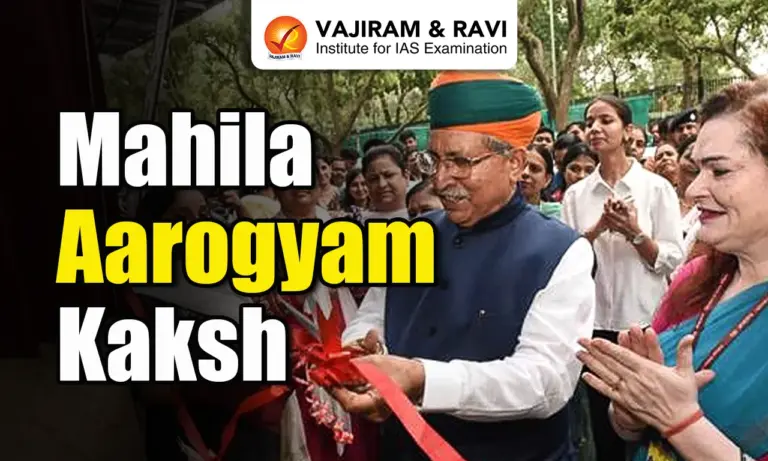
“Mahila Aarogyam Kaksh” (Women’s Health & Wellness Zone) is a pioneering workplace initiative launched by the Department of Legal Affairs, Ministry of Law & Justice, at Shastri Bhawan, New Delhi on 18 July 2025. The facility converts an underused space into a women-only wellness zone with gym equipment and a private lactation room, aiming to institutionalize health, dignity and inclusion for female government employees. The launch was officiated by Union Minister Arjun Ram Meghwal.
Mahila Aarogyam Kaksh
Mahila Aarogyam Kaksh is a dedicated fitness, wellness and support space for women working within government offices. It is designed to address both physical fitness and family-care needs by providing: (a) a women-only gym to promote physical activity and mental well-being; and (b) a private lactation room for nursing mothers to express and store breastmilk in privacy and comfort. The initiative expressly aligns with national drives such as the Fit India Movement and the broader vision of a healthy, inclusive workplace.
Mahila Aarogyam Kaksh Objectives
Mahila Aarogyam Kaksh aims to:
- Promote physical fitness and mental health among women employees.
- Institutionalize maternal friendliness at the workplace by offering dedicated lactation facilities and nursing breaks.
- Improve work-life balance, increase retention of female staff, and reduce stigma around breastfeeding in workplaces.
- Create a replicable model that other ministries, departments and public institutions can adopt.





Mahila Aarogyam Kaksh Features
The Shastri Bhawan Mahila Aarogyam Kaksh includes several features and accessibilities as mentioned here:
- A women-only gym area equipped with basic exercise machines and space for yoga or group fitness sessions to support cardiovascular and musculoskeletal health.
- A private, hygienic lactation room with a comfortable chair, privacy partitioning, and arrangements for temporary milk storage, supporting the Maternity Benefit Act’s provisions and international best practices on breastfeeding at work.
- Signage, information materials, and guidance on nutrition, maternal health, and workplace mental health.
- Integration with local health outreach (where feasible) for preventive checks and awareness sessions, consistent with Government advisories on workplace gender-friendly infrastructure.
Mahila Aarogyam Kaksh Policy
Mahila Aarogyam Kaksh rests on a strong policy and legal foundation:
- Maternity Benefit (Amendment) Act, 2017: The Act expanded maternity leave and mandates provisions such as nursing breaks and crèche facilities for establishments with 50 or more employees, establishing the legal case for lactation spaces and childcare infrastructure at workplaces. Mahila Aarogyam Kaksh operationalizes these obligations in a government office.
- Government advisories on gender-friendly workplace spaces: Recent government guidance (Ministries & Departments advisory) recommends allocating space for feeding rooms, restrooms, yoga rooms and crèches in public buildings, Mahila Aarogyam Kaksh follows this blueprint.
- Supreme Court guidance (2025): The Supreme Court has emphasized that breastfeeding in public and the workplace should not carry stigma and has urged appropriate infrastructure, reinforcing the rationale for protected lactation rooms.
- National & international best practice guidance: WHO/UNICEF and ILO recommend workplace breastfeeding support and private lactation rooms, citing benefits for maternal and child health and for employee retention. Mahila Aarogyam Kaksh aligns with these global standards.
Mahila Aarogyam Kaksh Shastri Bhawan Implementation
The Department of Legal Affairs converted an unused garage into the Mahila Aarogyam Kaksh, illustrating a low-cost, high-impact repurposing strategy. The inauguration press release and media coverage highlight:
- Leadership & ownership: Initiative led by the Department of Legal Affairs under the Ministry of Law & Justice, inaugurated by Union Minister Arjun Ram Meghwal.
- Facilities: Gym equipment for women, private lactation room for nursing mothers, informational displays on wellbeing, and provisions for routine fitness activities or sessions.
- Intended outcomes: Normalize breastfeeding at workplaces, reduce barriers for women returning from maternity leave, and encourage other ministries to replicate the model.
This makes Shastri Bhawan an early adopter and model site for public-sector workplace wellness.
Mahila Aarogyam Kaksh Benefits
The expected outcome and benefits of the Mahila Aarogyam Kaksh are:
- Health and productivity gains: Regular physical activity improves cardiovascular and mental health, which can lower absenteeism and enhance productivity. The facility makes fitness accessible during the workday.
- Support for breastfeeding & infant nutrition: Provision of lactation rooms supports exclusive breastfeeding practices recommended by WHO/UNICEF, with health benefits for infants and mothers. Workplace support increases breastfeeding duration and reduces infant morbidity.
- Retention of female employees: By addressing childcare and breastfeeding needs, workplaces can improve retention rates for women after maternity leave, an objective consistent with the Maternity Benefit law and labour studies.
- Cultural change: Visible, institutionalized support reduces stigma around breastfeeding and normalizes women’s health needs in professional spaces. The Supreme Court’s 2025 guidance underscores the social importance of such steps.
- Scalability: The repurposing model, converting unused space into wellness rooms, is low-cost and can be scaled across central and state government buildings and public sector undertakings.
Mahila Aarogyam Kaksh Challenges
The Mahila Aarogyam Kaksh faces several challenges and criticism for various reasons as listed below along with their suggested reforms:
- Space & retrofitting constraints: Not all offices have spare space; retrofitting may require capital and design input to ensure privacy and hygiene. Practical guidance (UNICEF/WHO) should be followed for safe lactation facilities.
- Maintenance & hygiene: Regular cleaning, secure milk storage (where provided), and upkeep of gym equipment are vital. Departments must budget for recurring maintenance.
- Usage norms & scheduling: Clear usage protocols, booking systems for lactation rooms and time slots for fitness areas, are needed to prevent conflicts and ensure equitable access.
- Awareness & culture change: Infrastructure alone is insufficient; awareness drives and sensitization of all staff are required to remove stigma and ensure respectful use. The Supreme Court and central advisories call for such cultural shifts.
- Extending benefits to contractual staff: Ensuring that contractual/outsourced women staff (common in government offices) have equal access requires policy clarity and enforcement under labour laws.
Scalability and Policy Recommendations:
- Adopt a Ministry-wide policy: Central ministries should issue internal circulars to institutionalize Mahila Aarogyam Kaksh as a standard feature in buildings employing women staff. This can mirror the Ministry advisory recommending feeding rooms, crèches and yoga spaces.
- Minimum standards & technical guidelines: Use WHO/UNICEF guidance for lactation rooms and national labour rules (Maternity Benefit Act) to set minimum specs, privacy, seating, ventilation, and sanitary disposal.
- Budgeting & maintenance plans: Departments should allocate small recurring budgets for cleaning, minor repairs, and equipment replacement, costs are modest compared to benefits in retention and morale.
- Monitoring & reporting: Include workplace wellbeing indicators (number of lactation-room users, session attendance, employee satisfaction) in employee welfare reports.
- Extend to the wider public sector and private employers: Encourage PSUs, state departments and large private employers to replicate the model, linked to corporate social responsibility and women-friendly workplace certification initiatives.
- Training & sensitization: Regular gender-sensitivity workshops help normalize breastfeeding and support women’s health needs at work. This aligns with court guidance and ministry advisories.
Mahila Aarogyam Kaksh UPSC
Mahila Aarogyam Kaksh is a practical, rights-based step to make workplaces more inclusive for women. By combining fitness, lactation support and awareness, it operationalizes legal obligations (Maternity Benefit law) and international best practices (WHO/UNICEF). If replicated across government and large workplaces, it can meaningfully support women’s health, workplace continuity and gender equality in employment.

 Last updated on March, 2026
→ UPSC Final Result 2025 is now out.
→ UPSC has released UPSC Toppers List 2025 with the Civil Services final result on its official website.
→ Anuj Agnihotri secured AIR 1 in the UPSC Civil Services Examination 2025.
→ UPSC Marksheet 2025 is now out.
→ UPSC Notification 2026 & UPSC IFoS Notification 2026 is now out on the official website at upsconline.nic.in.
→ UPSC Calendar 2026 has been released.
→ Check out the latest UPSC Syllabus 2026 here.
→ UPSC Prelims 2026 will be conducted on 24th May, 2026 & UPSC Mains 2026 will be conducted on 21st August 2026.
→ The UPSC Selection Process is of 3 stages-Prelims, Mains and Interview.
→ Prepare effectively with Vajiram & Ravi’s UPSC Prelims Test Series 2026 featuring full-length mock tests, detailed solutions, and performance analysis.
→ Enroll in Vajiram & Ravi’s UPSC Mains Test Series 2026 for structured answer writing practice, expert evaluation, and exam-oriented feedback.
→ Join Vajiram & Ravi’s Best UPSC Mentorship Program for personalized guidance, strategy planning, and one-to-one support from experienced mentors.
→ Shakti Dubey secures AIR 1 in UPSC CSE Exam 2024.
→ Also check Best UPSC Coaching in India
Mahila Aarogyam Kaksh FAQs
Q1. What is Mahila Aarogyam Kaksh?+
Q2. Who launched the Mahila Aarogyam Kaksh initiative?+
Q3. What facilities are available inside Mahila Aarogyam Kaksh?+
Q4. Why is a lactation room important in workplaces?+
Q5. Can other government departments adopt the Mahila Aarogyam Kaksh model?+
Tags: mahila aarogyam kaksh