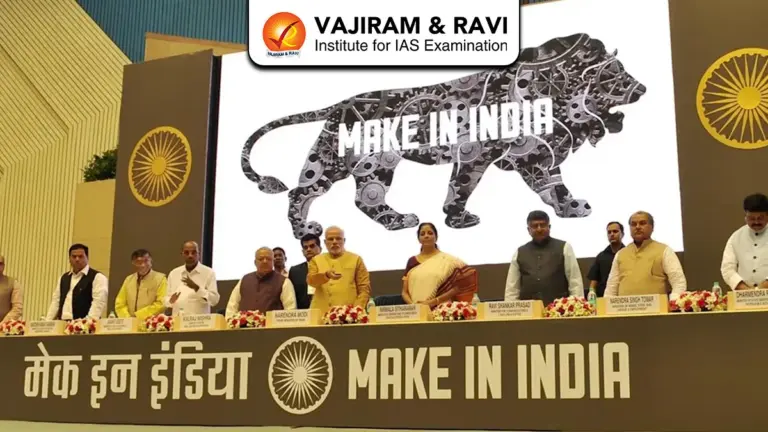
The Make in India initiative was launched in September 2014 with the aim of transforming India into a global manufacturing hub and boosting economic growth through industrial development. The programme focuses on encouraging domestic production, attracting foreign investment, generating employment, and strengthening India’s position in global supply chains.
Make in India Objectives
The Make in India initiative was launched with several important goals to strengthen India’s manufacturing sector and improve economic growth. The key objectives of Make in India are:
- Boost Manufacturing Growth & GDP: Increase the share of manufacturing in India’s GDP and improve its yearly growth rate.
- Employment Generation: Create nearly 100 million new manufacturing jobs to utilise India’s large and young workforce.
- Attract Investment: Encourage domestic and foreign investments by developing a business-friendly and investor-supportive environment.
- Enhance Global Competitiveness: Strengthen Indian manufacturing to compete in international markets and integrate with global supply chains.
- Promote Innovation & Skill Development: Support research, technological advancement, and workforce skill training to meet Industry 4.0 requirements.
- Improve Ease of Doing Business: Simplify regulations, reduce compliance burden, and make business operations smoother.
- Infrastructure Development: Build modern industrial corridors, logistics networks, and transportation infrastructure to support manufacturing growth.
- Inclusive and Sustainable Growth: Promote balanced regional development and encourage environmentally sustainable industrial practices.
- Focus on Priority Sectors: Promote growth across 27 key manufacturing sectors, including automobiles, electronics, renewable energy, textiles, and food processing.
Pillars of Make in India
The Make in India programme is based on four major pillars that guide policy implementation and industrial growth.
- New Processes
This pillar focuses on improving the business environment by simplifying industrial licensing, reducing regulations, and improving ease of doing business. India improved its global ranking from 142nd in 2014 to 63rd in 2020 due to reforms in business policies.
- New Infrastructure
The government focuses on developing industrial corridors, logistics networks, and smart cities to support manufacturing growth. Better infrastructure helps industries reduce costs and improve efficiency.
- New Sectors
Foreign investment norms were relaxed in sectors like defence production, railways, insurance, medical devices, and construction. This helped attract global companies and boost domestic production.
- New Mindset
The government shifted from being a regulator to a facilitator by working with industries, startups, and private investors to promote industrial development.





Make in India Features
The Make in India initiative has several unique features that make it a major economic reform programme.
- Focus on Multiple Manufacturing Sectors: The initiative promotes industrial development across important sectors such as automobiles, electronics, defence, textiles, pharmaceuticals, renewable energy, and food processing.
- Liberal Foreign Direct Investment (FDI) Policies: The government has relaxed FDI rules in many sectors, allowing foreign companies to invest easily in India and bring advanced technology and capital.
- Improved Ease of Doing Business: Several reforms have been introduced to simplify licensing procedures, reduce paperwork, and make it easier to start and operate industries in India.
- Promotion of Innovation and Technology: The programme encourages research, technological development, and adoption of modern manufacturing methods such as automation and digital production systems.
- Infrastructure Development: The initiative focuses on building industrial corridors, smart cities, modern transport systems, and logistics networks to support industrial growth and reduce production costs.
- Support for Startups and MSMEs: Special policies and schemes are provided to support startups and small industries, helping them grow and contribute to manufacturing and employment generation.
- Strengthening Intellectual Property Rights (IPR): The government has improved IPR protection systems to encourage innovation and protect new ideas and technologies developed by industries.
Make in India 2.0 Sectoral Expansion
Make in India 2.0 represents the next phase of the Make in India initiative, where the government has shifted its focus from general manufacturing promotion to targeted and high-value industrial growth.
The programme now covers 27 key sectors, promoting advanced manufacturing, technology-driven industries, and service sector expansion. It is strongly supported by Production Linked Incentive (PLI) schemes, which aim to increase domestic production, improve export performance, encourage local value addition, and generate large-scale employment opportunities.
- Electronics Manufacturing (ESDM): Focus on producing semiconductors, PCBs, and electronic components to reduce import dependence.
- Strategic and Frontier Sectors: Union Budget 2026-27 prioritised sectors like biotechnology under the Biopharma SHAKTI Programme (₹10,000 crore) and increased allocation of ₹40,000 crore for electronic components.
- Advanced Manufacturing: Expansion in defence, aerospace, capital goods, and automobile components supported by 14 PLI schemes.
- Infrastructure and Logistics: Development of manufacturing hubs, plug-and-play industrial parks, and specialised Chemical Parks.
- Sustainability and Technology: Promotion of green manufacturing, renewable energy, AI, space, and drone technology.
- Textile Industry: Launch of Tex-Eco initiative and Mega Textile Parks to boost sustainable textile production and exports.
Government Initiatives Supporting Make in India
The Government of India has introduced several major schemes and policy reforms to strengthen the Make in India initiative and promote domestic manufacturing. These initiatives focus on increasing industrial production, attracting investments, improving infrastructure, and supporting innovation and skill development.
Production Linked Incentive (PLI) Scheme
The PLI scheme is one of the most important flagship programmes supporting Make in India. It provides financial incentives to companies for manufacturing products within India. The scheme covers 14 major sectors, including electronics, automobiles, pharmaceuticals, telecom, and renewable energy. It aims to increase domestic production, boost exports, and generate large-scale employment.
National Single Window System (NSWS)
The NSWS was launched to improve ease of doing business by providing investors with a single digital platform for approvals and clearances. It offers information related to land availability, licensing, and regulatory approvals, making business setup faster and more transparent.
Infrastructure Development
- Industrial Corridors: The government is developing 11 Industrial Corridor Projects to build world-class manufacturing infrastructure and industrial hubs that support large-scale production and exports.
- PM GatiShakti National Master Plan: PM GatiShakti focuses on improving multimodal connectivity by integrating transport systems such as roads, railways, ports, airports, and logistics networks. This helps reduce logistics costs and improves supply chain efficiency.
Foreign Direct Investment (FDI) Reforms
The government has liberalised FDI policies in several sectors to attract global investors. For example, FDI up to 74% is allowed in defence manufacturing under the automatic route. Similar reforms have been introduced in railway infrastructure, medical devices, and other sectors.
Ease of Doing Business Measures
Various reforms have been implemented to simplify regulatory processes and reduce compliance burden. These include digitisation of approvals, simplified taxation systems, and improvements in property registration processes.
Supportive Flagship Programmes
- Startup India: This initiative supports innovative startups through funding schemes such as the ₹10,000 crore Fund of Funds, mentorship programmes, and simplified regulations. It encourages entrepreneurship and job creation.
- Skill India Mission: Skill India focuses on developing a trained workforce by providing vocational training and industry-based skill programmes to meet manufacturing sector requirements.
- Digital India Programme: Digital India promotes technology adoption across industries by improving digital infrastructure, encouraging e-governance, and supporting digital business operations.
Sector-Specific Policies
- FAME Scheme: The Faster Adoption and Manufacturing of Hybrid and Electric Vehicles (FAME) scheme promotes electric vehicle manufacturing and supports India’s clean energy goals.
- Phased Manufacturing Programme (PMP): PMP encourages domestic production of electronic components by gradually reducing import dependence and promoting local manufacturing.
Major Achievements under Make in India
- Growth in Defence Manufacturing: India has made major progress in indigenous defence production. The successful development of INS Vikrant, India’s first domestically built aircraft carrier, highlights self-reliance in defence. Defence production reached nearly ₹1.27 lakh crore in 2023–24, with exports to over 90 countries.
- Rapid Expansion of Electronics and Mobile Manufacturing: India has become the second-largest mobile phone manufacturer in the world. The electronics sector grew to approximately USD 155 billion, with mobile phone manufacturing contributing a major share.
- Global Leadership in Vaccine Production: India emerged as a leading vaccine producer during the COVID-19 pandemic, supplying nearly 60% of global vaccine demand, strengthening India’s global healthcare reputation.
- Introduction of Vande Bharat Trains: The development of Vande Bharat Express, India’s first indigenous semi-high-speed train, reflects technological advancement and strong domestic manufacturing capabilities.
- Increase in Merchandise Exports: India’s merchandise exports reached approximately USD 437 billion in FY 2023–24, showing strong growth in manufacturing and industrial exports.
- Growth in Renewable Energy Manufacturing: India has expanded solar panel and renewable energy equipment manufacturing, supporting clean energy goals and reducing dependency on imports.
- Employment Generation in Textile Industry: The textile sector has generated around 14.5 crore jobs, making it one of the largest employment-generating sectors in India.
- Rise of India’s Startup Ecosystem: India has developed the third-largest startup ecosystem globally, with more than 1.48 lakh recognised startups, generating over 15.5 lakh direct jobs.
- Growth in Toy Manufacturing: India produces nearly 400 million toys annually, strengthening domestic production and export potential in the toy sector.
- Global Recognition of Indian Products: Products such as Kashmir willow cricket bats, Amul dairy products, and Made-in-India footwear have gained strong international demand and recognition.
Make in India Challenges
- Low Manufacturing Contribution to GDP: The manufacturing sector currently contributes around 16-17% of India’s GDP, which is still far from the target of 25%. This shows the need for stronger policy implementation and industrial growth.
- Skill Gap in Workforce: A large portion of India’s workforce lacks industry-relevant skills. Reports suggest that nearly 60% of workers require skill training, which affects productivity and manufacturing efficiency.
- Infrastructure and Logistics Issues: Although improvements have been made, India still faces challenges related to transportation, power supply, and logistics costs. High logistics expenses reduce global competitiveness of Indian products.
- Supply Chain Vulnerabilities: Global disruptions such as the COVID-19 pandemic exposed weaknesses in supply chains. India still depends heavily on imports for raw materials and electronic components.
- Investment Gaps: The government aims to attract large manufacturing investments, but actual investment levels are lower than targets. This slows down industrial expansion and technology adoption.
- Low Research and Development (R&D) Spending: India’s R&D investment is around 0.7% of GDP, which is much lower than developed economies. Limited innovation restricts technological advancement in manufacturing.
- Regulatory and Compliance Burden: Complex labour laws, approval procedures, and compliance requirements sometimes discourage investors and increase business costs.
- Global Competition: Countries such as China, Vietnam, and South Korea have strong manufacturing ecosystems, better infrastructure, and skilled labour, creating tough competition for India.
- Technology and Automation Challenges: Adoption of advanced manufacturing technologies like automation, artificial intelligence, and robotics is still limited in many Indian industries.
- Regional Development Imbalance: Industrial growth is concentrated in certain states, while many regions lack manufacturing infrastructure and investment opportunities.
Way Forward
- Simplifying Regulations and Labour Laws: The government should reduce compliance burden and implement labour law reforms to create a more business-friendly environment. Faster approvals and simplified licensing processes will encourage domestic and foreign investments.
- Strengthening Infrastructure and Logistics: Expanding industrial corridors, transport networks, and logistics infrastructure can reduce production costs and improve supply chain efficiency. Improved connectivity will help industries operate more smoothly.
- Expanding Skill Development Programmes: India needs to focus on industry-based training programmes to reduce skill gaps in the workforce. Strengthening vocational education and technical training will improve productivity and employment opportunities.
- Encouraging Research and Development (R&D): Increasing investment in innovation and research through tax benefits and government funding can promote technological advancement and improve manufacturing quality.
- Promoting Domestic Supply Chains: Developing strong local supply chains can reduce dependence on imports and improve industrial resilience during global disruptions.
- Enhancing Foreign Trade and Investment Partnerships: Strengthening international trade relations and attracting foreign investment can help India gain advanced technology and expand export markets.
- Supporting MSMEs and Startups: Providing financial assistance, technology support, and market access to small industries and startups can strengthen manufacturing growth and employment generation.
- Promoting Green and Sustainable Manufacturing: Encouraging renewable energy usage, energy-efficient production, and eco-friendly industrial practices can support long-term sustainable development.
- Adopting Advanced Manufacturing Technologies: Promoting automation, artificial intelligence, robotics, and digital manufacturing systems can increase productivity and global competitiveness.
Effective Monitoring and Policy Evaluation: Establishing strong monitoring systems can help track programme progress, identify challenges, and improve policy implementation.

 Last updated on April, 2026
→ UPSC Final Result 2025 is now out.
→ UPSC has released UPSC Toppers List 2025 with the Civil Services final result on its official website.
→ Anuj Agnihotri secured AIR 1 in the UPSC Civil Services Examination 2025.
→ UPSC Marksheet 2025 is now out.
→ UPSC Notification 2026 & UPSC IFoS Notification 2026 is now out on the official website at upsconline.nic.in.
→ UPSC Calendar 2026 has been released.
→ Check out the latest UPSC Syllabus 2026 here.
→ UPSC Prelims 2026 will be conducted on 24th May, 2026 & UPSC Mains 2026 will be conducted on 21st August 2026.
→ The UPSC Selection Process is of 3 stages-Prelims, Mains and Interview.
→ Prepare effectively with Vajiram & Ravi’s UPSC Prelims Test Series 2026 featuring full-length mock tests, detailed solutions, and performance analysis.
→ Enroll in Vajiram & Ravi’s UPSC Mains Test Series 2026 for structured answer writing practice, expert evaluation, and exam-oriented feedback.
→ Join Vajiram & Ravi’s Best UPSC Mentorship Program for personalized guidance, strategy planning, and one-to-one support from experienced mentors.
→ Shakti Dubey secures AIR 1 in UPSC CSE Exam 2024.
→ Also check Best UPSC Coaching in India
Make in India FAQs
Q1. When was Make in India launched?+
Q2. What is the main goal of Make in India?+
Q3. How many sectors are covered under Make in India 2.0?+
Q4. What is the PLI scheme?+
Q5. What is the current manufacturing contribution to India’s GDP?+
Tags: make in india