About Mammography:
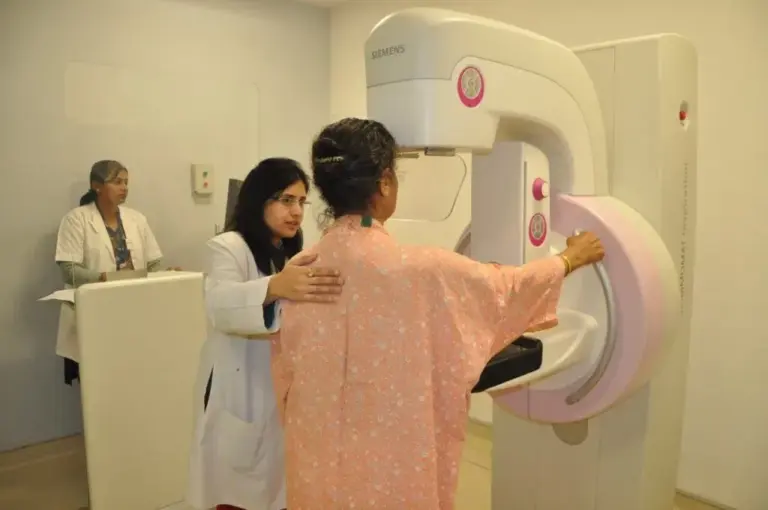
- It is an x-ray imaging method used to examine the breast for the early detection of cancer and other breast diseases.
- Healthcare providers use mammograms, or mammography, to look for early signs of breast cancer before symptoms develop. This is called a screening mammogram.
- Providers also use mammography to look for any abnormalities if you develop a new symptom, such as a lump, pain, nipple discharge, or breast skin changes. This is called a diagnostic mammogram.
- How does it work?
- During a mammogram, a patient’s breast is placed on a flat support plate and compressed with a parallel plate called a paddle.
- An x-ray machine produces a small burst of x-rays that pass through the breast to a detector located on the opposite side.
- The detector can be either a photographic film plate, which captures the x-ray image on film, or a solid-state detector, which transmits electronic signals to a computer to form a digital image.
- The images produced are called mammograms.
- On a film mammogram, low density tissues, such as fat, appear translucent (i.e. darker shades of gray approaching the black background), whereas areas of dense tissue, such as connective and glandular tissue or tumors, appear whiter on a gray background.
- These high-density regions could represent many different types of abnormalities, including cancerous tumors, non-cancerous masses called benign tumors, fibroadenomas, or complex cysts.
Q1: What are tumors?
Tumors are groups of abnormal cells that form lumps or growths. They can start in any one of the trillions of cells in our bodies. Tumors grow and behave differently, depending on whether they are cancerous (malignant), non-cancerous (benign) or precancerous.
Source: Health Rounds: Mammography finding in arteries could indicate heart disease






 Last updated on March, 2026
→ UPSC Final Result 2025 is now out.
→ UPSC has released UPSC Toppers List 2025 with the Civil Services final result on its official website.
→ Anuj Agnihotri secured AIR 1 in the UPSC Civil Services Examination 2025.
→ UPSC Marksheet 2025 is now out.
→ UPSC Notification 2026 & UPSC IFoS Notification 2026 is now out on the official website at upsconline.nic.in.
→ UPSC Calendar 2026 has been released.
→ Check out the latest UPSC Syllabus 2026 here.
→ UPSC Prelims 2026 will be conducted on 24th May, 2026 & UPSC Mains 2026 will be conducted on 21st August 2026.
→ The UPSC Selection Process is of 3 stages-Prelims, Mains and Interview.
→ Prepare effectively with Vajiram & Ravi’s UPSC Prelims Test Series 2026 featuring full-length mock tests, detailed solutions, and performance analysis.
→ Enroll in Vajiram & Ravi’s UPSC Mains Test Series 2026 for structured answer writing practice, expert evaluation, and exam-oriented feedback.
→ Join Vajiram & Ravi’s Best UPSC Mentorship Program for personalized guidance, strategy planning, and one-to-one support from experienced mentors.
→ Shakti Dubey secures AIR 1 in UPSC CSE Exam 2024.
→ Also check Best UPSC Coaching in India