About Mangrove Alliance for Climate (MAC):
- The alliance will raise awareness about the role of mangroves as a “nature-based solution to climate change”.
- The alliance will be amplified at the G20 Summit that will be held between November 15 and 16, 2022 in Bali under the presidency of Indonesia.
- The MAC seeks to scale up, accelerate conservation, restoration and growing plantation efforts of mangrove ecosystems for the benefit of communities globally, and recognize the importance of these ecosystems for climate change mitigation and adaptation.
Mangroves:
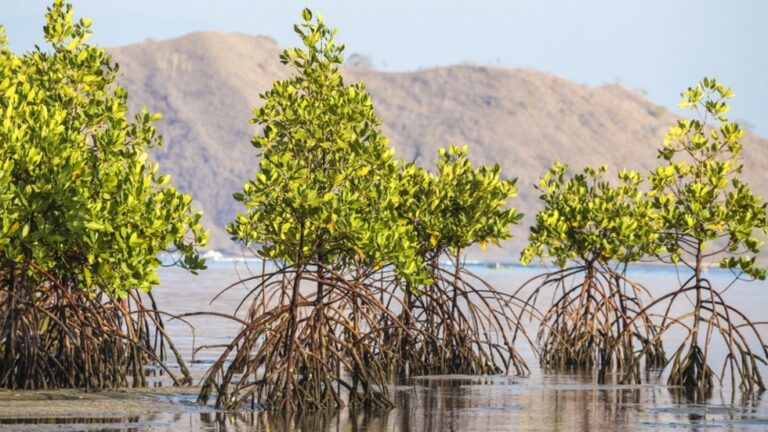
- A mangrove is a shrub or a small tree that grows along the coastlines and has roots in salty sediments, often underwater. They also grow in swamps.
- Mangrove forests can survive extreme weather conditions and require low oxygen levels to survive.
- The mangroves cannot survive freezing temperatures and thus are found mainly in tropical and subtropical latitudes.
- UNESCO celebrates July 26 as the International Day for the Conservation of the Mangrove Ecosystem to raise awareness about mangrove ecosystems and to promote their conservation.
- According to MAC, Mangrove forests can store ten times more carbon per hectare than terrestrial forests. Also, they can store carbon up to 400 per cent faster than land-based tropical rainforests.
- According to Global Mangrove Alliance (GMA), when the mangroves are cut, the carbon stored in these plants gets released into the air. So, preserving them to keep the carbon emissions levels low is necessary.
- Once the plants die, they take the stored carbon into the soil. This is called “Blue Carbon”.
- Moreover, Mangrove forests act as natural barriers against rising tides and storms. Each year, they prevent property damages of over $65 billion.
Mangroves in India:
- India contributes to nearly half of the total mangrove cover in South Asia.
- According to the Forest Survey report 2021 released in January, mangroves cover in the country is 4,992 square km, which is 0.15 per cent of the country’s total geographical area. Since 2019, the cover has risen by only 17 sq km.
- West Bengal has the highest percentage of mangrove cover in India, mainly because it has Sundarbans, the largest mangrove forest in the world. It is followed by Gujarat and Andaman, and Nicobar islands.
- Other states that have mangrove cover are Maharashtra, Odisha, Andhra Pradesh, Tamil Nadu, Goa and Kerala.
Source : PIB






 Last updated on April, 2026
→ UPSC Final Result 2025 is now out.
→ UPSC has released UPSC Toppers List 2025 with the Civil Services final result on its official website.
→ Anuj Agnihotri secured AIR 1 in the UPSC Civil Services Examination 2025.
→ UPSC Marksheet 2025 is now out.
→ UPSC Notification 2026 & UPSC IFoS Notification 2026 is now out on the official website at upsconline.nic.in.
→ UPSC Calendar 2026 has been released.
→ Check out the latest UPSC Syllabus 2026 here.
→ UPSC Prelims 2026 will be conducted on 24th May, 2026 & UPSC Mains 2026 will be conducted on 21st August 2026.
→ The UPSC Selection Process is of 3 stages-Prelims, Mains and Interview.
→ Prepare effectively with Vajiram & Ravi’s UPSC Prelims Test Series 2026 featuring full-length mock tests, detailed solutions, and performance analysis.
→ Enroll in Vajiram & Ravi’s UPSC Mains Test Series 2026 for structured answer writing practice, expert evaluation, and exam-oriented feedback.
→ Join Vajiram & Ravi’s Best UPSC Mentorship Program for personalized guidance, strategy planning, and one-to-one support from experienced mentors.
→ Shakti Dubey secures AIR 1 in UPSC CSE Exam 2024.
→ Also check Best UPSC Coaching in India