Manufacturing in India News
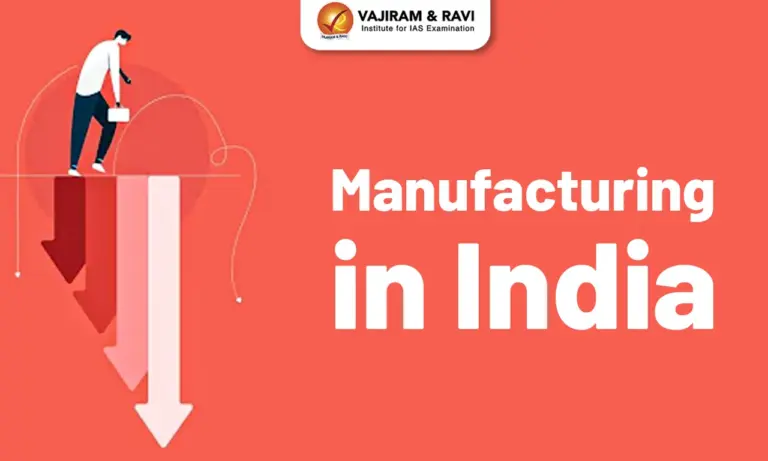
- India’s persistent lag in manufacturing growth has come under focus due to renewed debate on structural constraints, wage dynamics, and their impact on industrial competitiveness.
Manufacturing and Structural Transformation
- Manufacturing has historically played a central role in economic development by absorbing surplus labour, driving productivity growth, and enabling exports.
- Countries such as China and South Korea used manufacturing-led growth to transition from low-income to middle- and high-income economies.
- In contrast, India’s structural transformation has followed an atypical path, with services expanding rapidly while manufacturing’s share in GDP has remained broadly stagnant.
- Despite beginning the 20th century at levels comparable to several East Asian economies, India did not experience a sustained manufacturing boom.
- Instead, growth increasingly shifted toward services such as software, finance, and business process outsourcing.
- This divergence raises important questions about the structural weaknesses of India’s industrialisation strategy.





India’s Manufacturing Performance
- Manufacturing’s share in India’s GDP has remained roughly constant over decades and has recently ceded further ground to services.
- While India has witnessed pockets of industrial success, these have not translated into large-scale employment generation or broad-based technological upgrading.
- This underperformance becomes more apparent when compared with China and South Korea, where manufacturing expanded both in scale and sophistication.
- The limited growth of manufacturing has also constrained India’s ability to absorb low-skilled labour from existing agriculture, contributing to informal employment and underemployment.
- As a result, India faces the challenge of high economic growth without commensurate job creation in productive sectors.
Role of Public Sector Wages
- One explanation for India’s manufacturing stagnation lies in the wage structure shaped by public sector policies.
- Experts argue that relatively high government salaries drew workers away from manufacturing, pushing up economy-wide wages.
- Manufacturing firms, operating with lower productivity levels, found it difficult to match these wages, reducing their competitiveness.
- Higher public sector incomes also increased demand for domestic goods and services, raising prices.
- This indirectly hurt manufacturing by making domestically produced goods less competitive compared to imports. Over time, these dynamics weakened incentives for industrial expansion and discouraged firms from scaling up operations.
Dutch Disease Framework
- Traditionally, Dutch disease describes how a resource boom, such as oil or gas, raises wages and appreciates the currency, harming manufacturing exports.
- In India’s case, the analogy is applied to non-tradable government services rather than natural resources.
- Expansion of the public sector with high wages raised domestic prices and led to a real exchange rate appreciation, even without changes in the nominal exchange rate.
- This made imports cheaper and domestic manufacturing less competitive, reducing demand for locally produced goods.
- Thus, policy-driven wage increases functioned similarly to a resource windfall in weakening manufacturing.
Technology and Productivity Constraints
- A key question emerging from this analysis is why Indian manufacturing failed to respond through technological upgrading.
- Economic theory suggests that high wages can induce innovation, pushing firms to adopt labour-saving technologies and improve productivity.
- This process played a crucial role in historical industrialisation in countries like Britain, Germany, and Japan.
- In India, however, manufacturing firms did not sufficiently invest in technology or capital-intensive production.
- Instead, many industries continued to rely on abundant cheap labour, limiting productivity growth.
- This failure to move up the value chain meant that manufacturing could neither sustain higher wages nor compete effectively in global markets.
Uneven Growth and Rising Inequality
- India’s growth story has been marked by strong performance in services alongside weak wage growth for a large segment of workers.
- Even in fast-growing sectors such as software and platform-based services, entry-level wages have stagnated over long periods.
- Many modern Indian “unicorns” depend more on labour reserves than on genuine technological innovation.
- This pattern has contributed to rising income inequality. While the private sector has generated wealth and entrepreneurship, its growth has been uneven and insufficiently linked to mass employment creation.
- Manufacturing’s stagnation thus reflects deeper issues in India’s development trajectory, including inadequate diffusion of technology and skills.
Implications for Economic Policy
- The lag in manufacturing has significant implications for India’s long-term growth and employment prospects.
- Without a strong industrial base, India risks premature deindustrialisation, where services dominate before manufacturing reaches maturity.
- This limits job creation for semi-skilled workers and constrains export diversification.
- Policy responses need to focus on improving manufacturing productivity, encouraging technological adoption, and aligning wage growth with productivity gains.
- Investments in skills, infrastructure, and industrial clusters are critical to revive manufacturing as a driver of inclusive growth.
Source: TH

 Last updated on March, 2026
→ UPSC Final Result 2025 is now out.
→ UPSC has released UPSC Toppers List 2025 with the Civil Services final result on its official website.
→ Anuj Agnihotri secured AIR 1 in the UPSC Civil Services Examination 2025.
→ UPSC Marksheet 2025 is now out.
→ UPSC Notification 2026 & UPSC IFoS Notification 2026 is now out on the official website at upsconline.nic.in.
→ UPSC Calendar 2026 has been released.
→ Check out the latest UPSC Syllabus 2026 here.
→ UPSC Prelims 2026 will be conducted on 24th May, 2026 & UPSC Mains 2026 will be conducted on 21st August 2026.
→ The UPSC Selection Process is of 3 stages-Prelims, Mains and Interview.
→ Prepare effectively with Vajiram & Ravi’s UPSC Prelims Test Series 2026 featuring full-length mock tests, detailed solutions, and performance analysis.
→ Enroll in Vajiram & Ravi’s UPSC Mains Test Series 2026 for structured answer writing practice, expert evaluation, and exam-oriented feedback.
→ Join Vajiram & Ravi’s Best UPSC Mentorship Program for personalized guidance, strategy planning, and one-to-one support from experienced mentors.
→ Shakti Dubey secures AIR 1 in UPSC CSE Exam 2024.
→ Also check Best UPSC Coaching in India
Manufacuring in India FAQs
Q1. Why has manufacturing remained weak in India?+
Q2. What is the Dutch disease in the Indian context?+
Q3. How does India differ from China and South Korea?+
Q4. Why did manufacturing not respond through innovation?+
Q5. What are the long-term risks of weak manufacturing?+
Tags: mains articles manufacturing in India upsc current affairs upsc mains current affairs