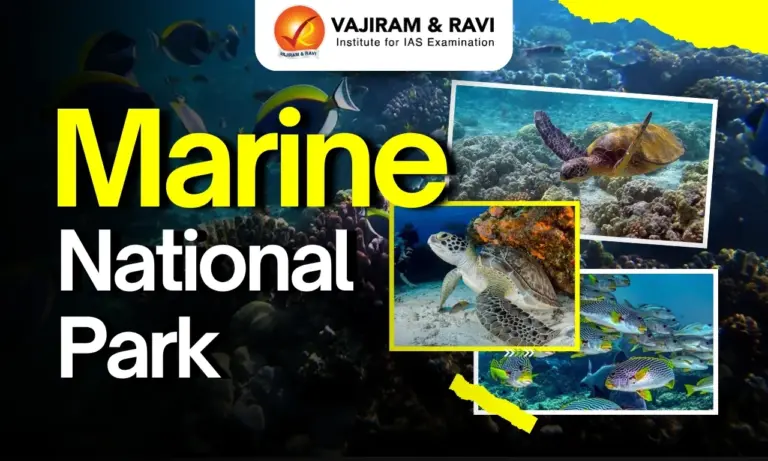
Marine National Park (Gulf of Kutch) is India’s first Marine National Park, located along the southern shore of the Gulf of Kutch in Gujarat. Established to protect the region’s rich marine biodiversity, the park is known for its coral reefs, mangrove forests, mudflats, tidal creeks, and diverse marine life. It forms an important part of the Gulf of Kutch Marine Sanctuary and plays a vital role in conserving India’s coastal and marine ecosystems.
Marine National Park (Gulf of Kutch)
Marine National Park (Gulf of Kutch) preserves diverse coastal and marine ecosystems, including coral reefs, mangrove forests, seagrass beds, mudflats, and intertidal habitats that support exceptional biodiversity. The park plays a crucial role in conserving endangered marine species, maintaining ecological balance, and promoting sustainable management of India’s coastal resources.
Marine National Park (Gulf of Kutch) Climate & Vegetation
Marine National Park (Gulf of Kutch) experiences a tropical semi-arid climate, with vegetation adapted to high salinity, tidal fluctuations, and coastal conditions.
- Climate Type: Tropical semi-arid with hot summers and mild winters.
- Summer Temperature: Ranges between 35°C and 42°C.
- Winter Temperature: Usually ranges from 12°C to 28°C.
- Monsoon Season: Receives rainfall mainly from June to September.
- Tidal Influence: High tidal fluctuations shape the park’s intertidal ecosystems.
- Mangrove Vegetation: Dominated by Avicennia marina along the coastline.
- Seagrass Beds: Found in shallow waters, supporting dugongs and juvenile fish.
- Coral Reef Habitats: Extensive fringing coral reefs around several islands.
- Marine Algae: Rich diversity of green, brown, and red seaweeds.
- Salt Marshes: Covered with halophytic (salt-tolerant) grasses and shrubs.


Gulf of Kutch National Park Flora
The flora of Gulf of Kutch National Park is specially adapted to survive in saline coastal conditions, tidal inundation, and harsh climatic conditions. Its mangrove forests, seagrass beds, and marine algae form the foundation of the park’s productive marine ecosystem.
- Mangrove Forests: Dominated by Avicennia marina, the most widespread mangrove species, which stabilizes coastlines, prevents erosion, and serves as a nursery for fish, crabs, and prawns.
- Rhizophora Species: Found in suitable tidal zones, these mangroves possess stilt roots that provide stability in soft, waterlogged soils and offer shelter to marine organisms.
- Ceriops and Aegiceras: Salt-tolerant mangrove species that contribute to shoreline protection, nutrient cycling, and habitat diversity.
- Sonneratia Species: Thrive in intertidal regions and develop pneumatophores (breathing roots) that enable survival in oxygen-deficient muddy soils.
- Seagrass Meadows: Species such as Halodule, Halophila, and Cymodocea provide feeding grounds for dugongs, support juvenile fish populations, and improve water quality.
- Marine Algae (Seaweeds): Rich diversity of green, brown, and red algae contributes significantly to primary productivity and serves as food for several marine invertebrates.
- Phytoplankton: Microscopic floating plants that form the base of the marine food chain, supporting fish, crustaceans, and other aquatic life.
- Salt Marsh Vegetation: Includes various halophytic (salt-tolerant) grasses and shrubs that stabilize coastal sediments and withstand high salinity.
- Coastal Shrubs and Herbs: Adapted to dry, saline conditions, these plants help reduce soil erosion and provide habitat for insects and coastal birds.
Marine National Park (Gulf of Kutch) Fauna
Marine National Park (Gulf of Kutch) is one of India’s richest marine biodiversity hotspots, supporting a wide variety of marine mammals, coral species, fishes, reptiles, invertebrates, and migratory birds. Its coral reefs, mangroves, mudflats, and seagrass beds provide ideal habitats for numerous aquatic and coastal species.
- Marine Mammals: The park is home to the Dugong (Sea Cow), Indo-Pacific Humpback Dolphin, Bottlenose Dolphin, and Finless Porpoise, which inhabit its shallow coastal waters.
- Coral Reefs: More than 50 species of hard and soft corals form extensive reef ecosystems that support thousands of marine organisms.
- Fish Diversity: Waters of the park contain groupers, snappers, butterflyfish, angelfish, parrotfish, pufferfish, mullets, and catfish, making it an important fish breeding ground.
- Sea Turtles: Green Sea Turtle and Olive Ridley Turtle are commonly recorded, using the coastal waters for feeding and migration.
- Whale Shark: The Whale Shark, the world’s largest fish and a protected species in India, is occasionally sighted in the Gulf during seasonal migrations.
- Crustaceans: A rich population of crabs, prawns, shrimps, lobsters, and hermit crabs inhabits the mangroves, mudflats, and tidal creeks.
- Molluscs: The park supports diverse oysters, mussels, clams, gastropods, octopuses, and squids, contributing to the region’s marine biodiversity.
- Echinoderms: Species such as starfish, sea cucumbers, sea urchins, brittle stars, and feather stars are commonly found on coral reefs and intertidal zones.
- Cnidarians and Sponges: Sea anemones, jellyfish, hydroids, and marine sponges are abundant and play an important role in maintaining reef ecosystems.
- Bird Species: The park attracts numerous resident and migratory birds, including Greater Flamingo, Lesser Flamingo, Pelicans, Herons, Egrets, Ospreys, Gulls, Terns, Curlews, and Sandpipers.
- Intertidal Fauna: During low tide, organisms such as mudskippers, sea slugs, barnacles, polychaete worms, and horseshoe crabs become visible across the exposed mudflats and rocky shores.
Threats to Marine National Park (Gulf of Kutch)
Marine National Park (Gulf of Kutch) faces several natural and human-induced threats that affect its fragile marine ecosystems, coral reefs, and coastal biodiversity.
- Industrial Pollution: Effluents from ports, refineries, and coastal industries degrade water quality.
- Oil Spills: Shipping and offshore activities pose risks to coral reefs, mangroves, and marine fauna.
- Plastic Pollution: Marine litter harms turtles, dolphins, seabirds, and other aquatic organisms.
- Coral Bleaching: Rising sea temperatures due to climate change damage coral reef ecosystems.
- Coastal Development: Expansion of ports, industries, and infrastructure leads to habitat loss.
- Illegal Fishing: Destructive fishing practices disturb breeding grounds and reduce fish populations.
- Mangrove Degradation: Encroachment and cutting of mangroves weaken coastal protection and biodiversity.
- Sedimentation: Increased silt deposition reduces sunlight penetration, affecting coral growth and seagrass beds.
- Invasive Species: Non-native marine organisms compete with indigenous species and alter ecosystem balance.
- Climate Change: Sea-level rise, ocean acidification, and changing weather patterns threaten the park’s long-term ecological health.
Marine National Park (Gulf of Kutch) Conservation Efforts
Several conservation initiatives have been implemented to protect the unique marine ecosystems, coral reefs, mangroves, and endangered species of Marine National Park (Gulf of Kutch).
- Protected Area Status: Declared as a Marine Sanctuary (1980) and Marine National Park (1982) to safeguard marine biodiversity.
- Legal Protection: Conserved under the Wildlife (Protection) Act, 1972, with regulated activities within the protected area.
- Coral Reef Conservation: Regular monitoring, restoration, and scientific studies help maintain healthy coral ecosystems.
- Mangrove Restoration: Afforestation programmes promote the regeneration of degraded mangrove habitats.
- Species Protection: Focused conservation measures for Dugongs, Whale Sharks, Sea Turtles, Dolphins, and reef-building corals.
- Anti-Poaching Patrols: Continuous surveillance prevents illegal fishing, poaching, and habitat destruction.
- Biodiversity Monitoring: Periodic surveys assess the health of marine flora, fauna, and coastal ecosystems.
- Community Participation: Local fishing communities are involved in awareness campaigns and sustainable resource management.
- Regulated Eco-tourism: Visitor activities are monitored to minimize disturbance to sensitive marine habitats.
- Research & Awareness: Scientific institutions and the Gujarat Forest Department conduct research and public awareness programmes on marine conservation.

 Last updated on Oct, 2026
→ UPSC 2027 Notification will be released on 13 January 2027 at upsconline.nic.in.
→ Check Nobel Prize 2026 Winners List here.
→ Download PIB PRiSM Monthly Magazine 2026 here.
→ Check UPSC Monthly Current Affairs Magazine The Recitals here.
→ Check out the latest UPSC Syllabus here.
→ Download UPSC Model Answers for Mains 2026
→ UPSC Mains Question Paper 2026 is out now for Essay & GS Paper 1, 2, 3 & 4.
→ UPSC Calendar 2027 has been released.
→ Enroll in Vajiram & Ravi’s UPSC Mains Test Series 2027 for structured answer writing practice, expert evaluation, and exam-oriented feedback.
→ Join Vajiram & Ravi’s UPSC Mentorship Program 2027 for personalized guidance, strategy planning, and one-to-one support from experienced mentors.
→ Go through the UPSC Mains Previous Year Papers to enhance your preparation.
→ UPSC has released UPSC Toppers List 2025 with the Civil Services final result on its official website.
→ Also check Best UPSC Coaching in India
Marine National Park FAQs
Q1. Why is Marine National Park (Gulf of Kutch) famous?+
Q2. Where is Marine National Park (Gulf of Kutch) located?+
Q3. Which is the first Marine National Park in India?+
Q4. How many islands are there in Marine National Park (Gulf of Kutch)?+
Q5. Which endangered species are found in Marine National Park (Gulf of Kutch)?+
Tags: environment environment and ecology national park