


Phytoplankton Latest News
According to the researchers, from across institutions in the U.S., iron released due to human activities enhances spring phytoplankton blooms as well as speeds up the rate at which nutrients are consumed.
About Phytoplankton
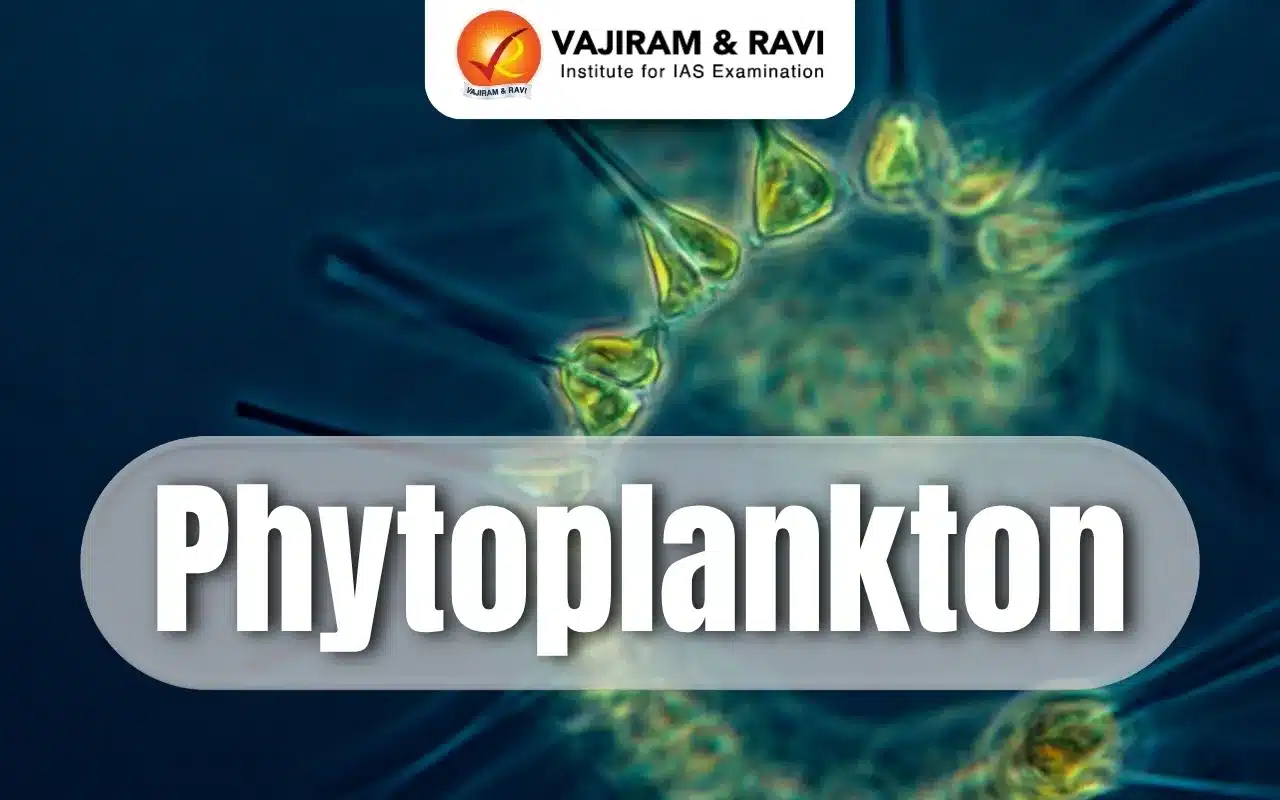
- Phytoplanktons are microscopic plants, but they play a huge role in the marine food web.
- Phytoplankton, also known as microalgae, are similar to terrestrial plants in that they contain chlorophyll and require sunlight in order to live and grow.
- Most phytoplankton are buoyant and float in the upper part of the ocean, where sunlight penetrates the water.
- They require inorganic nutrients such as nitrates, phosphates, and sulfur which they convert into proteins, fats, and carbohydrates.
- The two main classes of phytoplankton are dinoflagellates and diatoms.
- Dinoflagellates use a whip-like tail, or flagella, to move through the water and their bodies are covered with complex shells.
- Diatoms also have shells, but they are made of a different substance and their structure is rigid and made of interlocking parts. Diatoms do not rely on flagella to move through the water and instead rely on ocean currents to travel through the water.
- In a balanced ecosystem, phytoplankton provide food for a wide range of sea creatures including shrimp, snails, and jellyfish.
- When too many nutrients are available, phytoplankton may grow out of control and form harmful algal blooms (HABs).
- These blooms can produce extremely toxic compounds that have harmful effects on fish, shellfish, mammals, birds, and even people.


Ecological Significance of Phytoplankton
- Phytoplankton is estimated to produce about 50 per cent of Earth’s oxygen.
- They have a crucial role in the global carbon cycle.
- They provide an essential food source for organisms like zooplanktons.
- Just like land plants, they grow more in certain seasons.
Phytoplankton FAQs
Q1: What is the difference between phytoplankton and zooplankton?
Ans: Phytoplanktons and zooplanktons are two types of planktons that are found in water. Phytoplanktons are plants, while zooplanktons are animals.
Q2: What causes algal blooms?
Ans: Algal blooms can be dramatic and are a result of excess nutrients from fertilizer, wastewater and stormwater runoff, coinciding with lots of sunlight, warm temperatures and shallow, slow-flowing water.
Q3: What are phytoplankton and its role?
Ans: Phytoplankton is microscopic marine algae. In a balanced ecosystem, they provide food for a wide range of sea creatures.
Source: TH

 Last updated on Oct, 2026
→ UPSC 2027 Notification will be released on 13 January 2027 at upsconline.nic.in.
→ Check Nobel Prize 2026 Winners List here.
→ Download PIB PRiSM Monthly Magazine 2026 here.
→ Check UPSC Monthly Current Affairs Magazine The Recitals here.
→ Check out the latest UPSC Syllabus here.
→ Download UPSC Model Answers for Mains 2026
→ UPSC Mains Question Paper 2026 is out now for Essay & GS Paper 1, 2, 3 & 4.
→ UPSC Calendar 2027 has been released.
→ Enroll in Vajiram & Ravi’s UPSC Mains Test Series 2027 for structured answer writing practice, expert evaluation, and exam-oriented feedback.
→ Join Vajiram & Ravi’s UPSC Mentorship Program 2027 for personalized guidance, strategy planning, and one-to-one support from experienced mentors.
→ Go through the UPSC Mains Previous Year Papers to enhance your preparation.
→ UPSC has released UPSC Toppers List 2025 with the Civil Services final result on its official website.
→ Also check Best UPSC Coaching in India
Tags: phytoplankton prelims pointers upsc current affairs upsc prelims current affairs








