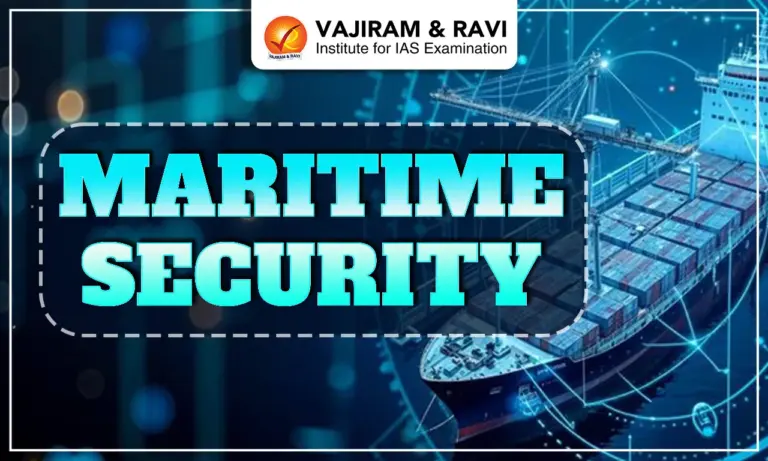
Maritime security is one of the most important dimension of national and international security in the contemporary world. With growing threats in the maritime domain and the increasing significance of sea-based trade, energy, and strategic interests, nations are prioritizing measures to ensure the safety and stability of their maritime boundaries. In this article, we are going to cover Maritime Security, its importance, mechanisms employed to secure the maritime domain, India’s initiatives, international cooperation, the role of coastal communities, challenges in addressing maritime threats, and the way forward.
Maritime Security
Maritime security is a multidimensional challenge that requires proactive, coordinated, and technologically advanced measures. For India, safeguarding its extensive coastline and ensuring the stability of the Indian Ocean region is critical for national security, economic growth, and international influence. National mechanisms, international cooperation, and active participation of coastal communities collectively strengthen maritime security. Addressing challenges like jurisdictional complexity, resource constraints, and technological advancements of adversaries is essential to create a secure and resilient maritime domain. Moving forward, continuous investment in technology, capacity building, and international collaboration will be key to sustaining maritime security in the rapidly evolving global landscape.
Maritime Security Significance
Maritime security includes the protection of national waters, economic interests, and maritime resources from threats such as terrorism, piracy, smuggling, and environmental hazards. The following factors underline its relevance:
- India’s Geo-Strategic Location: India possesses a long coastline of 7,516 km, spanning the Arabian Sea, Bay of Bengal, and Indian Ocean. Its strategic location in the Indo-Pacific region necessitates robust maritime security measures to protect national interests and regional stability.
- Security Imperative: Securing territorial waters and maritime borders is important to prevent unauthorized intrusions and safeguard sovereignty. The 2008 Mumbai attacks, where terrorists entered via the sea, underscored the vulnerabilities in coastal security.
- Changing Dynamics of International Politics: The maritime domain has grown central to global geopolitics, compelling nations to focus on maritime security. The formation of QUAD (India, USA, Japan, and Australia) is an example of cooperation to maintain a free, open, and inclusive Indo-Pacific.
- Geo-Economics of the Indian Ocean: Making sure that the security of sea lanes is important for uninterrupted trade, energy transport, and economic growth. Additionally, the potential for deep-sea exploration enhances the economic potential of the region. For instance, Operation Sankalp by the Indian Navy ensures the safety of Indian vessels in conflict zones.
- Prevention of Smuggling: Effective maritime security prevents illegal transportation of goods, narcotics, and weapons into national territory.
- Environmental Protection: Maritime security also plays a role in safeguarding marine ecosystems, protecting biodiversity, and mitigating pollution impacts. The 2017 Ennore oil spill exemplified the need for prompt maritime response to environmental crises.
- Humanitarian Assistance and Disaster Relief (HADR): Maritime capabilities are vital during humanitarian emergencies, such as evacuations during the Yemeni civil war under Operation Rahat.
- Stability and Diplomacy: Maritime security fosters regional cooperation. Exercises like Malabar, conducted with the USA, Japan, and Australia, aim to ensure a free, open, and stable Indo-Pacific.
- Safeguarding Offshore Energy Installations: Offshore oil and gas platforms, like Mumbai High, require robust maritime protection to ensure uninterrupted energy supplies.
- Preventing Illegal Fishing: Security measures regulate illegal, unreported, and unregulated fishing in coastal waters. In 2020, the Indian Navy intercepted a Sri Lankan fishing vessel violating Indian waters near the Lakshadweep Islands.
The increasing relevance of maritime security shows it multifaceted importance in national defense, economic growth, environmental protection, and regional stability.





Maritime Security Available Mechanism
India has a combination of naval, coast guard, and law enforcement mechanisms to provide maritime security.
- Indian Navy and Coast Guard Patrols: Regular patrols in territorial waters and the Exclusive Economic Zone (EEZ) deter unauthorized activities. In 2019, the Indian Coast Guard intercepted a Sri Lankan boat carrying narcotics off Tamil Nadu.
- Coastal Surveillance Network (CSN): This network integrates coastal radars and Automatic Identification System (AIS) stations to monitor maritime activities. CSN was instrumental in tracking terrorists during the 2008 Mumbai attacks.
- Maritime Exercises and Joint Operations: India conducts exercises with foreign navies to enhance interoperability and cooperation. The Varuna exercise with France exemplifies such collaboration.
- Legislative and Legal Frameworks: India has enacted laws to address piracy, terrorism, and environmental protection, such as the Suppression of Unlawful Acts against the Safety of Maritime Navigation and Fixed Platforms on Continental Shelf Act, 2002.
- International Cooperation: India actively collaborates through platforms like the Indian Ocean Naval Symposium (IONS) and Indian Ocean Rim Association (IORA) to strengthen regional security.
- Capacity Building and Technology Adoption: Investments in advanced surveillance systems, patrol vessels, and aircraft enhance maritime domain awareness. The acquisition of the P-8I Poseidon maritime patrol aircraft has significantly bolstered reconnaissance capabilities.
- Port Security Measures: Implementation of International Ship and Port Facility Security (ISPS) Code ensures the safety of ports such as Mumbai, Chennai, and Visakhapatnam.
Maritime Security and India’s Initiative
India has undertaken strategic initiatives to strengthen its maritime domain:
- SAGAR (Security and Growth for All in the Region): This strategic doctrine emphasizes security and sustainable development in the Indian Ocean region.
- Information Fusion Centre – Indian Ocean Region (IFC-IOR): Established in 2018, IFC-IOR acts as a hub for information sharing and maritime situational awareness.
- The Blue Economy Vision 2030: This initiative aims to harness maritime resources while conserving marine ecosystems.
- National Committee for Strengthening Maritime and Coastal Security (NCSMCS): Set up in 2013, this committee coordinates maritime security initiatives across agencies.
- National Command Control Communication and Intelligence (NC3I) Network: Integrates surveillance data to enhance maritime domain awareness and response capability.
Maritime Security for International Mechanisms
Global cooperation complements national efforts in ensuring maritime security. This includes:
- International Legislation: Treaties like the United Nations Convention on the Law of the Sea (UNCLOS) define maritime rights and responsibilities, reducing disputes.
- International Organizations: The International Maritime Organization (IMO) oversees safety, security, and environmental regulations in global shipping.
- Regional Maritime Security Initiatives: Agreements such as the Djibouti Code of Conduct (DCoC) and forums like IONS enhance cooperation in regional waters.
- Maritime Exercises and Drills: Exercises like the US-led Sea Dragon or Combined Maritime Forces operations improve interoperability and readiness against piracy, terrorism, and other threats.
- Information Sharing and Fusion Centers: MAOC-N in Europe, for instance, facilitates collaboration to combat drug trafficking.
- Capacity Building and Assistance Programs: The Africa Partnership Station (APS) program trains and equips African maritime forces, enhancing regional security capabilities.
Maritime Security and Role of Coastal Communities
Coastal communities are important to maritime security due to their proximity and interaction with maritime activities:
- Early Warning and Reporting: Communities often detect suspicious activities first. In 2019, Kerala fishermen reported a suspicious boat involved in drug trafficking.
- Supporting Maritime Law Enforcement: Local knowledge aids law enforcement in monitoring maritime threats. Initiatives like Sagar Rakshak Dal involve residents in coastal surveillance.
- Safeguarding Fisheries and Marine Resources: Coastal communities help prevent illegal fishing. In Gujarat, the Porbandar community actively reports unlawful fishing activities.
- Disaster Rescue Operations: Communities assist in evacuation and disaster relief. During Cyclone Fani in 2019, Odisha’s coastal communities played a key role.
- Promoting Maritime Awareness: Communities educate members about maritime security and safety, such as Mandvi in Gujarat.
- Cultural and Social Ties: Deep-rooted maritime traditions foster ownership and responsibility for maritime security.
Maritime Security Challenges
Despite extensive efforts, maritime security faces many challenges:
- Jurisdictional Complexity: Transnational threats complicate enforcement. For example, disputes in the Bay of Bengal between India and Bangladesh posed security challenges.
- Information Sharing and Intelligence Gaps: Limited cooperation can hinder timely response. The 2008 Mumbai attacks highlighted intelligence-sharing failures.
- Resource Constraints: Some strategic maritime regions, especially island nations, face shortages of trained personnel and naval assets.
- Corruption and Illicit Networks: Corruption can facilitate smuggling and piracy. West African maritime zones have been impacted by such issues.
- Lack of Coordination among Agencies: Disjointed responses reduce efficiency. Post-2019 Gulf of Oman oil tanker attacks exposed such coordination gaps.
- Technological Advancements of Adversaries: Threats evolve rapidly with technology. In 2020, drones were used for smuggling gold from India to Sri Lanka.
- Political Considerations: Territorial disputes can complicate cooperation, such as the complex dynamics involving India, Pakistan, and China in the Indian Ocean.
- Maritime Environment and Weather: Vast areas and adverse weather conditions challenge surveillance and rescue operations, particularly during the monsoon in the Bay of Bengal and Arabian Sea.
Way Forward
To strengthen maritime security, nations must adopt a comprehensive approach:
- Enhanced Maritime Domain Awareness: Invest in radar systems, satellite surveillance, and AIS tracking to monitor real-time maritime activity.
- Information Sharing and Intelligence Cooperation: Establish agreements among countries and agencies to close intelligence gaps and coordinate responses.
- Public-Private Partnerships: Collaborate with port authorities, shipping companies, and private stakeholders to identify and mitigate risks.
- Coastal Community Engagement: Leverage local knowledge through awareness campaigns, reporting mechanisms, and community-based surveillance.
- Research and Development: Innovate in counter-UAV technologies, underwater surveillance, and cybersecurity to address evolving threats.
Public Diplomacy and Maritime Awareness: Promote awareness on maritime security issues and encourage international collaboration for a stable maritime environment.

 Last updated on March, 2026
→ UPSC Final Result 2025 is now out.
→ UPSC has released UPSC Toppers List 2025 with the Civil Services final result on its official website.
→ Anuj Agnihotri secured AIR 1 in the UPSC Civil Services Examination 2025.
→ UPSC Marksheet 2025 is now out.
→ UPSC Notification 2026 & UPSC IFoS Notification 2026 is now out on the official website at upsconline.nic.in.
→ UPSC Calendar 2026 has been released.
→ Check out the latest UPSC Syllabus 2026 here.
→ UPSC Prelims 2026 will be conducted on 24th May, 2026 & UPSC Mains 2026 will be conducted on 21st August 2026.
→ The UPSC Selection Process is of 3 stages-Prelims, Mains and Interview.
→ Prepare effectively with Vajiram & Ravi’s UPSC Prelims Test Series 2026 featuring full-length mock tests, detailed solutions, and performance analysis.
→ Enroll in Vajiram & Ravi’s UPSC Mains Test Series 2026 for structured answer writing practice, expert evaluation, and exam-oriented feedback.
→ Join Vajiram & Ravi’s Best UPSC Mentorship Program for personalized guidance, strategy planning, and one-to-one support from experienced mentors.
→ Shakti Dubey secures AIR 1 in UPSC CSE Exam 2024.
→ Also check Best UPSC Coaching in India
Maritime Security FAQs
Q1. What is Maritime Security?+
Q2. What is UNCLOS?+
Q3. What is Blue Economy Vision 2030?+
Q4. What is EEZ?+
Q5. What is HADR?+
Tags: maritime security