After the end of World War II, Europe faced massive economic collapse, destroyed industries, food shortages, refugee crises and political instability. Normal trade had broken down, currencies were weak and governments lacked resources for reconstruction. The United States feared that prolonged poverty and chaos would weaken democratic institutions and allow communist influence to spread. To address these interconnected economic and strategic risks, the US proposed a comprehensive recovery program to stabilize Europe, restore production, revive trade and rebuild confidence in democratic governance.
Marshall Plan
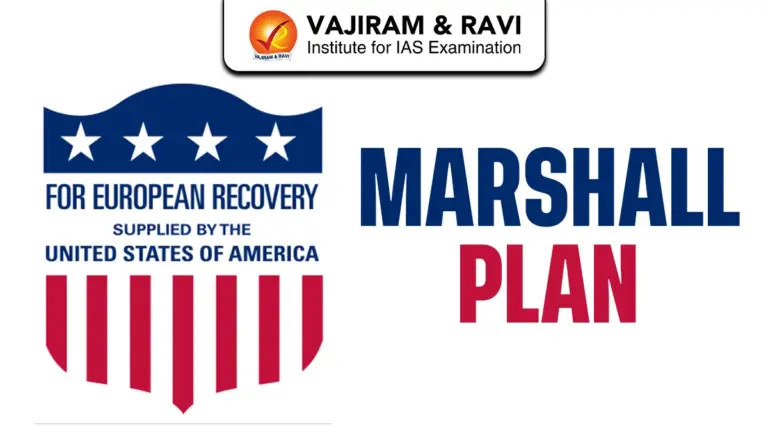
The Marshall Plan, officially called the European Recovery Program, was an American funded economic assistance initiative enacted on April 3rd 1948 to help Western European countries rebuild after World War II. It provided financial aid, goods, technology and technical expertise to restore industrial capacity, modernize economies, remove trade barriers and encourage cooperation among European nations. The plan was named after US Secretary of State George C. Marshall, who announced it in June 1947, during his Harvard University speech.
Marshall Plan Objectives
The Marshall Plan aimed to address urgent post war challenges through targeted economic recovery measures as highlighted here:
- Economic Reconstruction: The plan focused on rebuilding destroyed industries, transport networks and agriculture to restore normal economic activity across war affected European nations.
- Industrial Modernization: It promoted adoption of modern American production methods, machinery and management practices to raise productivity and efficiency in European industries.
- Trade Revival: The plan aimed to remove artificial trade barriers and revive intra-European and transatlantic trade essential for long term economic growth.
- Political Stability: By reducing poverty, unemployment and shortages, the plan sought to prevent political unrest and reduce the appeal of communism in Western Europe.
- European Integration: The program encouraged economic cooperation and coordination among European countries, laying foundations for future regional integration.





Marshall Plan Organizational Structure
The Marshall Plan operated through coordinated American and European institutions with defined leadership and administrative roles as given below:
- United States Government: The US Congress approved funding, while President Harry S. Truman signed the Economic Cooperation Act on April 3, 1948, giving the plan legal authority.
- Economic Cooperation Administration: The ECA was created to administer the program and was headed by Paul G. Hoffman, responsible for allocating aid and supervising implementation.
- Organisation for European Economic Co-operation: European recipient nations formed the OEEC to coordinate aid usage, economic planning and cooperation across participating states.
- Participating Countries: Sixteen Western European nations including the United Kingdom, France, West Germany, Italy and the Netherlands participated, while the Soviet Union and Eastern Bloc refused.
- Policy Architects: George C. Marshall, William L. Clayton, George F. Kennan and Senator Arthur Vandenberg played major roles in designing, advocating and passing the plan.
Marshall Plan Implementation
The Marshall Plan was executed through phased aid delivery, coordinated planning and strict oversight to ensure productive use of resources in the following manner:
- Start and Duration: Implementation began on April 3, 1948 and continued for four years, concluding in 1951 before transition to the Mutual Security framework.
- Goods Based Aid: The US supplied food, fuel, machinery and raw materials rather than direct cash, easing Europe’s dollar shortage problem.
- Counterpart Funds: European governments sold imported goods locally and deposited payments into special national funds for reconstruction investment.
- Technical Assistance: Thousands of European engineers, managers and officials studied American productivity methods through organized industrial visits.
- Conditional Cooperation: Aid required joint European planning, fiscal discipline and gradual removal of internal trade barriers.
Marshall Plan Funding
The program represented one of the largest peacetime foreign aid efforts in history, relative to the US economy. The key highlights of the Marshall Plan Funding are:
- Total Allocation: The United States transferred about 13.3 billion dollars between 1948 and 1951, equivalent to roughly 137 billion dollars in 2024 values.
- GDP Context: This spending occurred when US GDP was around 258 billion dollars in 1948, showing significant national commitment.
- Major Recipients: The United Kingdom received about 26% of funds, followed by France at 18% and West Germany at 11%.
- Grants and Loans: Around 85% of aid was grants, while roughly 15% was provided as long term loans.
- Sectoral Use: Funds supported food imports, industrial machinery, fuel, transport infrastructure and limited military rebuilding after 1950.
- Replacement Program: In 1951, the plan transitioned into the Mutual Security Act, continuing economic and military assistance under Cold War priorities.
- Economic Scale: Aid amounted to around 3% of combined national income of recipient countries, supplementing domestic recovery efforts.
Marshall Plan Outcomes
The Marshall Plan significantly shaped Europe’s post war recovery and long term development trajectory. The major outcomes of this plan are:
- Economic Recovery: By 1952, all participating countries exceeded pre-war output levels, with industrial production at least 35% higher than in 1938.
- Industrial Growth: Industrial production across Western Europe rose sharply, increasing by about 35% during the plan period.
- Agricultural Stability: Food shortages declined as agricultural output surpassed pre-war levels, ending widespread rationing and hunger.
- European Integration: The plan reduced trade barriers and institutionalized cooperation, becoming a foundation for later European economic integration.
- Strategic Stability: Economic recovery strengthened democratic governments and limited communist expansion during the early Cold War period.
Marshall Plan Limitations
Despite its success, the Marshall Plan had economic, political and structural limitations as discussed below:
- Limited GDP Impact: Aid accounted for a small share of national income, contributing less than half a% to GDP growth annually.
- Unequal Benefits: Larger industrial nations gained more, while smaller economies experienced slower and less visible recovery effects.
- Selective Participation: The Soviet Union rejected participation and blocked Eastern Bloc countries, deepening Europe’s Cold War division.
- Recovery Debate: Many economists argue Europe was already recovering, with the plan accelerating rather than initiating growth.
- Temporary Program: The plan ended in 1951, requiring later security based aid frameworks to sustain recovery momentum.
- Dependence Concerns: Some critics argued that reliance on American goods and models reduced economic autonomy of recipient nations.
- Unclear Attribution: Long term growth cannot be fully credited to the plan alone, as domestic reforms and global recovery also played major roles.

 Last updated on April, 2026
→ UPSC Final Result 2025 is now out.
→ UPSC has released UPSC Toppers List 2025 with the Civil Services final result on its official website.
→ Anuj Agnihotri secured AIR 1 in the UPSC Civil Services Examination 2025.
→ UPSC Marksheet 2025 is now out.
→ UPSC Notification 2026 & UPSC IFoS Notification 2026 is now out on the official website at upsconline.nic.in.
→ UPSC Calendar 2026 has been released.
→ Check out the latest UPSC Syllabus 2026 here.
→ UPSC Prelims 2026 will be conducted on 24th May, 2026 & UPSC Mains 2026 will be conducted on 21st August 2026.
→ The UPSC Selection Process is of 3 stages-Prelims, Mains and Interview.
→ Prepare effectively with Vajiram & Ravi’s UPSC Prelims Test Series 2026 featuring full-length mock tests, detailed solutions, and performance analysis.
→ Enroll in Vajiram & Ravi’s UPSC Mains Test Series 2026 for structured answer writing practice, expert evaluation, and exam-oriented feedback.
→ Join Vajiram & Ravi’s Best UPSC Mentorship Program for personalized guidance, strategy planning, and one-to-one support from experienced mentors.
→ Shakti Dubey secures AIR 1 in UPSC CSE Exam 2024.
→ Also check Best UPSC Coaching in India
Marshall Plan FAQs
Q1. What was the Marshall Plan?+
Q2. Who proposed the Marshall Plan?+
Q3. How much money was provided under the Marshall Plan?+
Q4. Which country received the highest Marshall Plan aid?+
Q5. Why did the Soviet Union reject the Marshall Plan?+
Tags: marshall plan