Marsupials Latest News
Recently, a team of scientists has successfully produced the first kangaroo embryos using in vitro fertilisation (IVF) which could be a crucial step towards the conservation of endangered marsupial species.
About Marsupials
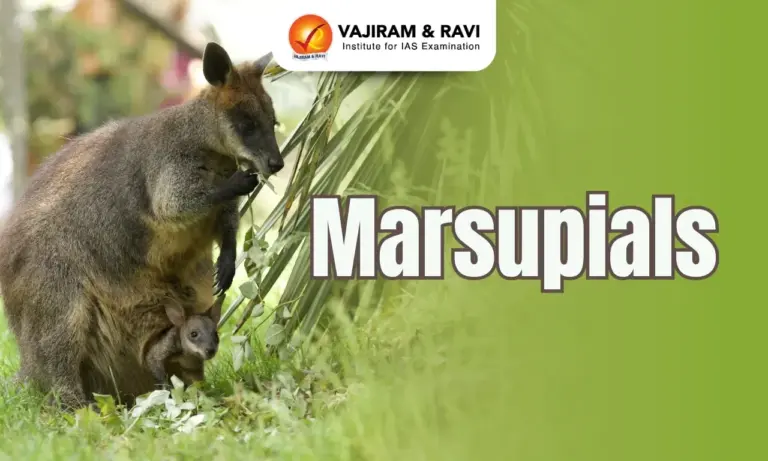
- Marsupials are the group of mammals commonly thought of as pouched mammals.
- They give birth to relatively undeveloped young that often reside in a pouch located on their mothers’ abdomen for a certain amount of time.
- A distinctive characteristic common to most of these species is that the young are carried in a pouch.
- Examples: Marsupials include opossums, Tasmanian devils, kangaroos, koalas, wombats, wallabies, bandicoots, and the extinct thylacine.
- They represent the clade originating from the last common ancestor of extant metatherians, the group containing all mammals more closely related to marsupials than to placentals. Not all marsupials have pouches.
- Marsupials have an extra pubic bone, the epipubic bone, to support their pouch.
- Distribution of Marsupials: There are over 330 species of marsupials. Around two-thirds of them live in Australia. The other third live mostly in South America.
What is In Vitro Fertilization?
- It is a medical procedure used to assist individuals or couples who are facing fertility challenges in achieving pregnancy.
- It is the most common and effective type of assisted reproductive technology (ART).
- Process of In Vitro Fertilization:
- It is a complex process that involves retrieving eggs from ovaries and manually combining them with sperm in a lab for fertilization.
- Several days after fertilization, the fertilized egg (now called an embryo) is placed inside a uterus.
- Pregnancy occurs when this embryo implants itself into the uterine wall.
- The procedure can be done using a couple’s own eggs and sperm. Or IVF may involve eggs, sperm or embryos from a known or anonymous donor.




Marsupials FAQs
Q1: Which continent is famous for its marsupials?
Ans: Presently, close to 70% of the 334 extant species of marsupials are concentrated on the Australian continent,
Q2: What are 4 examples of marsupials?
Ans: kangaroos, koalas, opossums, possums, Tasmanian devils, wombats, wallabies, and bandicoots,
Q3: Are marsupials found in India?
Ans: The Marsupials are native to Australia. They are not naturally found in India.
Source: DTH

 Last updated on March, 2026
→ UPSC Final Result 2025 is now out.
→ UPSC has released UPSC Toppers List 2025 with the Civil Services final result on its official website.
→ Anuj Agnihotri secured AIR 1 in the UPSC Civil Services Examination 2025.
→ UPSC Marksheet 2025 is now out.
→ UPSC Notification 2026 & UPSC IFoS Notification 2026 is now out on the official website at upsconline.nic.in.
→ UPSC Calendar 2026 has been released.
→ Check out the latest UPSC Syllabus 2026 here.
→ UPSC Prelims 2026 will be conducted on 24th May, 2026 & UPSC Mains 2026 will be conducted on 21st August 2026.
→ The UPSC Selection Process is of 3 stages-Prelims, Mains and Interview.
→ Prepare effectively with Vajiram & Ravi’s UPSC Prelims Test Series 2026 featuring full-length mock tests, detailed solutions, and performance analysis.
→ Enroll in Vajiram & Ravi’s UPSC Mains Test Series 2026 for structured answer writing practice, expert evaluation, and exam-oriented feedback.
→ Join Vajiram & Ravi’s Best UPSC Mentorship Program for personalized guidance, strategy planning, and one-to-one support from experienced mentors.
→ Shakti Dubey secures AIR 1 in UPSC CSE Exam 2024.
→ Also check Best UPSC Coaching in India