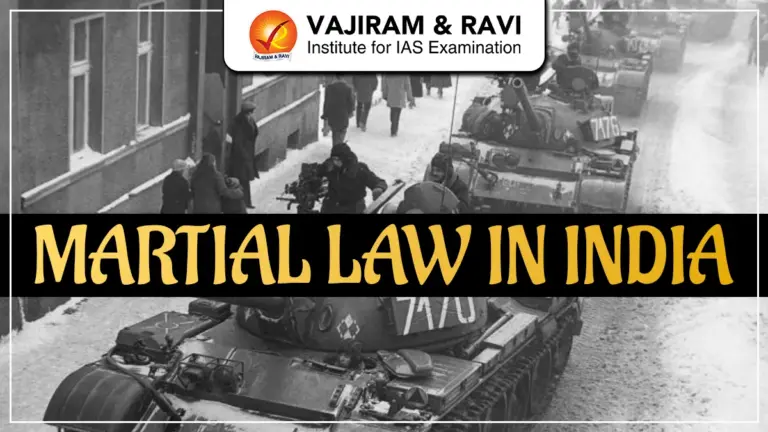
Martial Law in India refers to a situation where the civil administration is replaced by military authority due to an extreme breakdown of law and order. It is generally imposed during war, armed rebellion, or severe internal disturbances when ordinary laws are insufficient to maintain public order. Under Martial Law, the military takes control of governance, and civilians may be tried in military courts.
Martial Law in India
India has never officially declared Martial Law at the national level after independence. However, limited forms of military control resembling Martial Law have been observed in disturbed areas, especially during insurgencies or extreme security situations. In such cases, the armed forces assist civil authorities but do not completely replace the civilian government.
The Indian democratic framework strongly emphasizes civil supremacy over the military. Therefore, Martial Law is viewed as a last resort, and its use is restrained by constitutional values, judicial review, and fundamental rights protection.
Martial Law Provisions in Indian Constitution
The Indian Constitution does not explicitly define or mention the term Martial Law. However, it indirectly recognizes the concept by allowing the military to assist civil authorities during extreme breakdowns of law and order.
- Article 34 empowers Parliament to indemnify persons for acts done in connection with the maintenance or restoration of order when martial law is in force.
- Fundamental Rights may be restricted or suspended in practice during martial law due to military control.
- The authority and scope of martial law depend on Parliamentary laws and military necessity, not constitutional proclamation.





Differences between Martial Law and National Emergency
The differences between Martial Law and National Emergency are explained in the table below:
| Differences between Martial Law and National Emergency | ||
| Basis of Difference | Martial Law | National Emergency |
|
Constitutional Status |
Not explicitly mentioned in the Constitution |
Clearly defined under Article 352 |
|
Authority Exercised |
Military authority replaces civil administration |
Civil government continues with expanded powers |
|
Scope |
Limited to specific disturbed areas |
Can be imposed on the entire country or part of it |
|
Fundamental Rights |
May be suspended or severely restricted |
Article 19 automatically suspended; others as per law |
|
Role of Judiciary |
Courts may be restricted or replaced by military courts |
Judiciary continues to function |
|
Parliamentary Approval |
Not mandatory |
Mandatory within one month |
|
Nature |
Extra-constitutional and exceptional |
Constitutional and regulated |
|
Objective |
Restore law and order through military control |
Protect sovereignty, unity, and security of India |

 Last updated on March, 2026
→ UPSC Final Result 2025 is now out.
→ UPSC has released UPSC Toppers List 2025 with the Civil Services final result on its official website.
→ Anuj Agnihotri secured AIR 1 in the UPSC Civil Services Examination 2025.
→ UPSC Marksheet 2025 is now out.
→ UPSC Notification 2026 & UPSC IFoS Notification 2026 is now out on the official website at upsconline.nic.in.
→ UPSC Calendar 2026 has been released.
→ Check out the latest UPSC Syllabus 2026 here.
→ UPSC Prelims 2026 will be conducted on 24th May, 2026 & UPSC Mains 2026 will be conducted on 21st August 2026.
→ The UPSC Selection Process is of 3 stages-Prelims, Mains and Interview.
→ Prepare effectively with Vajiram & Ravi’s UPSC Prelims Test Series 2026 featuring full-length mock tests, detailed solutions, and performance analysis.
→ Enroll in Vajiram & Ravi’s UPSC Mains Test Series 2026 for structured answer writing practice, expert evaluation, and exam-oriented feedback.
→ Join Vajiram & Ravi’s Best UPSC Mentorship Program for personalized guidance, strategy planning, and one-to-one support from experienced mentors.
→ Shakti Dubey secures AIR 1 in UPSC CSE Exam 2024.
→ Also check Best UPSC Coaching in India
Martial Law in India FAQs
Q1. Is Martial Law mentioned in the Indian Constitution?+
Q2. Has Martial Law ever been imposed in India?+
Q3. Who has the power to impose Martial Law in India?+
Q4. How is Martial Law different from Emergency?+
Q5. Can Fundamental Rights be suspended during Martial Law?+
Tags: martial law in india