‘Master of Roster’ Latest News
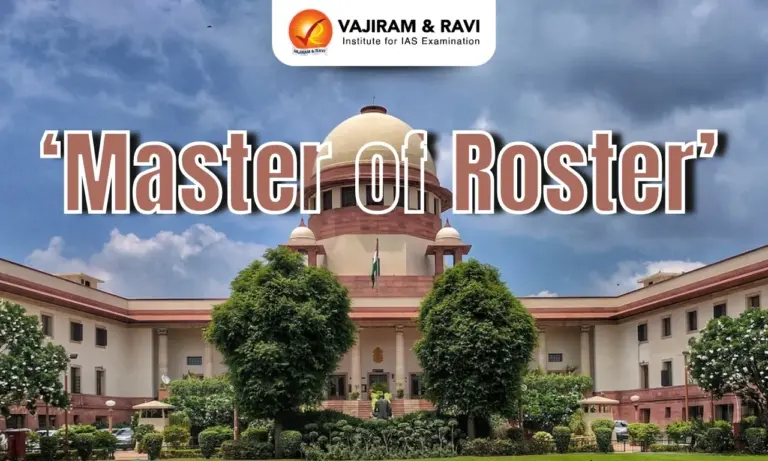
- The Supreme Court’s (SC) recent censure of an Allahabad High Court (HC) judge for an “absurd” order has reignited debate over whether the apex court can intervene in the internal functioning of High Courts, particularly in the domain of a State HC Chief Justice’s exclusive ‘Master of Roster’ powers.
- This raises important constitutional questions on judicial independence, institutional integrity, and the scope of the Supreme Court’s authority under Articles 141 and 142.
Background
- Incident: Recently, an SC Bench of Justices J.B. Pardiwala and R. Mahadevan directed that Justice Prashant Kumar (Allahabad HC) be paired with a senior judge and not be given a criminal roster till retirement, following an “erroneous” order.
- Objection: HC lawyers and Chief Justice Arun Bhansali raised concerns over interference with the Chief Justice’s administrative powers.
- Modification: Following a letter from the Chief Justice of India (CJI) B.R. Gavai, the SC modified its order later, clarifying it did not intend to challenge ‘Master of Roster’ powers.





Key Constitutional and Judicial Principles
- Master of the Roster principle:
- Definition: Exclusive authority of a Chief Justice (SC or HC) to constitute benches and allocate cases.
- Landmark judgments:
- State of Rajasthan vs. Prakash Chand (1998): Only CJ can decide which judge hears which case.
- State of Rajasthan vs. Devi Dayal (1959): HC CJ decides single/division bench composition.
- Mayavaram Financial Corporation (Madras HC, 1991): CJ has inherent powers for judicial business allocation.
- SC’s hierarchical role:
- Article 141: SC’s declared law is binding on all courts in India.
- Article 142: SC can pass any decree/order to ensure “complete justice” beyond ordinary procedure.
- Tirupati Balaji Developers Case (2004): SC is “elder brother” in judicial administration but has no power of superintendence over HCs.
- Judicial independence vs. institutional oversight:
- HCs are independent constitutional bodies, but the integrated judiciary structure allows SC to intervene in rare cases threatening the rule of law.
- Intervention in HC internal matters is exceptional and often debated as potential overreach.
Issues Raised
- Scope of SC’s powers: Can SC give administrative directions to a HC CJ on roster allocation?
- Judicial discipline: Maintaining quality of judgments without undermining HC autonomy.
- Article 142 usage: Justification for preventive action to avoid repeated judicial errors.
- Separation of powers within judiciary: Balancing hierarchy with independence.
In-House Mechanism vs. Public Reprimand
- Formal process: Impeachment (Parliament) for serious misbehaviour/incapacity; in-house inquiry for lesser issues.
- SC’s move: Public directive in open court rather than confidential administrative procedure.
- Nature: Not punitive removal; corrective mentoring by pairing with a senior judge and removing from the criminal roster.
Way Forward
- Clear guidelines for when SC may step into HC administrative functions.
- Strengthening in-house mechanisms to address judicial conduct without public controversy.
- Mentorship and training for judges to avoid repeated errors in sensitive matters.
Conclusion
- While the ‘Master of Roster’ principle protects judicial independence, it is not an absolute barrier to SC intervention when judicial errors threaten the rule of law.
- The SC’s Article 142 powers allow exceptional corrective steps, but such actions must be balanced to avoid undermining the autonomy of High Courts.
Source: TH

 Last updated on March, 2026
→ UPSC Final Result 2025 is now out.
→ UPSC has released UPSC Toppers List 2025 with the Civil Services final result on its official website.
→ Anuj Agnihotri secured AIR 1 in the UPSC Civil Services Examination 2025.
→ UPSC Marksheet 2025 is now out.
→ UPSC Notification 2026 & UPSC IFoS Notification 2026 is now out on the official website at upsconline.nic.in.
→ UPSC Calendar 2026 has been released.
→ Check out the latest UPSC Syllabus 2026 here.
→ UPSC Prelims 2026 will be conducted on 24th May, 2026 & UPSC Mains 2026 will be conducted on 21st August 2026.
→ The UPSC Selection Process is of 3 stages-Prelims, Mains and Interview.
→ Prepare effectively with Vajiram & Ravi’s UPSC Prelims Test Series 2026 featuring full-length mock tests, detailed solutions, and performance analysis.
→ Enroll in Vajiram & Ravi’s UPSC Mains Test Series 2026 for structured answer writing practice, expert evaluation, and exam-oriented feedback.
→ Join Vajiram & Ravi’s Best UPSC Mentorship Program for personalized guidance, strategy planning, and one-to-one support from experienced mentors.
→ Shakti Dubey secures AIR 1 in UPSC CSE Exam 2024.
→ Also check Best UPSC Coaching in India
‘Master of Roster’ FAQs
Q1. What do Articles 141 and 142 empower the Supreme Court to do?+
Q2. What is the ‘Master of the Roster’ principle?+
Q3. Does the Supreme Court have superintendence over High Courts?+
Q4. How does the in-house mechanism differ from a public reprimand?+
Q5. How is balance maintained between judicial independence and oversight?+
Tags: mains articles master of roster upsc current affairs upsc mains current affairs